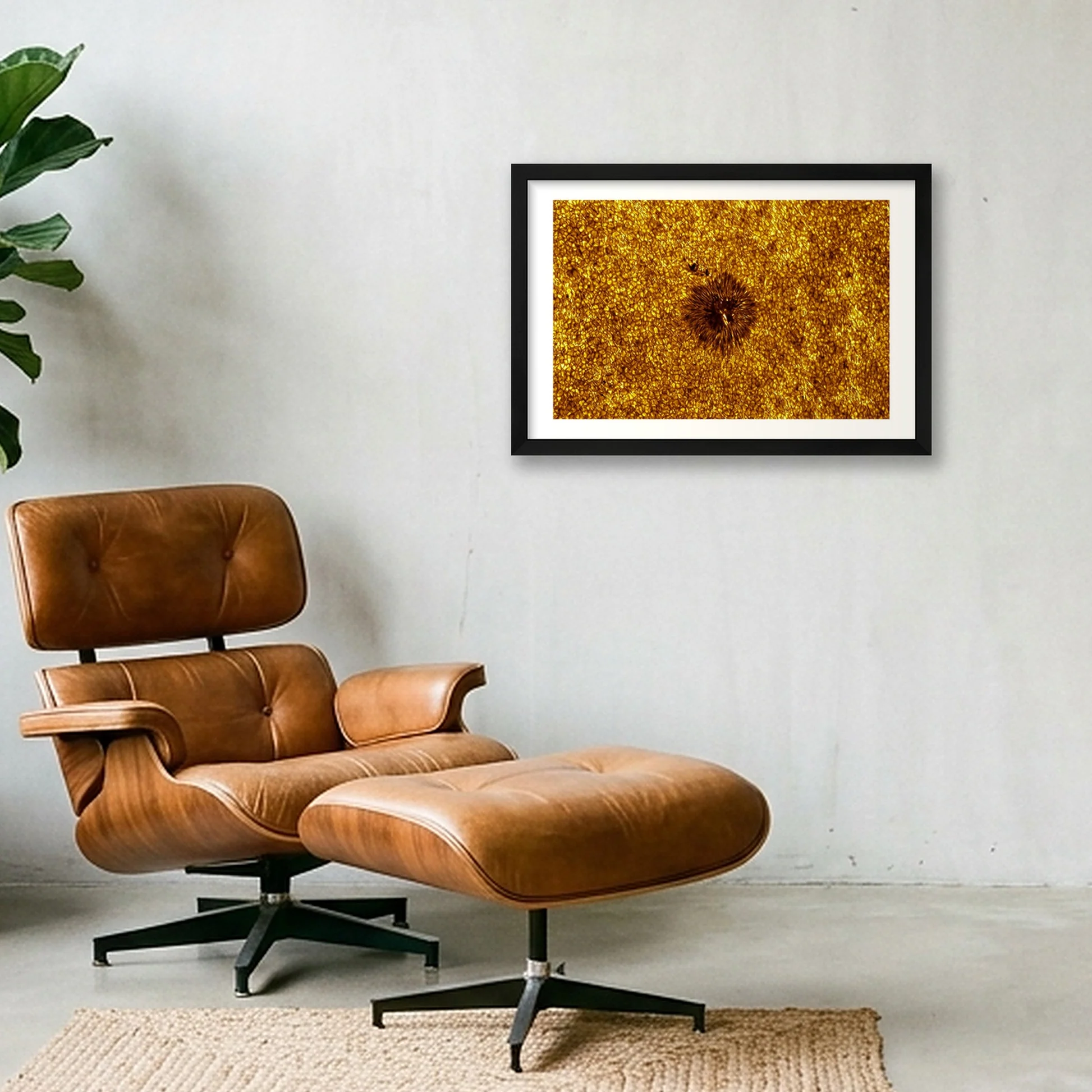
Convective Cells and Intergranular Filigree Surrounding Active Region 4122
Alqueva´s Dark Sky Reserve | By Year: 2025 | Solar Ha

Glad to share with you what I believe being my most detailed image so far captured with Soleye 300 dual-band on the photosphere, revealing the diversity of sizes and shapes of convective cells and intergranular filigree, visible in G-band with 2nm filter pair with APM and a telecentric barlow. Distinguished as ZWO Astronomy Photographer of the Year 2026, in “Our Sun” category, the image shows the small sunspot AR4122 captured from Dark Sky® Alqueva territory in Portugal on 2nd July 2025 at around UT 1025 in the morning during a moment of great seeing stability. The Baader SunDancer II Telecentric System TZ-4S combined with Soleye APM can deliver a much more contrasted results. I was impressed with the great quality of TZ-4s comparing to my older telecentrinc barlow from another trusty brand, which revelead to be very sharp and much more contrasted, as well as free of light reflections in the optical path. So What are then these Granules? The 4 cropped images at 100% zoom visible below, can easily help to understand the explanation by Dr. Jan Jurcák, from the Astronomical Institute of the Academy of Sciences of the Czech Republic:
“The solar surface is constantly heated from deeper layers. The heating is provided in the form of bubbles of hot material that rise convectively through the sub-surface layers. These convective cells are called granules and appear as bright dots on the solar surface. Their typical size is around 1000 km. Granules are sensitive to the presence of magnetic field. Their shapes, sizes and lifetimes are highly dependent on the magnetic field properties. With increasing field strength, the granules become smaller. In the extreme cases of sunspots, the magnetic field is strong enough to suppress convective motions, the solar surface cools down considerably and appears dark compared to its surroundings. The magnetic field is strongest in the darkest regions, but its presence can be recognised also in other areas, where the granules are smaller, brighter, or very elongated, and in the myriad of tiny bright points sitting in between the granules.“ These images were captured from Dark Sky® Alqueva, Portugal.
PT: Tenho o gosto de partilhar convosco aquela que acredito ser a minha imagem mais detalhada da fotoesfera captada até ao momento, com o Soleye 300 dual-band, revelando a diversidade de tamanhos e formas das células convectivas e filigrana intergranular, visível na G-band com um filtro de 2 nm combinado com o APM da Soleye e um barlow telecêntrico. Distuinguida omo ZWO Astronomy Photographer of the Year 2026, in “Our Sun” category, a imagem revela ao centro a pequena mancha solar AR4122, captada no território Dark Sky® Alqueva, em Portugal, no dia 2 de julho de 2025 por volta das 10h25 UT, durante um momento de grande estabilidade visual. O sistema telecêntrico Baader SunDancer II TZ-4S, combinado com o Soleye APM, proporciona resultados com muito mais contraste. Fiquei impressionado com a qualidade do TZ-4S ao comparar com a minha antiga lente telecêntrica Barlow de outra marcam reconhecida, que se revelou muito mais nítido e com um contraste muito superior, bem como isento de reflexos de luz no percurso óptico. Mas de que se tratam então estes grânulos tão difíceis de captar a partir da Terra? As 4 imagens recortadas com zoom a 100%, visíveis abaixo, podem facilmente ajudar a compreender a explicação do Dr. Jan Jurcák, do Instituto Astronómico da Academia de Ciências da República Checa:
“A superfície solar é constantemente aquecida por camadas mais profundas. O aquecimento é fornecido sob a forma de bolhas de material quente que sobem convectivamente através das camadas subterrâneas. Estas células convectivas são designadas por grânulos e aparecem como pontos brilhantes na superfície solar. O seu tamanho típico é de cerca de 1000 km. Os grânulos são sensíveis à presença de campo magnético. As suas formas, tamanhos e tempos de vida são altamente dependentes das propriedades do campo magnético. Com o aumento da intensidade do campo, os grânulos tornam-se mais pequenos. Nos casos extremos de manchas solares, o campo magnético é suficientemente forte para suprimir os movimentos convectivos, a superfície solar arrefece consideravelmente e parece escura em comparação com o ambiente circundante. O campo magnético é mais forte nas regiões mais escuras, mas a sua presença pode ser reconhecida também noutras áreas, onde os grânulos são mais pequenos, mais brilhantes ou muito alongados, e na miríade de pequenos pontos brilhantes situados entre os grânulos. Estas imagens foram captadas por mim a partir do Dark Sky® Alqueva, Portugal.


Above 2 different crops from the original 100% image, are showing the convective cells in detail, revealing different shapes, sizes and elongation, each one with an average size of 1000km. Below, a monochromatic version can help to perceive the details for not being so distractive PT: Acima, 2 cortes diferentes da imagem original a 100% mostram as células de convecção em detalhe, revelando diferentes formas, tamanhos e alongamentos, cada uma com um tamanho médio de cerca de 1000 km. Abaixo, uma versão monocromática permite ajudar a perceber melhor os detalhes sem ser tão distrativa.

Technical details | Detalhes Técnicos
Soleye 300 Dual-band | EQ-6 Pro mount | APM | Baader SunDancer II Telecentric System TZ-4S | Player One Apollo 428M Max Pro | Filter Altair G-Band 2nm | Stack of 200 frames for each single image, captured in good seeing conditions from Dark Sky® Alqueva territory, Portugal.
Important Note | Nota Importante: Never look and point a telescope or any other optical equipment directly to the sun without a proper and specialized safty filters! It can blind you forever. PT: Nota Importante – Nunca aponte um telescópio ou qualquer equipamento óptico directamente para o sol e observe através dele sem filtros especializados e seguros. Causará cegueira irreversível!
Fine Art Prints – Available to ORDER
I hope you enjoy it as much as I do, and if you still want to support my work as an independent artist, you can buy this image as a Fine Art Print, a piece of Art to bring some magic to your sweet home! I will be deeply grateful for your kind support. I have created a special limited Edition of this Print supplied with a signed & numbered Certificate of Authenticity, global delivery with tracked & insured shipping, in a carbon neutral sustainable production, packaging and shipping. Explore the size options and prices by clicking on my Print gallery. Meanwhile, you can sign-up my newsletter to get early access of future Print releases.