
Visible Corona during the Partial Phase of the Total Lunar Eclipse
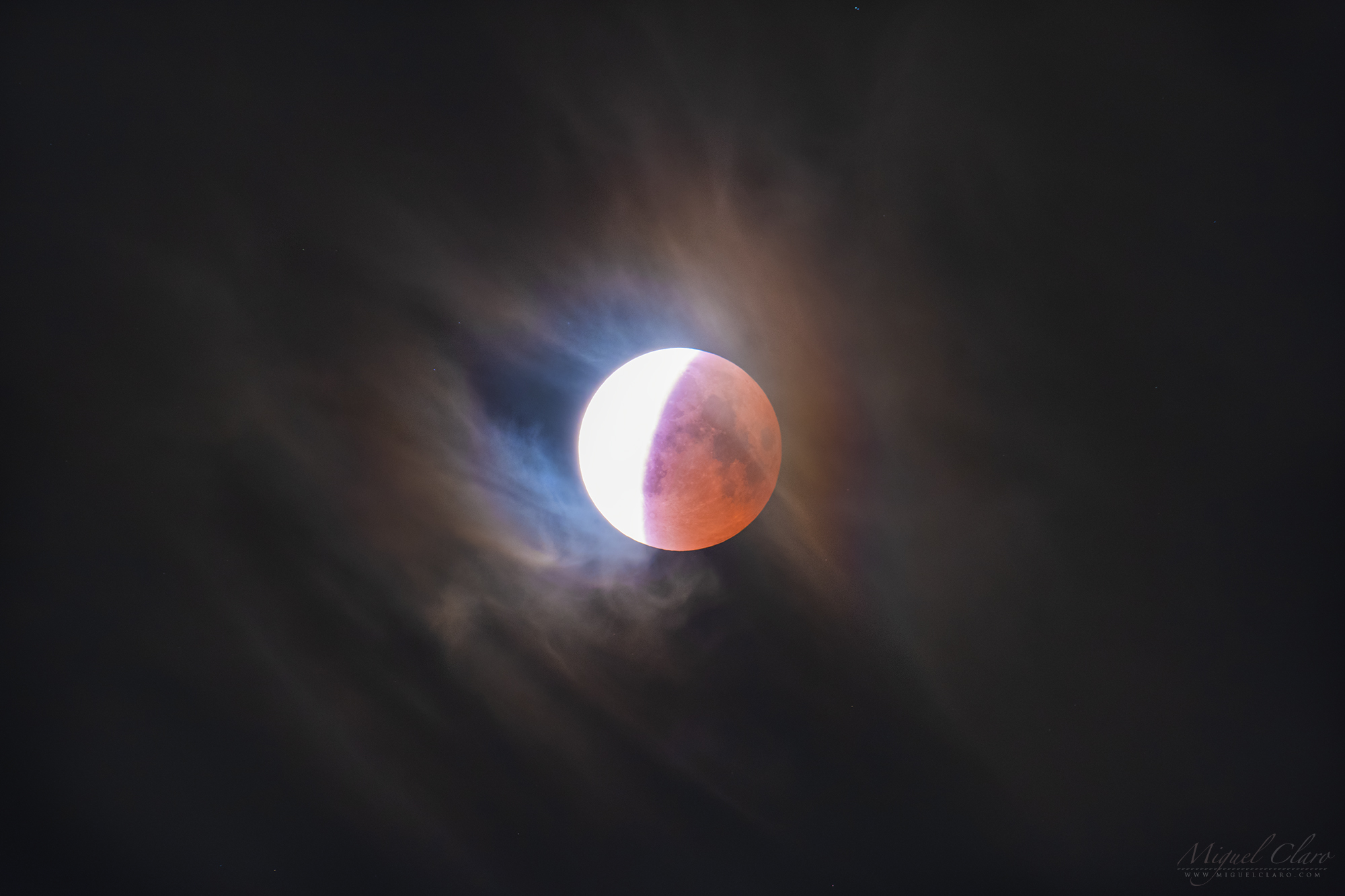
Sequence of the partial ending phase of the longest Total Lunar Eclipse of the Century, where during a few seconds some iridescent clouds and a short Lunar Corona around the eclipsed disk of the moon showed up, due to a short presence of passing clouds. While the partial phase is moving forward, we can also see the intense light of the sun catching and hiding the well known Tycho Crater.
PT: Sequência da fase final parcial do mais longo Eclipse Lunar Total do Século, onde durante alguns segundos apareceram algumas nuvens iridescentes formando uma Corona Lunar ao redor do disco eclipsado da lua. Estas formações ocorrem devido à presença de uma camada fina de nuvens que contém normalmente micro cristais de gelo que refractam a luz de Lua. Enquanto a fase parcial avança na sequência Time Lapse, também podemos ver a intensa luz solar que vai ocultando por sobre exposição a conhecida cratera Tycho.
Cumeada Observatory and the Winter Sky

After astronomical twilight ends, a retractable roof observatory shows an open window to the Universe, with the Winter Sky shinning bright against a variety of different telescopes, advanced optical equipment for visual and astrophotography purposes, available in Cumeada Observatory, the headquarter of Dark Sky® Alqueva Reserve – the First Starlight Tourism Destination in the World – located in Reguengos de Monsaraz, Portugal. The recovered building is an old primary school rehabilitated by the Municipality of Reguengos, to receive the official Observatory of Dark Sky® Alqueva
PT: Após o final do crepúsculo astronómico, um observatório de tecto retráctil mostra uma janela aberta para o Universo, com o Céu de Inverno brilhando contra uma variedade de telescópios diferentes, equipamentos ópticos avançados para fins visuais e astrofotográficos, disponíveis no Observatório da Cumeada, sede oficial da Reserva Dark Sky® Alqueva – o Primeiro Destino Turístico do Mundo Starlight – localizado em Reguengos de Monsaraz, Portugal. O edifício recuperado é uma antiga escola primária reabilitada pelo município de Reguengos, para receber o Observatório oficial de Dark Sky® Alqueva.
Oficial Observatory of Dark Sky Alqueva Working in a Winter Night from Miguel Claro on Vimeo.
The Path of Light from a Super Blue Moon

The path of light from a Super Blue Moon is rising behind a windmill from Sesimbra, in Portugal. The second Full Moon of the month is well known as the “Blue Moon”. Supermoons happen when a full moon approximately coincides with the moon’s perigee, or a point in its orbit at which it is closest to Earth. This makes the moon appear up to 8 percent larger and 16 percent brighter than usual. The Super Moon from January 2018 was very unusual because it also happened a Total Lunar Eclipse, although, it was not visible from Portugal. Below is a Time Lapse sequence captured during Moonrise.
PT: O rasto de luz de uma Super “Blue Moon” ergue-se por detrás de um moinho de vento de Sesimbra, em Portugal. A segunda Lua cheia do mês é conhecida como a “Lua Azul” ou “Blue Moon”. As popularmente designadas Super Luas acontecem, quando uma lua cheia coincide aproximadamente com o perigeu da lua, o ponto em sua órbita que está mais próximo da Terra. Isso faz com que a lua apareça até 8% maior e 16% mais brilhante do que o normal. A Super Lua de janeiro de 2018 foi muito incomum porque também permitiu a ocorrência de um Eclipse Lunar Total, embora não fosse visível de Portugal. Abaixo está uma sequência Time Lapse captada durante o nascer da lua.
Solar Radiography – Sun´s Corona Shinning bright during a Total Solar Eclipse

One of the most beautiful things about viewing the solar corona during a total solar eclipse is the light from the corona itself with the fine structures and lines coming from magnetic fields. On August 21, 2017, I and millions of people across the United States had the opportunity to witness the unique and unforgettable moment when the Moon itself completely blocks the sun´s disc. The image above was captured in Stanley Lake, Idaho, a beautiful scenario with an amazing atmosphere of happiness vs stress, for being controlling all the equipment.
A corona (Latin, ‘crown’) is an aura of plasma that surrounds the sun and other stars. The Sun’s corona extends millions of kilometres into space and is most easily seen during a total solar eclipse, but it is also observable with a coronagraph. The word “corona” is a Latin word meaning “crown”, from the Ancient Greek κορώνη (korōnè, “garland, wreath”).
The maximum temperature inside of our star is about 16 million degrees (Celsius). The photosphere – the visible surface of the Sun – has a temperature of about 6000 degrees C. However, the temperature increases very steeply from 6000 degrees to a few million degrees in the corona, in the region 500 kilometers above the photosphere.
Bright Meteor and Planet Jupiter above Alqueva

In this winter scene of a cloudy night, a bright and fast meteor have crossed the sky near Arcturus while at the right side planet Jupiter were shinning near the blue star Spica. Below, in the small lagoon from the rural hotel Naveterra, in Alandroal, northern part of Dark Sky® Alqueva Reserve, two horses were spotted near the water that is reflecting the greenish color of the sky.
The Precession of Earth – New Photo Technique showing a Vega Polar Startrail.

Featured as NASA´s Astronomy Picture of the Day (APOD).
Since the very first moment I read and learned about the Precession of Earth that I was fascinated with the possibility of having a different star than Polaris, pointing to north, although in that time, few years ago, I didn’t had the right technology and even the chance to could show in a real image how it would be…how would be the sky of my land if I had another star in the place of the well known, Polaris ?
After a long time of burning my mind with some new ideias, I figured out how I could do it, developing what I think is, a totally new astrophotographic technique never applied before, and where I can show in real time the sky rotating around another star, simulating the shifting of Earth Axis even being inside our Earth.
In astronomy, axial precession is a gravity-induced, slow, and continuous change in the orientation of an astronomical body’s rotational axis. In particular, it refers to the gradual shift in the orientation of Earth’s axis of rotation, which, similar to a wobbling top, traces out a pair of cones joined at their apices in a cycle of approximately 26,000 years.
A consequence of the precession is a changing pole star. Currently, Polaris is extremely well suited to mark the position, as Polaris is a moderately bright star located about 0,7º degrees from the pole. But with the crescent light pollution is Increasingly difficult to distinguish the few bright stars in the middle of cities, so near the year 14 000, the brilliant Vega in the constellation Lyra, is touted as the best north star. Although, it never comes closer than 5° to the celestial pole.
When Polaris becomes the north star again around 27,800, due to its proper motion it then will be farther away from the pole than it is now, while in 23,600 BC it came closer to the pole.
What I did to create the both startrails and time lapse images, was to use 2 mountings Vixen Polarie, one to pointing to the actual Polaris Axis and making all the stars staying fixed, but using another Polarie attached to the first one, I could simulate again the Earth Axis Rotation using the sideral motion inverted (I mean, like if I was in the south pole, near the batteries you can switch the button to (N) north or (S) south motion).
But I had special carefully with some things. I have waited until Vega star reach the same altitude I had in my observing latitude, in my case 38º, to have the same distance to the horizon that I have when looking to Polaris.
Very Important: The second condition to give the right movement, was to align carefully the star Vega near the center of the image (my new Earth Axis – now a Vixen Polarie Axis), to create the axis rotation simulating the 5º separation of the celestial north in +14000 (year). I also used the Live View magnifier with the grid option to have a more precise result.
*Important Note: Precession changes the direction of the Earth axis from Polaris to Vega on the celestial sphere, but the positions where the axis crosses the surface of Earth will not change by precession. So the north on the Earth from the observation point will not change, and the latitude of the observation point will not change too. Although, I choose the option that includes “apparently” almost the same landscape field view and where fits both Polaris (at left) and Vega (center), because if I had putting the Polaris in the same central framing position, as I did with Vega ( remembering that is the only possible way – as a condition – to simulating the Earth Axis rotation using the Vixen Polarie sideral motion, and show nowadays, the motion of the stars around Vega in a real Time Lapse movie sequence), I would loose the same landscape field of view with the Castle Tower, and this was also important to give people the notion that the image was really made in the same place. Vega is about 51º away from Polaris, so it means a big change in the field of view towards another position in the sky and consequently, in the landscape, in this case towards left, to Azimuth 0º – North, where stand the Polaris star.
As this technique induces movement, the landscape will move a bit from the first frame to the last one, but in the final startrail “still image”, I made a mask merging the landscape with the first frame again to have a more pleasant result.
All the images were taken from inside the Mourão Castle, in the Dark Sky Alqueva Reserve, the First Starlight Tourism Destination in the world, in Alentejo, Portugal.

Technical info:
Polaris Startrail starts in 19/04/2015 at 23h48 and Vega startrail starts in 20/04/2015 at 1:07
Canon EOS 6D – Canon EF 8-15 f/ 4L Fishseye USM at 8mm (All Sky). Exp. 30 sec. ISO 2500
Dark Sky Alqueva Time Lapse – The First Starlight Tourism Destination in the World
This time lapse sequence shows the beauty of the night sky as a world heritage of the human kind, making the perfect connection with Earth elements from the vantage point of Alqueva region, in Alentejo Portugal. A place that was created to preserve the darkness of the sky that only our ancestors had access few hundred years ago. The “Dark Sky® Alqueva” (darkskyalqueva.com) reserve, was created also thinking in the two thirds of the worlds population that never had the opportunity to observe with their naked eyes, the stunning views of our own Galaxy…the impressive presence of the Milky Way against a starry sky of about 4500 stars, suspended in each half of our celestial sphere!
Alqueva is the first site in the world to receive the “Starlight Tourism Destination” certification. This certification, awarded by the Starlight Foundation is supported by UNESCO, UNWTO and IAC. Starlight destinations are visitable places characterized by excellent quality for the contemplation of starry skies, and the practice of tourist activities based on this resource.
The region of the Great Lake Alqueva in Alentejo, Portugal is a wonderful place to see the stars, constellations and distant galaxies such as the Milky Way. The unique characteristics of the night sky with a very low rate of light pollution, in the municipalities of Alandroal, Reguengos, Monsaraz, Mourão, Barrancos, Portel and Moura ensure the ideal conditions for an excellent observation of the dark sky. In Alqueva the sky has good atmospheric conditions for stargazing most of the year. Such skies are disappearing in Europe, where most of the population has no longer the privilege to observe an unpolluted sky.
Its low level latitude (38degN), minimal light pollution and impressively clear skies provide the astronomy beginner and the expert with unparalleled opportunities to explore the magic and mystery of the night sky.
For the beginner the clarity of the night sky (average of 286 clear nights a year) makes it easier to recognize all the constellations, identify the stars and even spot some deep sky objects with the naked eye. Telescopes and binoculars are also available at key locations to enhance the visual experience and expert guides are on hand to provide information and advice.
For the more experienced observer and expert deep sky objects (galaxies, nebulas and star clusters) are visible down to 52 deg south declination. The low light pollution and clarity of the sky provides a unique opportunity to observe the dimmest deep sky objects and to see the moon and planets in sharp focus. Astrophotography too can be pursued successfully and dramatically here.
Credit: Time Lapse Images and Editing by @ Miguel Claro – The official astrophotographer of the great Dark Sky Alqueva reserve. Music: Ultimate Chillstep #9 ‘Into The Wild’
Sponsors:
Dark Sky Alqueva | darkskyalqueva.com | facebook.com/Alqueva | Vixen Europe – vixen-astronomie.de | LR Time Lapse – lrtimelapse.com
A Short Journey from the Heavens of Dark Sky Alqueva up to the Comet Lovejoy
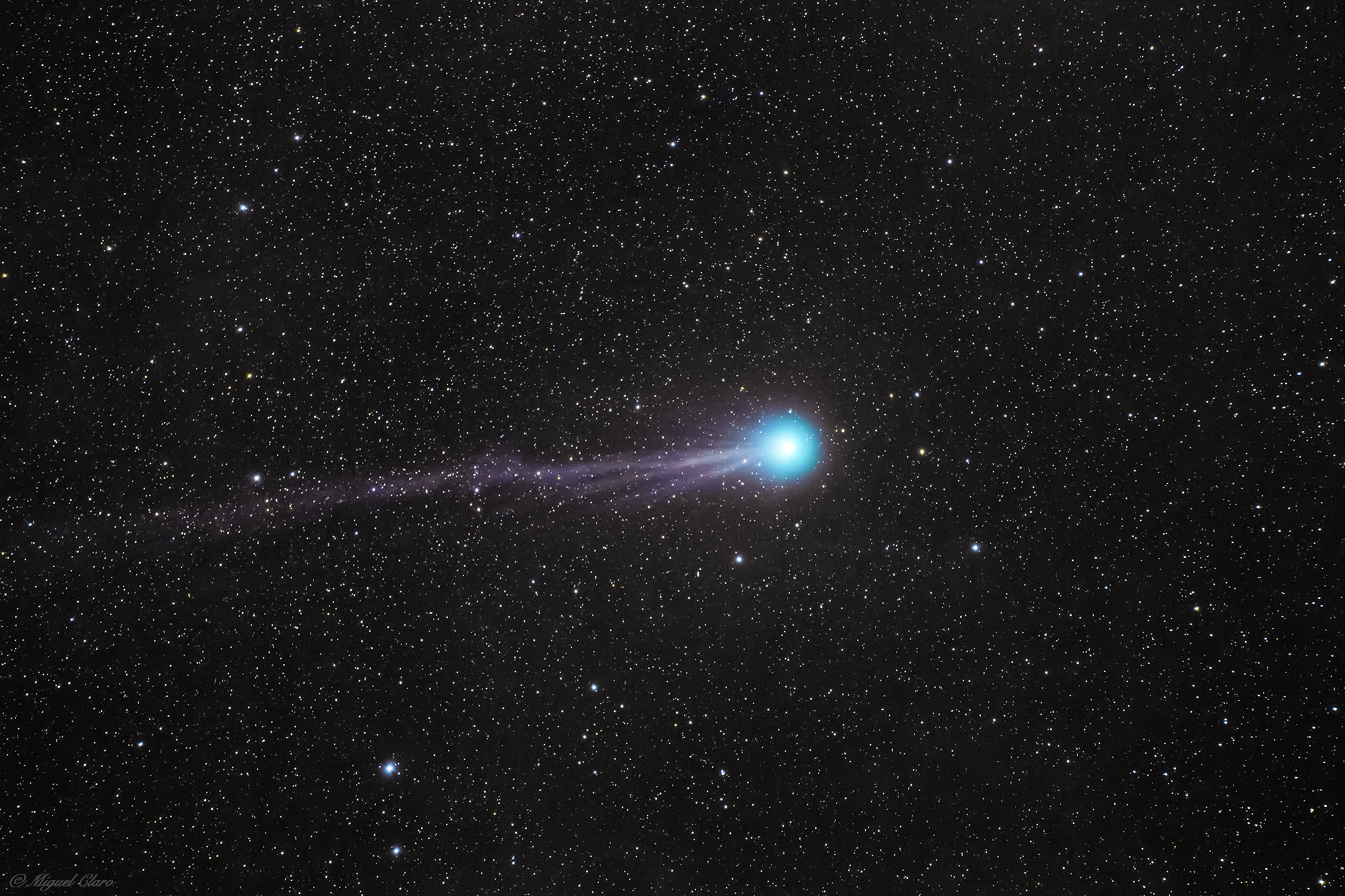
In the movie sequence below, resulting in the final still picture above, we can dip into a short journey that starts in the land of Juromenha, in Dark Sky Alqueva Reserve, Alentejo, with a stargazer trying to find with their own eyes and binoculars the glowing green head of Comet Lovejoy. After a few seconds we will zoom in, entering in a real time lapse sequence capturing the slowly movement of the comet and their ion blue tail, made by ionized gas – gas energized by ultraviolet light from the Sun and pushed outward by the solar wind – while it is crossing some stars of Taurus constellation. Finally, we will zoom out in a final still photograph that shows the strong and huge green head of diatomic carbon (C2) – gas fluorescing in sunlight that produces the coma’s green color – as well as a wide view of the entire fainter bluish tail, with more then 5 million kilometers at the comet’s estimated distance of 75 million kilometers from Earth.
Captured in the land of Hotel Naveterra, the sky of Juromenha, Dark Sky Alqueva Reserve, Portugal in 11/01/2015 at 20h52m – Canon EOS 6D; ISO 2000, Exp: 56s. at f/2.8 with a Canon telephoto lens serie L at 200mm + Travel mount Vixen Polarie. Sum of 7 pictures combined in Maxim DL 5 with a total time integration of 6,5 minutes. To find the first still landscape picture, click here: Stargazing the Comet Lovejoy!
PT: Passagem em 2015 do Cometa Lovejoy (C/2014 Q2) na constelação do Touro, a uma distância estimada de 75 milhões de quilómetros da Terra, exibiu uma cauda de mais de 5 milhões de quilómetros | Céu do Alandroal, Hotel Rural Nave Terra.
Note: We advise to watch it in HD Mode, to do so, simply click here on Vimeo with the “HD” button turned blue.
Earth Hour 2014 in Lisbon
Earth Hour 2014 in Lisbon – by Miguel Claro from Miguel Claro on Vimeo.
For the first time Lisbon was participating of the international event, shutting down the lights, as a symbolic act, of some of the main monuments, buildings and structures, as the great statue Christ the King and the 25 April bidge across the Tagus River, as we can see in the time lapse sequence captured in the south edge of Lisbon, from Almada. Heart Hour is a worldwide grassroots movement uniting people to protect the planet, and is organised by WWF. Engaging a massive mainstream community on a broad range of environmental issues, Earth Hour was famously started as a lights-off event in Sydney, Australia in 2007. Since then it has grown to engage more than 7000 cities and towns worldwide, and the one-hour event continues to remain the key driver of the now larger movement.
Captured with 2 Canon cameras (50D and 60Da) and 2 Great Vixen Polarie travel mounts.
The Moonset over the Ocean

Picture of the Moonset facing to the Atlantic Ocean, captured from Fonte-de-telha pine forest, in Portugal. Below is a Short time lapse movie of the scene. Taken in 13/02/2013 between 21h34 and 21h59. The motion during the sequence was made with the use of Vixen Polarie travel mount, following the Crescent Moon. Canon 60Da ISO500 f/4; Exp:10 sec. 35mm.
The MAGIC Gamma-ray Cherenkov Telescope full of Stars

In the foreground we can see the great MAGIC I telescope (Major Atmospheric Gamma-ray Imaging Cherenkov Telescopes) with it´s gigantic structure in front of a colorful startrail background, also mirrored on its impressive brilliant surface of 236 m2.
MAGIC is a system of two Imaging Atmospheric Cherenkov telescopes situated at the Roque de los Muchachos Observatory on La Palma, one of the Canary Islands, at about 2200 m above sea level. MAGIC detects particle showers released by gamma rays, using the Cherenkov radiation, i.e., faint light radiated by the charged particles in the showers. With a diameter of 17 meters and 236 m2 reflective surface, it was the largest in the world before the construction of H.E.S.S. II. MAGIC is not only huge, but also pioneers a number of technical developments that had never been applied to Cherenkov telescopes before. The mirror is extremely light and can be moved to any position in the sky in less than thirty seconds. It is made up of 270 individual mirror panels that can be independently focussed using an active mirror control system equipped with lasers.
The cosmos and its evolution are studied using all radiation, in particular electromagnetic waves. The observable spectrum extends from radio waves to infrared, visible, ultraviolet, X-ray, gamma-rays and finally very high energy gamma rays (starting at energies of 10 GeV). Observations at visible wavelengths (.5 to 1 micrometer) have a history of centuries, gamma astronomy by satellites (keV to few GeV) and ground-based telescopes (above 300 GeV) are end-of-20th century newcomers. The MAGIC telescope can detect very high energy gamma rays in a range of energies where no other telescope in the world can operate, so it opens up a brand new window into the universe.
Below we can see a time lapse with the MAGIC in motion and a sky full of stars reflected in its impressive mirrored surface.
Below we can see the MAGIC with a sky full of “steady” stars (without trail), and lighted by the Milky Way presence in the background.

Canon 60Da – ISO2500; 24mm at f/2; Exp. 15 secs. Sum of 53 images taken in 01/10/2013 at 00:22.
BUY THIS PRINT | COMPRAR ESTA IMPRESSÃO
Buy a Fine Art Print or Wall Decor of this Image – Make your order Now!
You can choose the best style of print do you preffer to decorate in a fashion way your walls. Metal Prints with durable and vivid colors, Acrylic, Canvas or the highest quality Gallery Print – a 6 colour UV direct printing on acrylic glass (2mm) including light colours and reinforced by an aluminium dibond plate (3mm). Those type of Prints can highlight the final work in an artistic way, showing the photograph as a piece of art. I work with two high quality specialized Labs in US and in Europe, using Kodak Professional Endura Premier Metallic papers and Fujifilm Crystal Archive DP II Professional. You can select the image above or freely navigate to more than 800 photographs available in my gallery – each one with their own story and magic – and choose the photograph you would love to have in your home or office.
How to Order – Simple and easy, just “copy and paste” the link of this page or the image you choosed and fill it in the form below, with the size you want and any detail you wish to include on the message, like your country, name and postal address. Free Shipping included to all prints (except frames). For US and Europe the delivery is 4-8 working days, while to Portugal and Spain is normally 2-6 working days. After submitting the order through the form, I will contact you for the payment method (Paypal available or bank transfer) and with other questions related to your print(s) or requests. Once payment is confirmed, your order is shipped within 24h. In case you wish, I can send you separtely with no additional cost, a postcard autographed and numbered of the same image you have just bought, as a seal and proof of art work authenticity from the author. Let me know what is your wish.
The Sparrow, the Moon and the Awning

At first sight and due to this particular “comet” shape, we could imagine that the long “white to orange” tail in the left center of the image, would be from the century´s comet, the ISON. At least, all of us have already heard that the most optimistic predictions, seems to pointing to a comet with a brightness as strong as the Moon. Well, either or not, it will be a great sky show indeed, providing good opportunities for images like that.
In the left top corner – clearly visible in the still single shot picture – we could find in the arms of this dead tree, a sleepy sparrow, the perfect model for a night long exposure shot. Below right, the great trail with a “comet shape” isn´t from the ISON yet, but actually the path of the moon against a starry sky. As it goes down, the brightness drops below and the color of the moon stays more yellow and near the horizon, can even reach a red tone. At right, the strange white shape, is from a awning of the Monte Falperras rural hotel, in Mourão, one of the great places to rest in the Alqueva Dark Sky Reserve, in Portugal. This startrail image composed by 195 images from 30 seconds each, was capturing in 15th July 2013 at 23h11, during the moonset, as we could appreciate in this 13 seconds Time Lapse sequence.
Still image: Canon 50D – ISO640; 10mm f/4 Exp 30 secs. In 15/07/2013 at 23:11 AM

Below is the short time lapse sequence:
Cloudy Moonlit

Image of a Starry cloudy moonlit above the Pedrogão´s Albufeira, in Moura, a region of the Dark Sky Alqueva Reserve. Canon 60Da – ISO640, f/2.8; Exp. 6s ; 24mm. 27/04/2013 23h21 AM
Below is a Short time lapse sequence, of a cloud formation under the moonlit and above the Pedrogão´s Albufeira, in Moura, a region of the Dark Sky Alqueva Reserve.
Lisbon Moonset
Short sequence of the moon while the Earthshine effect is visible on its surface, the moon is passing behind the 25 April Bridge, until it sets behind the Lisbon city, after the passing of a huge cargo boat moving across Tagus river.
The Lighttrails of the Knights Templar

The castle of Almourol is one of the more emblematic and cenographic medieval military monuments of the reconquest, and the best representation of the influence of the Knights Templar in Portugal. Located on a small islet in the middle of the Tagus River, in Vila Nova da Barquinha, in the centre region of the country. The castle was conquered in 1129 and it was part of the defensive line controlled by the Knights Templar, and a stronghold used during the Portuguese reconquest.
In the scene, at right, is visible the strong path of planet Venus, also reflected in the calm water of the river.
Canon 50D – ISO500 f/4.5 10mm Exp.20″ in 30-04-2012. Sum of 161 images taken between 21h31 and 22h59, in a total time integration of about 54 minutes.

Canon 50D – ISO500 f/4.5 10mm Exp.20″ in 30-04-2012 at 21h45
Diana´s Temple Moon – Évora

The Roman Temple of Évora (Portuguese: Templo romano de Évora), also referred to as the Temple of Diana (Diana, was the ancient Roman goddess of the moon, the hunt, and chastity) is an ancient temple in the Portuguese city of Évora.Specialists believe that the temple as been constructed around the first century A.D. in homage to Augustus who was venerated as a god during and after his rule. The temple is part of the historical centre of the city, which was included in the classification by UNESCO as a World Heritage Site.It represents one of the most significant landmarks relating to the Roman and Lusitania civilizations of Évora, in Portuguese territory. In the sky we could see the path of the Moon and above it, the bright trail of planet Mars.
Canon 50D – ISO125 f/10 15mm Exp.20″ in 08-03-2012. Sum of 307 images taken between 21h47 and 23h39, in a total time integration of about 102 minutes.

The Moon Lapse
In this Moon lapse video image, we could see the Crescent Moon in the Sagittarius constellation, while it was setting behind the horizon. The Moon shows a strong Earthshine effect, for being just 9% directly iluminated by the Sun. As we watch the moonset, we notice that by the influence of the the Moon gravity, the tide goes down. The time lapse was taken in Costa da Caparica beach, facing the Atlantic Ocean. Sequence of 319 images, each one of 10 seconds. 27/11/2011
Canon 50D- ISO640 f/3.5 Exp. 10″ 50mm between 18h41 and 19h39.
The way of the Milky Way

Imagem da Via Láctea vista nos céus do Alentejo, em Vila Boim, Elvas. A imagem foi obtida na região sul do céu. Ao centro da imagem é possível ver a Via láctea e simultaneamente o rasto das estrelas que a compõem, descrevendo assim o movimento da esfera celeste ao longo da noite. Para obter este resultado foi feita uma soma de 398 imagens entre as 00h40 e as 04h25 de 30-06-2011. Cada imagem de 30 segundos, totalizando uma integração de 3h19 minutos. Na imagem é possível ver diversas constelações como: Lyra, Aquila, Scutum, Sagittarius, Scorpius, Aquarius, Capricornus.
Canon 50D -ISO3200 10mm F/4 Exp.30s por imagem.
Arrábida – The Vernal Equinox

Imagem do rasto das estrelas no Portinho da Arrábida, obtidas com a maior lua cheia dos últimos 18 anos, no perigeu. No céu são visíveis, as estrelas Sírius, por detrás do pico rochoso, Orion, Procyon, Capella, Castor e Pollux. Imagem obtida em 20-03-2011 entre as 23h05 e as 10h02. Soma de 254 imagens cada uma de 20 segundos, totalizando uma integração de 84 minutos.

This night time lapse photography was made during the Vernal Equinox, March 20, 2011. While the Pleiades, Orion and Sirius star, were getting down behind the Arrábida moutain range, in Portugal, the biggest Moon of the last 18 years was moving in the sky, iluminating all the scene and making a slow motion movement in the rock shadows on the sand. The Moon was also drawing the water from the Atlantic Ocean, due to gravity is noticeable the incoming tide at the end of the video, that was made between 21h30 and 01h00. This is a movie trailer from the “Arrábida Nightscape Project”, by Miguel Claro and Emanuel Magessi Lopes. A special thanks to local assitant, Paulo Lourenço.
Canon 50D -ISO640 10mm F/4.5 Exp.20s por imagem.
The Night, Sky lights and Motion
In this Time Lapse Photography taken during the night at 15-03-11 between 22h32 and 01h31, in Fonte-de-Telha, Portugal, in a small pine forest near the Atlantic Ocean, we could apreciate the motion of many stars from Pleiades and Perseus Constellation, as well as, Castor and Pollux, Procyon and even Regulus. The bright light of the Moon is well visible in the end of the movie. It is also impressive the the dynamic motion in diferent layers of clouds in formation.
Canon 50D -ISO640 10mm F/4 Exp.20s Total:359imgs
Star Motion in the Park of the Peace

Imagem do rasto das estrelas na região sudoeste do céu, obtida no Parque da Paz, um refúgio da natureza localizado no meio da cidade de Almada. Imagem obtida em 27-02-2011 entre as 22h22 e as 00h29. Soma de 234 imagens cada uma de 30 segundos, totalizando uma integração de 117 minutos.
São visíveis várias estrelas e respectivas constelações: Logo à esquerda o rasto mais brilhante é da estrela Sírius, seguindo-se logo à direita os rastos da estrelas de Orion, que atravessam o primeiro conjunto rochoso vertical. Logo acima de Orion é ainda visivel o rasto de Procyon e mais à frente em baixo, destaco o rasto das conhecidas Pleiades. Finalmente no canto superior direito, a estrela Capella, com uma tonalidade alaranjada e inconfundível. O rasto rectilíneo inferior que atravessa a imagem, é de alguns aviões que ali passaram.
Canon 50D -ISO500 10mm F/5.6 Exp.30s por imagem.
Crescent Moon and Earthshine

Imagem da Lua em fase Crescente, com apenas 3% do disco iluminado e onde é visível um forte Earthshine lunar, tornando visível a parte da Lua que nesta fase não se encontra directamente exposta aos raios solares, mas que se torna visível devido à luz reflectida na sua superfície, pelo próprio planeta Terra, que ilumina assim a parte escura da Lua, claramente visível, nesta imagem obtida no Feijó, Almada, em 04-02-2011 às 18h50.
Imagem above: Canon 50D -ISO400 300mm F/5.6 Exp. 2.5″ às 18:50

Image above: Canon 50D -ISO800 300mm F/5.6 Exp. 2″ às 18:58
Arrábida´s Mountain Startrail

Imagem do movimento das estrelas registado ao longo da noite com a lua cheia a iluminar o céu a Sudeste, no dia 26 de Abril de 2010, entre as 22h04 e as 23h08. Para o resultado final foi feita uma soma manual de 108 imagens no CS3 cada uma de 30 segundos, totalizando uma integração de 54 minutos, com uma Canon 50D a uma abertura F-5.6 a ISO 500, com uma Lente Sigma HSM EX a 10mm. Imagem obtida no Portinho da Arrábida, na Serra da Arrábida, Setúbal.
São visíveis várias estrelas assinaladas na legenda da imagem o no video motion, destacando de entre várias, as mais brilhantes como: Sirius, Betelgeuse, Castor, Pollux, Alphard, Alhena, Menkalinan, Alnath…etc.

Sky lights of Lisbon

Imagem do movimento da Lua registado ao longo da noite no dia 17 de Fevereiro de 2010, entre as 20h29 e as 21h30. Para o resultado final foi feita uma soma manual de 111 imagens no CS3 cada uma de 30 segundos, totalizando uma integração de 60 minutos, com uma Canon 50D a uma abertura F-5 a ISO 125, com uma Lente Sigma HSM EX a 15mm. Imagem obtida em Almada, junto ao Rio Tejo.
São visíveis vários rastos de aviões que se movimentam em direcção ao aeroporto de Lisboa, assim como o rasto da Lua Crescente e de algumas estrelas da constelação de Andromeda, Pegasus e Carneiro. Junto ao horizonte lisboeta é ainda visível o rasto luminoso de um navio que se movimenta em direcção ao Oceano Atlântico.
Image published in National Geographic, click here.


