
A Moon Sequence of the Total Lunar Eclipse of 2019

A photo time lapse sequence shows the path of totality during the Total Lunar Eclipse of 2019, on 21th January, as seen from Mina de São Domingos in Dark Sky® Alqueva Mértola, Portugal. During a lunar eclipse, the moon passes through Earth’s shadow, giving the natural satellite a blood-red hue. For being near the closest point to our planet Earth, this Moon was also called a “Super Moon”. The next total lunar eclipse will be in 2021. During a celestial event like that, is incredible to notice huge changes on the reflected light that illuminates the ground. Some stars are also reflected in a small puddle of acid water from Achada do Gamo, that was – since the beginning of modern mining activities in the São Domingos Mine – the center of metallurgical activities on extracted minerals. The areas of heaps, slag and channels of water, give the landscape a “lunar” aspect. The heaps are composed of different materials with high levels of metals, such as slag and ash, whose leaching through the rainwater leads to the production of acid mine drainage, usually with an ocher or reddish color
PT: A imagem mostra uma foto-sequência onde é possível ver o caminho da Lua percorrido durante a fase da totalidade durante o Eclipse Total Lunar ocorrido a 21 de Janeiro de 2019, captado a partir do complexo da Mina de São Domingos, no Dark Sky® Alqueva Mértola, em Portugal. Durante um eclipse lunar, a lua passa pela sombra da Terra, dando ao nosso satélite natural uma tonalidade vermelho-sangue. Por se encontrar no ponto orbital mais próximo da Terra, esta Lua é também apelidada de Super Lua. O próximo Eclipse Total da Lua ocorrerá em 2021. Durante um evento celestial como este, é incrível como se notam grandes mudanças na luz refletida que ilumina o solo. Algumas estrelas reflectem-se também nas águas ácidas da Achada do Gamo, que foi desde o início das atividades modernas de mineração na Mina de São Domingos, o centro das atividades metalúrgicas sobre os minérios extraídos. As áreas de escombreiras, escórias e canais de água, dão à paisagem um aspecto “lunar”. As escombreiras são constituídas por diferentes materiais com teores elevados em metais, como escórias e cinzas, cuja lixiviação através das águas das chuvas leva à produção de águas ácidas (‘acid mine drainage’), geralmente com uma cor ocre ou avermelhada.
A Super Red Moon in a Field of Stars

The image shows a close-up view of a red dark Moon taken with a telephoto lens during the Total Lunar Eclipse of 2019, on 21th January, as seen from Mina de São Domingos in Dark Sky® Alqueva Mértola, Portugal. During a lunar eclipse, the moon passes through Earth’s shadow, giving the natural satellite a blood-red hue. For being near the closest point to our planet Earth, this Moon was also called a “Super Moon”. The next total lunar eclipse will be in 2021.
PT: A imagem mostra um close-up de uma lua cheia vermelha e escurecida, captada com teleobjetiva durante o Eclipse Total Lunar ocorrido a 21 de Janeiro de 2019, captado a partir do complexo mineiro de São Domingos, no Dark Sky® Alqueva Mértola, em Portugal. Durante um eclipse lunar, a lua passa pela sombra da Terra, dando ao nosso satélite natural uma tonalidade vermelho-sangue. Por se encontrar no ponto orbital mais próximo da Terra, esta Lua é também apelidada de Super Lua. O próximo Eclipse Total da Lua ocorrerá em 2021.
Winter Corona Surrounding a Full Cold Moon

This relatively abstract view captured in a double exposure with focus stacking, shows the Full Moon of December, behind a layer of clouds and immersed between dozens of branches from a foreground tree. The colourful hue that surrounds the moon, is a lunar corona formed while bright moonlight is diffracted by water droplets in thin clouds, drifting in front of the lunar disk. The image was captured in the historic centre of Évora, a UNESCO World Heritage site, located in Dark Sky® Alqueva reserve, Portugal. According to the Old Farmer’s Almanac, the December full moon is also called the “Full Cold Moon”. The last time a full moon coincided with the solstice was in 2010, and the next will be in 2094.
PT: Uma visão relativamente abstrata captada em uma dupla exposição com focus stacking, mostra uma Lua Cheia envolta numa fina camada de nuvens e imersa entre dezenas de galhos de uma árvore que em contra-luz, se destaca em primeiro plano. As tonalidades coloridas que circundam a lua, são provocadas por um corona lunar, que se forma enquanto o brilho da lua é difractado por gotículas de água em nuvens finas, flutuando assim na frente do disco lunar. A imagem foi captada no centro histórico de Évora, Património Mundial da UNESCO, e inserido na reserva Dark Sky® Alqueva. De acordo com o Almanaque do Velho Fazendeiro, a lua cheia de dezembro também é chamada de “Full Cold Moon”. A última vez que uma lua cheia coincidiu com o solstício de inverno foi em 2010, sendo que a próxima só voltará a ocorrer em 2094.
All Sky View of Geminids Meteor Shower and Comet 46P/Wirtanen

A fisheye full dome view from headquarters of Dark Sky® Alqueva reserve, in Cumeada, shows a moonlight night after the peak of Geminids meteor shower. This composite shows the radiant of Geminids, located in Gemini constellation and near the star Castor, is combining 8 images where meteors were captured during a period of about 3h. Comet 46P/Wirtanen is also visible in Taurus constellation, making an historic close approach to Earth. The beautiful greenish-blue coma is very well visible even in this ultra wide-field view. High in the sky, and not faraway from 46/P Wirtanen, is shinning bright the blueish cluster of hot and young stars known as Pleiades (M45).
PT: Uma visão fisheye full dome captada a partir da sede da reserva Dark Sky® Alqueva, na Cumeada, mostra uma noite de luar após o pico da chuva de meteoros Geminídeas. Este compósito mostra o radiante da chuva de meteoros localizado na constelação de Gémeos, perto da estrela Castor, combinando 8 imagens de meteoros captados durante um período de cerca de 3h. O cometa 46P / Wirtanen, é também é visível na constelação do Touro, fazendo uma aproximação histórica à Terra. A tonalidade azul-esverdeada do coma – a nuvem de poeira e gás que circunda o núcleo de um cometa – é bem visível nesta imagem “all sky” ultra grande-angular. Alto no céu, e não muito longe do 46/P Wirtanen, brilha ainda em tons de azul, o aglomerado de estrelas quentes e jovens conhecidas como Pleiades (M45).
Celestial Encounter Between Comet 46P/Wirtanen, Pleiades, California Nebula and a Meteor

A wide-field scene shows Comet 46P/Wirtanen in Taurus constellation, making an historic close approach to Earth. Being only 11.5 million km away from us, the small comet is barely visible to the unaided eye, showing in a telescopic view a beautiful greenish-blue coma. Besides the visible comet, this panoramic scene composed of 3 panes captured from Cumeada Observatory in Dark Sky® Alqueva Reserve, is also featuring near the center of the frame a blueish cluster of hot and young stars known as Pleiades (M45). In the right edge, we can find California Nebula (NGC 1499), while a meteor from Geminids was crossing the sky and releasing a plume of smoke only perceptible in the sequence of shots.
PT: A imagem wide-field mostra o Cometa 46P/Wirtanen enquanto transitava pela constelação do Touro, numa aproximação histórica à Terra. Estando a apenas 11,5 milhões de quilómetros de distância de nós, o pequeno cometa – pouco visível a olho nu – revela numa imagem telescópica um coma azul-esverdeado. Além do cometa visível, esta cena panorâmica composta por 3 painéis de 8 imagens cada, captados a partir do Observatório da Cumeada, sede da Reserva Dark Sky® Alqueva, mostra um aglomerado estelar azul composto por estrelas jovens e ainda muito quentes, conhecido por Pleiades (M45). Na margem direita, podemos encontrar ainda a Nebulosa da Califórnia (NGC 1499), enquanto um meteoro de Geminídeas cruzava o céu e deixando para trás uma nuvem de fumaça apenas perceptível nos disparos seguintes.
Technical details | Detalhes Técnicos
Nikon D810a | Sigma 150-600mm DG OS HSM Sports at 150mm f/5 | ISO2500 – Exp. 80 seconds x 24 lights | Mount EQ6 Pro |Total integration of 24 Lights: 32 minutes divided in 10 minutes per panel. Processing on PixInsight 1.8.5 and Photoshop CC. Cumeada Observatory from Dark Sky® Alqueva Reserve, Reguengos de Monsaraz.
My Helmet´s Vision of the Milky Way

A large panoramic image of 9 single frames captured from edge-to- edge, shows the long path of our own galaxy, the Milky Way, as seen from the Northern Hemisphere. Besides the well know “Summer Triangle” with stars Deneb (from Cygnus), Altair (from Aquila) and Vega (from Lyra constellation), this colourful “helmet view” scene is featuring another larger and less usual triangle. This time, an asterism formed by planet Mars – the orange bright object in the upper left corner of the sky – the Andromeda Galaxy – the faint oblong object in upper right corner – as well as Vega, the blue bright star in the low center. The reddish hues spread around the Milky Way, are emission nebulae, stellar nurseries like North America Nebula (NGC7000). Located in Cygnus constellation, is an easily recognisable shape in the center of this lovely scene captured from Campinho, a small village in the hearth of Dark Sky® Alqueva reserve, Portugal.
PT: Uma grande panorâmica composta por 9 fotografias únicas, captadas de um horizonte ao outro, mostra o longo caminho da nossa própria galáxia, a Via Láctea, vista a partir do Hemisfério Norte. Além do já conhecido “Triângulo de Verão” formado pelas estrelas Deneb (do Cisne), Altair (da Águia) e Vega, da constelação Lira, esta colorida cena celeste que mais se assemelha à visão que teríamos a partir de um capacete, apresenta outro triângulo maior e menos comum. Desta vez, um asterismo formado pelo planeta Marte – o objeto laranja brilhante no canto superior esquerdo do céu – a galáxia de Andromeda – o objeto difuso e oblongo no canto superior direito – bem como Vega, a estrela azul brilhante perto do centro. Os tons avermelhados espalhados pela Via Láctea são nebulosas de emissão, berçários estelares como a Nebulosa América do Norte (NGC7000). Localizada na constelação do Cisne, é uma forma facilmente reconhecível no centro desta encantadora cena captada no Campinho, uma pequena vila no coração da reserva Dark Sky® Alqueva, Portugal.
The Great Orion Nebula – A Colourful Show in Visible Light
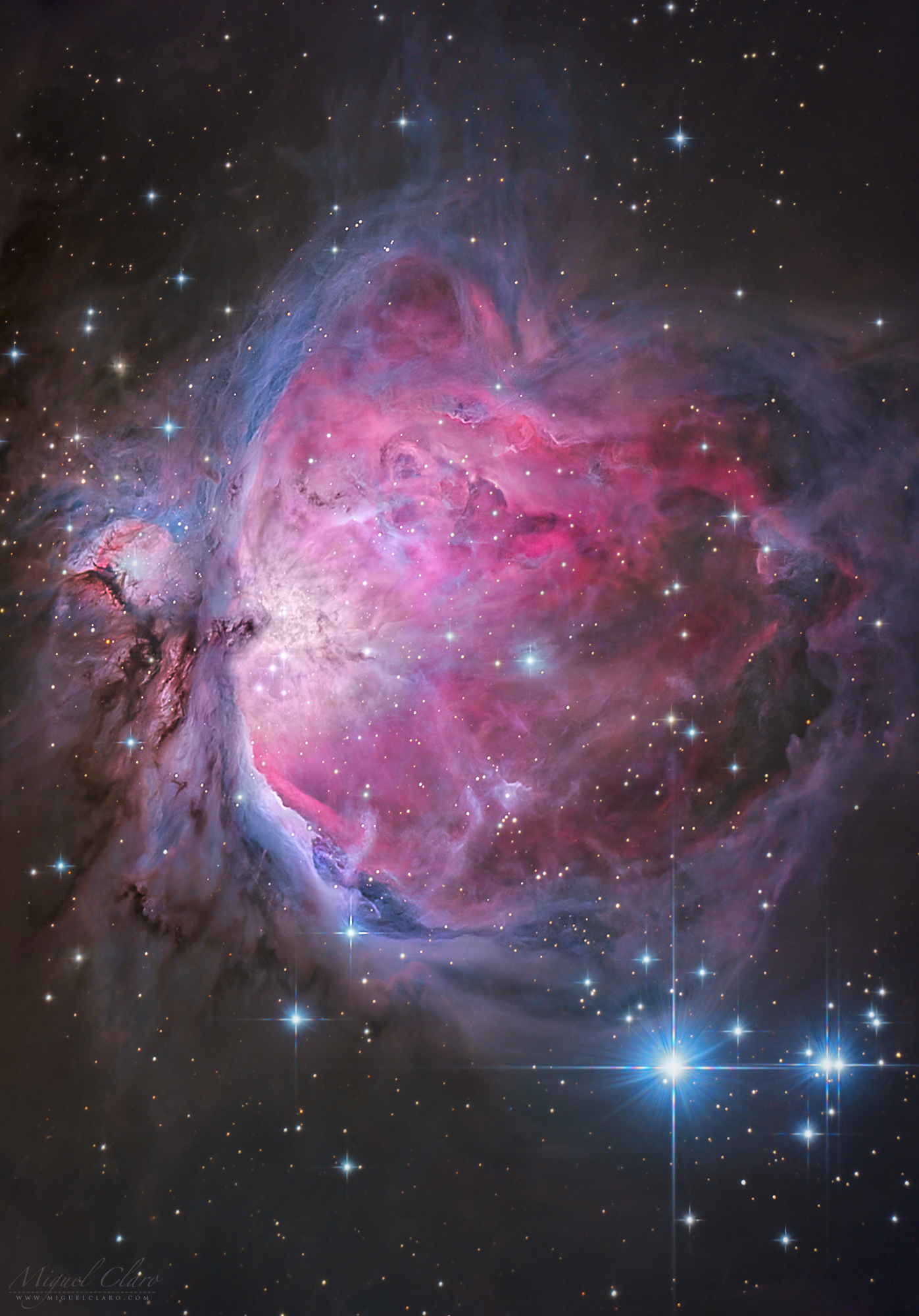
Captured in the “visible light”, the image shows a sharp and colourful view of the Great Orion Nebula. Also known as M42, is a diffuse and large nebula complex situated in the Milky Way, in the constellation of Orion. Located at a distance of about 1350 light years, Orion is estimated to be 24 light years across, being the closest region of massive star formation to Earth. This nebula has revealed much about the process of how stars and planetary systems are formed from collapsing clouds of gas and dust. The brightest central part of the nebula is called Huygenian region, and the Fish’s Mouth is the dark nebulosity that separates M43 from the bright part. Outside the edges of M42, we can also find the “Wings” of Orion. Due to the asterism of its primary four stars, the core of the nebula contains a very young open cluster known as the Trapezium, a cluster of newly formed stars shinning at the heart of the nebula. The red emission glows from the light of hydrogen gas excited by energetic newly-formed hot and young stars in the core of the nebula, but the blue-violet coloration, comes from the reflected radiation from the massive O-class stars. This complex contains dark nebulae, emission nebulae, reflection nebulae, and H II regions.
PT: Captada na banda da “luz visível”, a imagem revela uma visão nítida e colorida da Grande Nebulosa Orion. Também conhecida como M42, é um complexo nebuloso difuso muito grande situado na Via Láctea, na constelação de Orion. Localizado a uma distância de cerca de 1350 anos-luz, é a região mais próxima da Terra onde se formam estrelas maciças. Estima-se que o diâmetro da nebulosa M42 seja de aproximadamente 24 anos-luz. O estudo desta nebulosa já permitiu revelar muito sobre o processo de como as estrelas e os sistemas planetários são formados por nuvens de gás e poeira em colapso. A parte central mais brilhante da nebulosa é chamada região de Huygenian, e a “Fish’s Mouth” é a nebulosidade escura que separa M43 da parte mais brilhante da M42. Fora dos limites da M42 encontramos as “Asas” de Orion. O núcleo da nebulosa contém um aglomerado aberto muito jovem, conhecido como o Trapézio devido ao asterismo de suas quatro estrelas primárias. Duas destas podem ser resolvidas nos seus sistemas binários, em noites com boa visibilidade e estabilidade atmosférica, totalizando a soma de seis estrelas. As estrelas do Trapézio, conjuntamente com muitas outras estrelas do “berço estelar” que é a nebula de Orion, estão ainda nos seus primeiros anos de vida. A tonalidade avermelhada, é resultado de uma emissão brilhante a partir do gás de hidrogénio excitado por estrelas quentes e energéticas, recém-formadas no centro da nebulosa, mas a coloração azul-violeta visível na fotografia, provém da radiação refletida das estrelas da classe-O. Este complexo contém nebulosas escuras, nebulosas de emissão, nebulosas de reflexão e regiões H II.
Technical details | Detalhes Técnicos
Nikon D810a | GSO RC8 F/8 1624mm – Ritchey-Chrétien Astrograph Carbon Fiber| ISO1600 – Exp. 300 seconds x 10 lights + 20 shorter exposures | Mount EQ6 Pro |Total integration of 30 Lights: 65 minutes. Processing on PixInsight 1.8.5 and Photoshop CC 2019. Cumeada Observatory from Dark Sky® Alqueva Reserve, Reguengos de Monsaraz
A Titanium Moon

Winner of “Insight Investment Astronomy Photographer of the Year People’s Choice Award 2019“, this Full Moon image is a result of an high-resolution mosaic composed by four panels each one of 30 images combined together to reveal a sharp and detailed surface up to the lunar limb. Taken on 25th October 2018 from Cumeada Observatory in Dark Sky® Alqueva Reserve, the final image shows that the moon is more then a grey body as it is normally perceived by our human eye. The color of this RGB image have been slightly increased revelling a strange but even so, real appearance, corresponding to the differences in the chemical constitution of the lunar surface, as changes in mineral content can produce subtle color differences in reflected light. The blue hues that can be seen on the seas like “Mare Tranquillitatis”, or “Mare Fecunditatis” (right center and edge) are revelling rich areas in titanium. According to Hawai’s Institute of Geophysics and Planetology, the presence of this unusual titanium-rich layer was produced by the crystallization of a huge ocean of magma that surrounded the Moon when it formed. In the bottom center of the Moon, white stripes are radiating across the southern lunar highlands, coming from the 85 kilometer wide crater Tycho. Above it, in the left center, dark rays from Copernicus crater are extending into the “Mare Imbrium”. In the upper center edge and with a diameter of 51 kilometers, another bright but even small crater can be spotted. Named Anaxagoras, the crater interior has 3km and a relatively high albedo, making it a prominent feature when the Moon is full. In the past, multicolor images calibrated by rock samples from the Apollo missions, were recorded by Galileo and Celmentine spacecrafts and been used to explore the Moon’s global surface composition.
PT: Vencedora do “Insight Investment Astronomy Photographer of the Year People’s Choice Award 2019“ esta fotografia da Lua Cheia é o resultado de um mosaico de alta resolução composto por quatro painéis, cada um com 30 imagens combinadas, com a finalidade de revelar uma superfície nítida e detalhada até o limbo lunar. Captada a 25 de outubro de 2018, no Observatório da Cumeada, sede oficial da Reserva Dark Sky® Alqueva, a imagem final mostra que a Lua é mais do que um corpo cinzento, como é normalmente percepcionado pelo nosso olho humano. A saturação desta fotografia RGB foi aumentada ligeiramente, permitindo assim revelar uma aparência incomum mas ainda assim real, correspondente às diferenças na constituição química da superfície lunar, já que mudanças no conteúdo mineral podem produzir diferenças subtis de cor na luz refletida. As tonalidades de azul que podem ser vistas nos mares “Tranquillitatis” ou “Fecunditatis” (centro e extremo direito) revelam áreas ricas em titânio. De acordo com o Hawai’s Institute of Geophysics and Planetology, a presença dessa camada incomum rica em titânio foi produzida pela cristalização de um enorme oceano de magma que cercou a Lua quando ela se formou. No centro da Lua, faixas esbranquiçadas espalham-se de forma raiada pelas terras altas lunares do sul, vindas da cratera Tycho, com 85 quilómetros de largura. Acima, no centro esquerdo, as reentrâncias escuras e raiadas provenientes da cratera Copérnico, estendem-se até ao “Mare Imbrium”. No extremo superior central e com um diâmetro de 51 quilómetros, pode ser vista outra cratera brilhante mas mais pequena. Chamada de Anaxagoras, o interior da cratera tem 3km e um albedo relativamente alto, tornando-se um alvo proeminente quando a Lua está cheia. No passado, imagens multi-coloridas calibradas por amostras de rochas das missões Apollo foram registadas pelas sondas espaciais Galileo e Celmentine e usadas para explorar a composição da superfície global da Lua.
Technical details | Detalhes Técnicos
Celestron C14 EDGE HD (XLT) | Nikon D810a | ISO400 – Exp. 1/800 | Mosaic of four panels composed by 30 images each. Processed on Registax and PS CC 2019. Cumeada Observatory from Dark Sky® Alqueva Reserve, Reguengos de Monsaraz.
BUY THIS PRINT | COMPRAR ESTA IMPRESSÃO
Buy a Fine Art Print or Wall Decor of this Image – Make your order Now!
You can choose the best style of print do you preffer to decorate in a fashion way your walls. Metal Prints with durable and vivid colors, Acrylic, Canvas or the highest quality Gallery Print – a 6 colour UV direct printing on acrylic glass (2mm) including light colours and reinforced by an aluminium dibond plate (3mm). Those type of Prints can highlight the final work in an artistic way, showing the photograph as a piece of art. I work with two high quality specialized Labs in US and in Europe, using Kodak Professional Endura Premier Metallic papers and Fujifilm Crystal Archive DP II Professional. You can select the image above or freely navigate to more than 800 photographs available in my gallery – each one with their own story and magic – and choose the photograph you would love to have in your home or office.
How to Order – Simple and easy, just “copy and paste” the link of this page or the image you choosed and fill it in the form below, with the size you want and any detail you wish to include on the message, like your country, name and postal address. Free Shipping included to all prints (except frames). For US and Europe the delivery is 4-8 working days, while to Portugal and Spain is normally 2-6 working days. After submitting the order through the form, I will contact you for the payment method (Paypal available or bank transfer) and with other questions related to your print(s) or requests. Once payment is confirmed, your order is shipped within 24h. In case you wish, I can send you separtely with no additional cost, a postcard autographed and numbered of the same image you have just bought, as a seal and proof of art work authenticity from the author. Let me know what is your wish.
The Wonderful Lagoon of Deep Space

The Lagoon Nebula also known as M8, is a magnificent complex of hot gas and dark nebulosity located in Sagittarius constellation. Shining at magnitude 5, and being below the limit capacity of human eye to distinguish faint objects in the night sky, M8 can be seen with the naked eye from a dark sky location. Inside the nebula, the energetic processes of star formation creates a huge chaos and a beautiful combination of colors. The red-glowing gas is resulting from high-energy starlight striking interstellar hydrogen. Hot young stars are forming in this stellar nursery. The dark dust filaments inside the nebula, were created in the atmospheres of cool giant stars and in the debris from supernovae explosions. Small dark knots, and globules that are condensing protostellar clouds are a sign that the process of star formation is still happening. The Lagoon Nebula gets its name from the distinctive dark lane that runs through the heart of the nebula. At the left side of this dark lane, is visible a bright star cluster known as NGC 6523. The Lagoon Nebula is so large, that is about 110 light-years across in space. It is located 5,000 light-years distant from us.
PT: A Nebulosa da Lagoa, também conhecida como M8, é um magnífico complexo de gás quente e nebulosidade escura localizado na constelação de Sagitário. Brilhando com uma magnitude de 5 e estando abaixo da capacidade limite do olho humano para distinguir objetos ténues no céu noturno, a M8 pode ser vista a olho nu a partir de um local com céu escuro. Dentro da nebulosa, os processos energéticos de formação de estrelas criam um enorme caos e uma combinação de cores ímpar. O gás vermelho-brilhante é resultante da luz estelar de alta energia que atinge o hidrogénio inter-estelar. Estrelas jovens e quentes formam-se assim neste berço estelar. Os filamentos de poeira escura dentro da nebulosa, foram criados nas atmosferas de estrelas gigantes e na sequência de explosões de supernovas. Os pequenos nódulos escuros que se espalham pela nebulosa estão condensando as nuvens proto-estelares, sendo um sinal de que o processo de formação estelar continua a ocorrer. A Nebulosa da Lagoa recebe esse nome devido à distinta faixa escura que atravessa o coração da nebulosa. No lado esquerdo desta faixa escura, é visível um aglomerado de estrelas brilhante conhecido como NGC 6523. A Nebulosa da Lagoa é tão grande, que tem cerca de 110 anos-luz de diâmetro no espaço. Está localizada a 5.000 anos-luz de nós..
Technical details | Detalhes Técnicos
Taka FSQ-106ED – EM200 auto-guided and GSO RC8 F/8 1624mm – Ritchey-Chrétien Astrograph Carbon Fiber | Nikon D810a | ISO2500 – Exp. 180 seconds x 22 lights| Total integration of 22 Lights: 66 minutes. Processing on PixInsight 1.8.5 and Photoshop CC 2019. Cumeada Observatory from Dark Sky® Alqueva Reserve, Reguengos de Monsaraz.
A Panoramic Milky Way Above Azenhas do Guadiana

An impressive panoramic view shows the Milky Way rising above the hills from the fluvial beach of Azenhas do Guadiana, in Dark Sky® Alqueva Mértola. While a family of ducks are standing near the water in the center of the picture, two photographers are capturing the wonders of the night sky during a workshop of astrophotography. At the right side of this scenic view, the core of our galaxy is shinning bright and with it, some deep sky objects like the Lagoon Nebula, visible in red-violet immediately above the hill top.
Milky Way, Andromeda and a Dutch Sailboat

Visible below two galaxies, our Great Milky Way that stands bright at the top of this vertical panorama and Andromeda Galaxy, the diffuse elliptic shape shining near the center of the image, is Sem Fim boat. A Westlander sailboat built in 1913 in Holland. This type of boat, was used in the Dutch channels for the transport of goods, among them flowers. It was later transformed into house and bring it to Portugal. Now it navigates in Alqueva lake giving tourists the experience of sailing in the wind on board of a vintage boat. The image was captured during the XII edition of Dark Sky® Party Alqueva, held annually in Campinho, Dark Sky® Alqueva reserve.
Discovering the Sky Above with a Mobile Planetarium

While we can´t have yet a smartphone with enough quality to face the challenges of night photography, we could actually use it as a powerful mobile planetarium. Fortunately, nowadays, there are several free or purchased apps in the market capable of help you every time you are under a starry dark sky, turning your smartphone in an easy tool to identify celestial objects in real time. This image captured in Azenhas do Guadiana, Dark Sky® Alqueva Mértola, shows one of this moments, when a sky enthusiast was searching for planet Saturn, shinning bright near the core of the galaxy, was only 6º apart from the Lagoon Nebula (visible above the mountain, in the center of the image).
The Colourful Spiral Galaxy of Andromeda
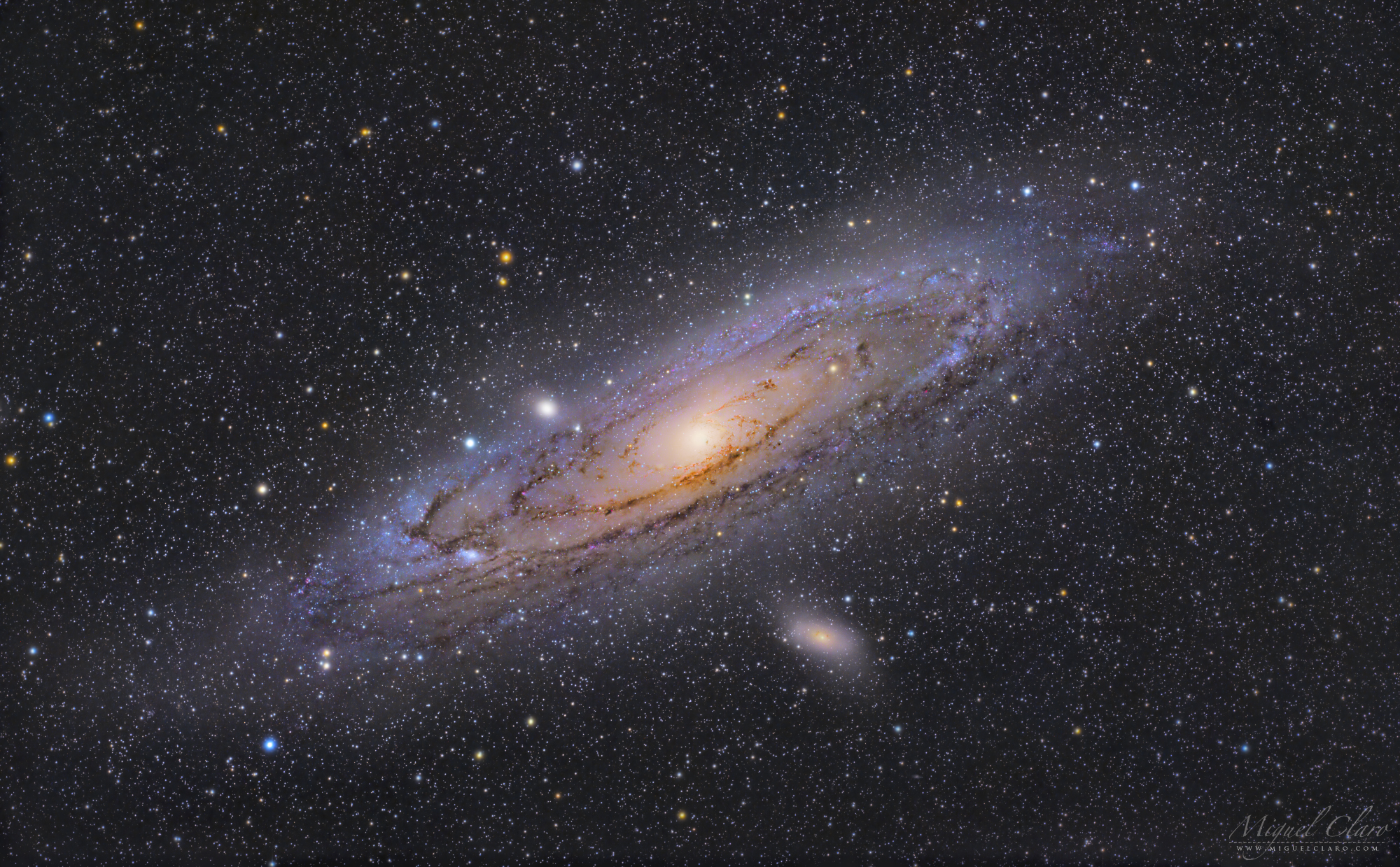
Homo is the genus that includes modern humans and their close relatives, originals habitants of planet Earth.The genus is estimated to be between 1.5 and 2.5 million years old. At approximately the same time, in space, the light from our neighboring galaxy Andromeda M31, has departed from the point in space where it is located, in the constellation of Andromeda. While the light from this source was travelling in the cold vacum of space at the speed of light, for the long journey of 2.5 million years, here in our planet, we have been evolved from the Homo Habilis up to the point where we have the necessary technology to construct powerful telescopes, giving us the capability to observing, studying, photographing and understanding the wonders of the vast Universe. Besides the huge distances, Andromeda galaxy is the nearest spiral galaxy to our Milky Way. With approximately 220,000 light-years across, Andromeda is the largest galaxy of the Local Group, which also contains the Milky Way, the Triangulum galaxy, and about 30 other smaller galaxies. This colorful scene shows the arms and core of Andromeda immersed in several distinct stars that surrounding the diffuse spiral shape, are actually stars from our own galaxy, the Milky Way, well visible in front of M31. While its spiral arms stand out in visible light images, the arms look like rings in the GALEX ultraviolet views. Being sites of intense star formation, the rings have been interpreted as evidence that Andromeda collided with its smaller neighboring elliptical galaxy M32 more than 200 million years ago. M32 is also visible as the bright circular diffuse shape on the left side of the core. M110, a dwarf elliptical galaxy visible below M31, is also a satellite of the Andromeda Galaxy.
PT: Homo é o género que inclui os humanos modernos e seus parentes próximos, habitantes originários do planeta Terra. Este Género está estimado entre 1,5 e 2,5 milhões de anos. Aproximadamente ao mesmo tempo, no espaço, a luz da nossa galáxia vizinha Andromeda M31, partiu do ponto onde está localizada, na constelação de Andromeda. Enquanto a luz desta fonte viajava no vácuo frio do espaço à velocidade da luz, durante a longa jornada de 2,5 milhões de anos que nos separa, aqui no nosso planeta, evoluímos do Homo Habilis até ao ponto actual em que temos a tecnologia necessária para construir telescópios poderosos, dando-nos a capacidade de observar, estudar, fotografar e compreender as maravilhas do vasto universo. Apesar destas distâncias enormes, a galáxia de Andromeda é a galáxia espiral mais próxima da nossa galáxia, a Via Láctea. Com cerca de 220.000 anos-luz de diâmetro, Andromeda é a maior galáxia do Grupo Local, que também contém a Via Láctea, a galáxia de Triângulo, e cerca de 30 outras galáxias menores. A imagem mostra os braços e o núcleo de Andromeda imerso em várias estrelas distintas que circundam a sua forma espiral difusa. Estas estrelas são na verdade estrelas da nossa própria galáxia, a Via Láctea, visíveis em frente à M31 em pano de fundo. Enquanto seus braços espirais se destacam em imagens de luz visível, os braços parecem anéis quando visto no ultravioleta através do GALEX (Galaxy Evolution Explorer ). Sendo locais de intensa formação estelar, os anéis têm sido interpretados como evidência de que Andromeda colidiu com sua menor galáxia elíptica vizinha M32, há mais de 200 milhões de anos. M32 também é visível como a forma difusa circular brilhante no lado esquerdo do núcleo da M31. M110, uma galáxia elíptica anã visível abaixo de M31, é também um satélite da galáxia de Andromeda.
Technical details | Detalhes Técnicos
Taka FSQ-106ED – EM200 auto-guided | Nikon D810a | ISO1600 – Exp. 140 seconds x 38 lights | Total integration of 38 Lights: 89 minutes. Processing on PixInsight 1.8 and Photoshop CC. Cumeada Observatory from Dark Sky® Alqueva Reserve, Reguengos de Monsaraz.
Comet 21p/Giacobini-Zinner Approaching Open Cluster M37

A rich starfield in Auriga constellation shows a close-up view of a bright tail and greenish coma from Comet 21P/Giacobini-Zinner only separated by approximately 1º from the colourful and brightest open cluster in Auriga, M37 (at right), with an apparent magnitude of 6.2, lies at a distance of 4,511 light years from our Solar System. On 10th September 2018, the comet Giacobini-Zinner was near its perihelion and closest approach to Earth in 72 years, being only at a distance of 58 million km from our planet, was shining like a 7th magnitude star, remaining too faint to our naked-eyes though. This periodic comet is the known parent body of the upcoming Draconid meteor shower, a bursty display that typically peaks on Oct. 8th. Draconid outbursts do tend to occur in years near the comet’s close approach to the sun. However, leading forecasters do not expect an outburst this year despite the comet’s flyby. The image was captured from Cumeada Observatory official headquarters of Dark Sky® Alqueva Reserve, Portugal.
PT: Um rico campo estelar na constelação de Auriga mostra uma visão de perto da cauda brilhante e coma esverdeado do Cometa 21P/Giacobini-Zinner, separado apenas por aproximadamente 1º do mais brilhante e colorido enxame aberto da Auriga, M37 (visível à direita), com uma aparente magnitude de 6,2, encontra-se a uma distância de 4.511 anos-luz do nosso Sistema Solar. Em 10 de setembro de 2018, o cometa Giacobini-Zinner encontrava-se perto de seu periélio, fazendo a sua máxima aproximação à Terra em 72 anos, ficando apenas a uma distância de 58 milhões de km de nosso planeta, brilhava como uma estrela de 7ª magnitude. Este cometa periódico é o corpo parente conhecido da próxima chuva de meteoros Dracónidas, uma chuva de meteoros que normalmente tem o seu pico no dia 8 de Outubro. As “Explosões de Dracónidas” tendem a ocorrer em anos que coincidem com a proximidade do cometa ao sol. No entanto, os cientistas não esperam uma explosão este ano, apesar da passagem do cometa por perto da Terra. A imagem e o Time Lapse, foram ambos captados no Observatório da Cumeada, sede oficial da Reserva Dark Sky® Alqueva.
Below, a short Time Lapse sequence of 3h captured on 14th September, shows the motion of the comet against the starry sky of Dark Sky Alqueva Reserve, Portugal.
Technical details | Detalhes Técnicos
Taka FSQ-106ED – EM200 auto-guided | Nikon D810a | ISO1600 – Exp. 160 seconds x 25 lights | Total integration of 25 Lights: 66 minutes. Processing on PixInsight 1.8 and Photoshop CC. Cumeada Observatory from Dark Sky® Alqueva Reserve, Reguengos de Monsaraz.
Under the Nature Our Roof is the Universe

Being under a starry sky always fascinated me since I was a child. Specially, when I was trying to reach the stars, setting my foots on the floor, just extending my arm while I was feeling and thinking in the fact that there is nothing separating us from outer space. Under the nature our roof is indeed the Universe itself and the most exciting thing, is the knowledge that let us know that we are an important part of it! The image shows a Milky Way rising in the background over Noudar Park, in Alqueva Dark Sky® Reserve, Portugal.
PT: Estar sob um céu estrelado sempre me fascinou desde que eu era criança. Especialmente, quando eu tentava alcançar as estrelas colocando os meus pés no chão, e estendendo o meu braço enquanto sentia e pensava no facto de que não há nada a separar-nos do espaço sideral acima. Sob a natureza, o nosso telhado é de facto o próprio Universo e a coisa mais excitante é o conhecimento que nos deixa saber que somos uma parte importante dele! A imagem mostra uma Via Láctea a nascer em pano de fundo, acima do Parque de Natureza de Noudar, na Reserva Dark Sky® Alqueva, em Portugal.
Under the Darkness the Sky is Anything but Black

Our eyes are not so good in distinguish colors under the darkness, but a simple DSLR camera can show us that the Universe is anything but black. The scene above captured from Noudar Park, in Dark Sky Alqueva Reserve, shows a colorful star field around the bright arm of the Milky Way also visible in the background behind a thin layer of clouds. Each color is directly related to the type and temperature of each star in a range that could features blue, white, yellow or even orange hues. The hottest stars, are showing a blue color, but in opposition, the coolest can reveal an orange-reddish color. The “Christmas balls” that seems to adorn this old olive tree in the foreground, are not only stars, but also planets, Like Mars and Saturn, shinning bright in the center of the tree in yellow-orange and white.
PT: Os nossos olhos não são muito bons a distinguir cores na escuridão da noite, mas uma simples câmara DSLR pode revelar-nos que o Universo é tudo menos preto. A cena acima captada no Parque de Noudar, Reserva Dark Sky® Alqueva, mostra-nos um colorido campo de estrelas ao redor do braço brilhante da Via Láctea, também visível em pano de fundo e envolta numa fina camada de nuvens. Cada cor está diretamente relacionada com o tipo e temperatura de cada estrela em um intervalo que pode apresentar tonalidades de azul, branco, amarelo ou até laranja. As estrelas mais quentes revelam uma cor azul, mas em oposição, as estrelas mais frias podem revelar uma cor laranja-avermelhada. As “bolas de Natal” que parecem enfeitar esta velha oliveira em primeiro plano, não são apenas estrelas, mas também planetas, como Marte e Saturno, brilhando ao centro da árvore numa tonalidade amarelo-alaranjado e branco.
A Stargazer Shows Where to Find Polaris in the Night Sky
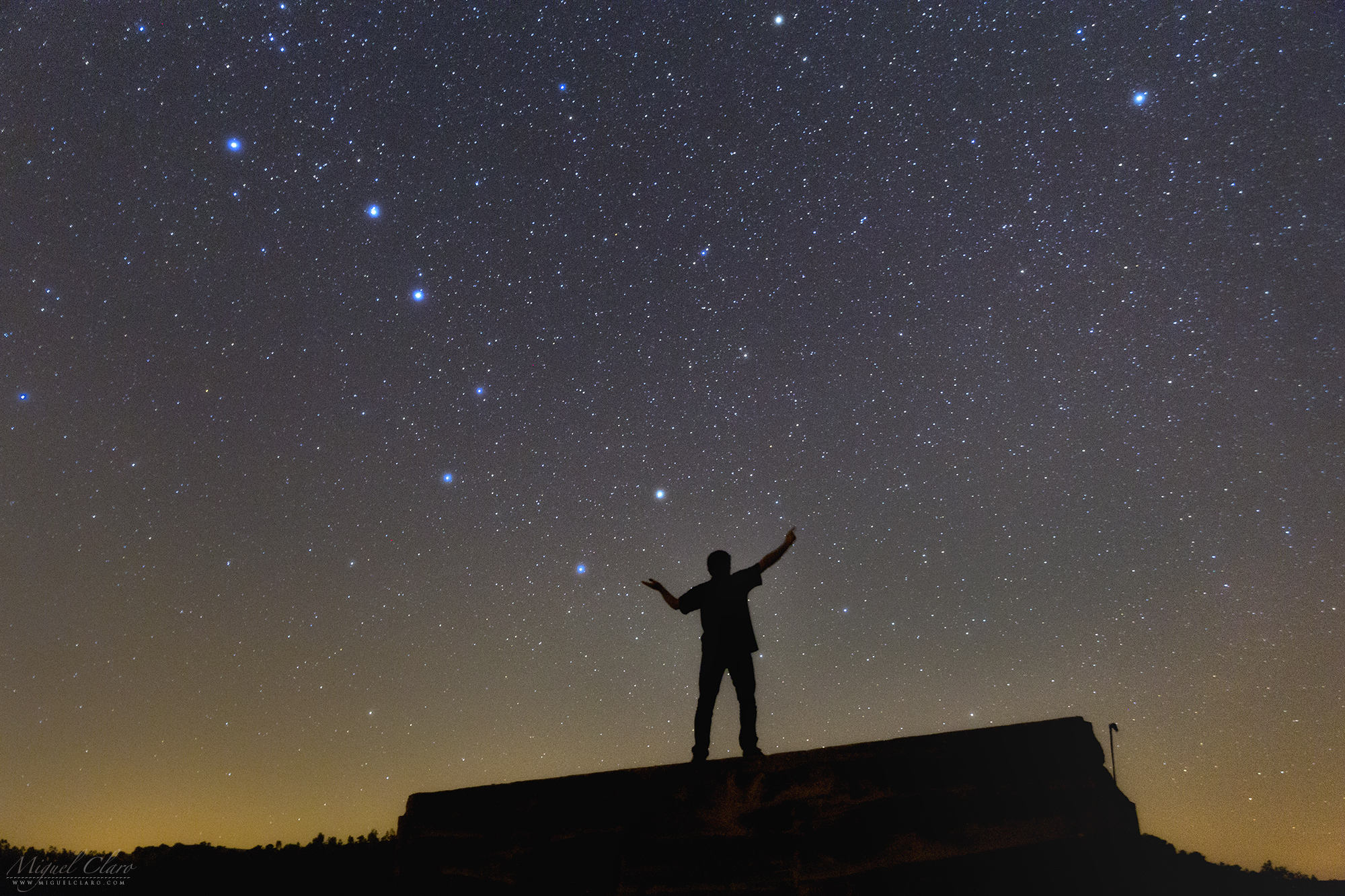
A night scene captured in Achada do Gamo, Dark Sky® Alqueva Mértola, shows the silhouette of a sky enthusiast that is trying to show us where to find Polaris, the Northern Star, and is not so hard. At left side are visible the colorful stars Alkaid, Mizar-Alcor, Alioth, Megrez, Phecda, Merak and Dubhe, the main stars that are composing the constellation of Ursa Major, also known as the Great Bear. Probably is the easiest constellation recognisable in night time and used as a starting point, from beginners to experienced stargazers, to help localize and identify the Northern Star. To find Polaris, use the so-called “Pointer” stars in the bowl of the Big Dipper, Merak and Dubhe. The left hand of the stargazer is pointing to Merak, then just draw an imaginary line between these two stars and extend it out for about 5 times, and you will end up in Polaris, located in the upper right corner of the image.
Milky Way Rising Over Noudar Park

The image and short time lapse clip shows the Milky Way rising over Noudar Park, in Alqueva Dark Sky® Reserve, Portugal.
PT: A Na imagem acima é possível ver o nascer da Via Láctea por detrás da paisagem do Parque de Natureza de Noudar.
An Eclipsed Moon with Mars, Milky Way with Saturn, and a Satellite near Jupiter

Captured 15 minutes after the end of totality during the longest Total Lunar Eclipse of the Century, the scene shows the bright light of a partially eclipsed Moon very close to the red planet Mars. With the galactic core featuring planet Saturn above Sagittarius, the Milky Way is well visible crossing the center of the picture, while above its arched shape, a flare from Satellite FORMOSAT-2 (ROCSAT 2) showed up high in the sky not faraway – in this wide angle view – from the bright light of planet Jupiter, seen near the right edge of the photo. This single shot was captured from Campinho, Dark Sky® Alqueva, Portugal.
PT: Captada 15 minutos após o final da totalidade durante o mais longo Eclipse Lunar Total do Século, a imagem mostra a luz brilhante de uma Lua parcialmente eclipsada muito próxima do planeta vermelho, Marte. Com o planeta Saturno no centro galáctico, a Via Láctea arqueada cruza o centro da imagem à medida que um flare do Satélite FORMOSAT-2 (ROCSAT 2) se trona visível por instantes, bem alto no céu. Por fim, à direita deste e já próximo do extremo da foto, é possível ver a luz brilhante do planeta Júpiter. Este disparo único foi captado no Campinho, Dark Sky® Alqueva, Portugal.
Visible Corona during the Partial Phase of the Total Lunar Eclipse
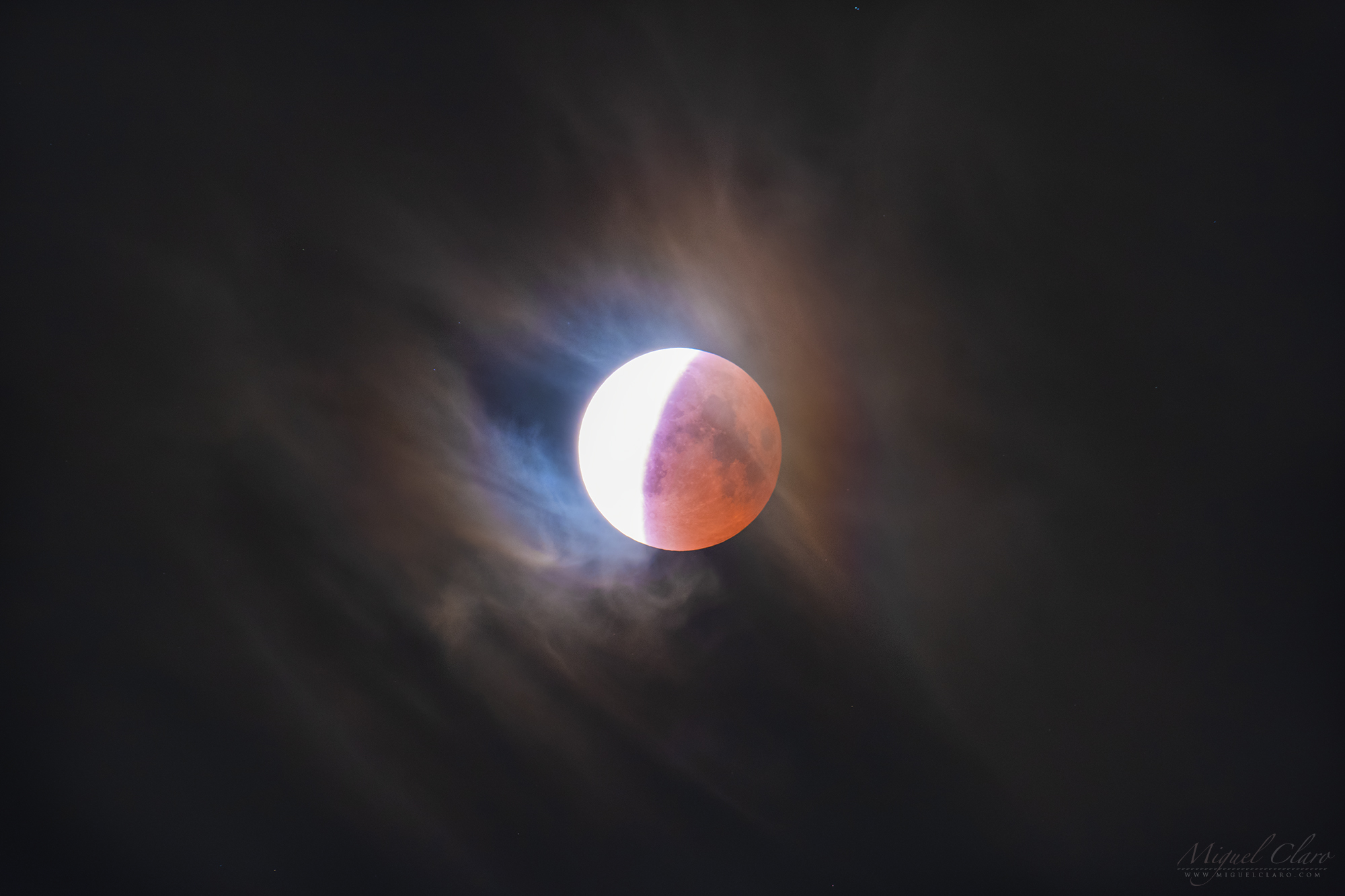
Sequence of the partial ending phase of the longest Total Lunar Eclipse of the Century, where during a few seconds some iridescent clouds and a short Lunar Corona around the eclipsed disk of the moon showed up, due to a short presence of passing clouds. While the partial phase is moving forward, we can also see the intense light of the sun catching and hiding the well known Tycho Crater.
PT: Sequência da fase final parcial do mais longo Eclipse Lunar Total do Século, onde durante alguns segundos apareceram algumas nuvens iridescentes formando uma Corona Lunar ao redor do disco eclipsado da lua. Estas formações ocorrem devido à presença de uma camada fina de nuvens que contém normalmente micro cristais de gelo que refractam a luz de Lua. Enquanto a fase parcial avança na sequência Time Lapse, também podemos ver a intensa luz solar que vai ocultando por sobre exposição a conhecida cratera Tycho.
Total Lunar Eclipse in the Twilight

The image shows a sequence of the red path left behind by the Moon during the longest Total Lunar Eclipse of the Century, as seen from Campinho, Dark Sky® Alqueva, Portugal, few minutes after the Moonrise and against a blue Twilight background. During a lunar eclipse, the moon passes through Earth’s shadow, giving the natural satellite a blood-red hue.

PT: A imagem mostra uma sequência do rasto vermelho deixado pela Lua durante o mais longo Eclipse Lunar Total do Século, captado a partir do Campinho, Dark Sky® Alqueva, Portugal, poucos minutos após o nascer da Lua e contra um fundo azul de Crepúsculo. Durante um eclipse lunar, a lua passa pela sombra da Terra, dando ao nosso satélite natural uma tonalidade vermelho-sangue.
Red Worlds – Moon and Mars Aligned Together During Total Lunar Eclipse

Only separated by approximately 6º apart, the red-orange planet Mars didn´t want to miss the “Red Celestial Party ” standing very close to the Moon during the longest Total Lunar Eclipse of the Century – 27th July 2018 – as seen from Dark Sky® Alqueva region in Portugal, this mosaic shows both in the same field of view. During a lunar eclipse, the moon passes through Earth’s shadow, giving the natural satellite a blood-red hue. With Mars making its closest approach in 15 years. The Red planet was also in opposition to the sun on this same night of the Lunar Eclipse, July 27, meaning being in opposite the sun in Earth’s sky, only 51 days before it passes through perihelion — its closest point relative to the sun in its orbit.
PT: Apenas separados por cerca de 6º um do outro, o planeta vermelho Marte não podia deixar de perder este “Evento Celestial” deixando-se ficar muito próximo da Lua durante o mais longo Eclipse Lunar Total do Século, em 27 de julho de 2018, visto do Dark Sky ® Alqueva, em Portugal. Durante um eclipse lunar, a lua passa pelo cone de sombra da Terra, dando ao satélite natural uma tonalidade vermelho-sangue.
The Longest Total Lunar Eclipse of the Century as seen from Portugal

The image shows a close-up view of a red dark Moon taken with a telephoto lens during the longest Total Lunar Eclipse of the Century, on 27th July 2018, as seen from Dark Sky® Alqueva region in Portugal. During a lunar eclipse, the moon passes through Earth’s shadow, giving the natural satellite a blood-red hue. The image was capture few minutes after the end of occultation of the star HD195157 in Capricornus. With a visual magnitude of +8.93 it can be seen very close to the right limb of the moon (look at 3 o´clock).
PT: A imagem mostra um close-up de uma lua cheia vermelha e escurecida, captada com teleobjetiva durante o mais longo Eclipse Total Lunar deste Século, ocorrido a 27 de julho de 2018, visto a partir do Dark Sky® Alqueva, em Portugal. Durante um eclipse lunar, a lua passa pela sombra da Terra, dando ao nosso satélite natural uma tonalidade vermelho-sangue. A imagem foi captada alguns minutos após o fim da ocultação da estrela HD195157 em Capricórnio. Com uma magnitude visual de +8,93, pode ser vista muito perto do limbo direito da lua.
A Golden Meteor

When spending a few nights enjoying the wonders of a starry sky you can suddenly be surprised with a sporadic meteor. You can make a wish, or simply scream “wooow” and smile to the sky above. The image shows a bright gold one captured in a single frame taken in Noudar Park, Alqueva Dark Sky® Reserve, from a total sequence of shots of about 4h. At the right side of the tree, a faint white light from the Milky Way is also visible.
PT: Ao passarmos algumas noites desfrutando das maravilhas de um céu estrelado, por vezes podemos ser repentinamente surpreendidos com um meteoro esporádico brilhante. A imagem mostra assim um desses momentos, em que um brilhante meteoro dourado foi captado num single frame obtido no Parque de Natureza de Noudar, Reserva Dark Sky® Alqueva, a partir de uma sequência total de disparos de cerca de 4 horas. Em pano de fundo e à direita da árvore, é ainda visível a suave presença esbranquiçada da Via Láctea.
Andromeda Galaxy Shinning above the Landscape

The photo shows a single shot made with a tracking mount of the entire Andromeda constellation rising above a puddle of acid water from Achada do Gamo. Andromeda Galaxy M31 stands very well visible and aligned between two chimneys from the century old mine of São Domingos, in Dark Sky® Alqueva – Mértola, highlighted against a faint greenish background from a thin band of airglow. With approximately 4 times the angular size of the full moon as seen from Earth, the great spiral galaxy Andromeda is at a mere 2.5 million light-years distant from us, being the closest large spiral to our own Milky Way. In really dark places we can clearly distinguish this naked eye galaxy, but how to find it? Start to identify the star Alpheratz, as the constellation Andromeda begins here, then follow down two stars and we will end up on Mirach. You should see two stars stacked one on top of each other, are they Mirach and Mu Andromedae. If you draw a line through the two stars and extend it past Mu Andromedae star, you should run into the Andromeda galaxy, which is located at about the same distance that separates this last two stars mentioned, being Mu Andromedae much dimmer than Mirach star. Very close to Andromeda galaxy is also visible an even week star called Nu Andromedae. The annotated version that can be found below, also shows galaxy M33 and the well known double cluster in Perseus.
PT: Nesta foto captada numa única exposição com seguimento, é possível ver toda a constelação de Andromeda enquanto nasce acima das águas ácidas da Achada do Gamo. A galáxia de Andromeda M31 está assim bem visível e alinhada entre as duas chaminés da centenária Mina de São Domingos, no Dark Sky® Alqueva – Mértola, destacando-se contra um fundo esverdeado proveniente de uma fina faixa de airglow (luminescência foto-química). Com aproximadamente 4 vezes o tamanho angular da Lua Cheia quando vista a partir da Terra, a grande galáxia espiral de Andromeda está a meros 2,5 milhões de anos-luz de nós, sendo a maior galáxia espiral próxima à nossa Via Láctea. Em lugares realmente escuros, podemos distinguir claramente esta galáxia a olho nu, mas como localizá-la no céu? Comece por identificar a estrela Alpheratz onde se inicia a constelação de Andromeda, depois siga duas estrelas até chegar a Mirach. A partir daqui deve ver duas estrelas que parecem estar uma por cima da outra, são elas Mirach e Mu Andromedae. Se traçar uma linha imaginária através destas duas estrelas e estender à estrela de Mu Andromedae, deverá se deparar com a galáxia de Andromeda, que está assim localizada sensivelmente à mesma distância que separa estas duas últimas estrelas mencionadas, sendo Mu Andromedae de brilho muito mais fraco que a estrela Mirach. Muito perto da galáxia de Andromeda encontra-se ainda uma estrela mais fraca de nome Nu Andromedae. A versão da imagem com legenda pode ser encontrada abaixo, e também mostra a galáxia M33 e o conhecido Duplo Enxame de Estrelas do Perseus.

A Colorful Universe Revealed in the Earth Motion

When we first look at the night sky, we can not distinguish the color of each star with our own eyes, although, if we record in a long exposure sequence the path of each star, due to the motion of rotating Earth and consequently the rotation of celestial sphere, a starry trailed sky can reveal much of our colorful Universe. In the image above, captured in Noudar Park, Alqueva Dark Sky® Reserve, Portugal, we can see a lot of different color paths, like: blue, white, yellow or even orange. Each color is directly related to the type and temperature of each star. The hottest stars, are showing a blue color, but in opposition the coolest, can reveal an orange-reddish color.
In astronomy, stellar classification is the classification of stars based on their spectral characteristics. Electromagnetic radiation from the star is analyzed by splitting it with a prism or diffraction grating into a spectrum exhibiting the rainbow of colors interspersed with absorption lines. Each line indicates an ion of a certain chemical element, with the line strength indicating the abundance of that ion. The relative abundance of the different ions varies with the temperature of the photosphere. The spectral class of a star is a short code summarizing the ionization state, giving an objective measure of the photosphere’s temperature and density.
Most stars are currently classified under the Morgan–Keenan (MK) system using the letters O, B, A, F, G, K, and M, a sequence from the hottest (O type – blue stars) to the coolest (M type – red stars). Each letter class is then subdivided using a numeric digit with 0 being hottest and 9 being coolest (e.g. A8, A9, F0, F1 form a sequence from hotter to cooler). The sequence has been expanded with classes for other stars and star-like objects that do not fit in the classical system, such as class D for white dwarfs and class C for carbon stars.
In the MK system, a luminosity class is added to the spectral class using Roman numerals. This is based on the width of certain absorption lines in the star’s spectrum, which vary with the density of the atmosphere and so distinguish giant stars from dwarfs. Luminosity class 0 or Ia+ stars for hypergiants, class I stars for supergiants, class II for bright giants, class III for regular giants, class IV for sub-giants, class V for main-sequence stars, class sd for sub-dwarfs, and class D for white dwarfs. The full spectral class for the Sun is then G2V, indicating a main-sequence star with a temperature around 5,800 K. Source and more info: click here.
PT: Quando de noite olhamos para o céu não conseguimos percepcionar com os nossos próprios olhos a cor de cada estrela, no entanto, se registarmos numa sequência de longa exposição o rasto de cada estrela, devido ao movimento de rotação da Terra e à consequente rotação da esfera celeste, uma imagem startrail poderá revelar um Universo colorido e rico em informação. Na imagem acima captada no Parque de Natureza de Noudar, Reserva Dark Sky® Alqueva, em Barrancos, podemos ver uma grande diversidade de cores desde o azul, ao amarelo, branco ou laranja. Cada cor está directamente relacionada com o tipo e temperatura de cada estrela. Algumas delas são mais quentes e por isso apresentam uma cor mais azulada, outras por sua vez são mais frias apresentando uma cor mais alaranjada.
A Spring Milky Way above Campinho

The image shows the Arch of Milky Way as seen during a Spring night in the Northern Hemisphere, Campinho, in Dark Sky® Alqueva Reserve. High in the sky, we can see a “blue bright” star with an apparent magnitude of 0,0 called Vega, serving as a middle reference in the magnitude system chart created for the first time in 150 B.C.E, by the greek astronomer Hipparchus. Vega, from Lyra constellation, is forming an asterism well know as the “Summer Triangle” with stars Deneb (from Cygnus) and Altair (from Aquila). At the right center of the picture, planet Mars and Saturn are shinning near the core of the Galaxy. Following the same line we can find the red supergiant star Antares, from Scorpius constellations, and the bright planet Jupiter. Above the horizon is visible a mix of yellow/greenish airglow with the lights from Aldeia da Luz, and below, a water mirror from the largest manmade lake in Europa, The Great Lake Alqueva.
PT: A imagem mostra o Arco da Via Láctea como visto durante uma noite de primavera no Hemisfério Norte, na região do Campinho, Reserva Dark Sky® Alqueva. No alto do céu, é possível ver uma estrela azulada e brilhante com uma magnitude aparente de 0.0, de nome Vega. Serve como uma referência intermédia na tabela do sistema de magnitudes criado pela primeira vez no 150 A.C, pelo astrónomo grego Hiparco. Vega, da constelação de Lyra, forma um asterismo conhecido como o “Triângulo de Verão” com as estrelas Deneb (Cisne) e Altair (da Águia). No centro direito da imagem, o planeta Marte e Saturno brilham perto do centro da galáxia. Seguindo a mesma linha, podemos encontrar a estrela supergigante vermelha Antares, da constelações do Escorpião, terminando no extremo direito da imagem com o brilho intenso do planeta Júpiter. Um pouco acima do horizonte é visível uma tonalidade de amarelo/esverdeado proveniente da subtil presença de airglow (Luminescência Foto-química) que se mistura ainda com algumas luzes da Aldeia da Luz, já bem junto ao horizonte deste panorama. Logo abaixo, o enorme espelho de água do maior lago artificial da Europa Ocidental, o Grande Lago Alqueva, reflecte assim algumas das estrelas que salpicam o firmamento do Dark Sky® Alqueva.
Flying above Moretus Crater

This lunar landscape scene, captured from Cumeada Observatory, headquarter of Dark Sky Alqueva reserve, shows in detail the lunar impact crater of Moretus (located at left), with a diameter of 114km. Due to the location near the lunar limb, the crater appears oblong because of foreshortening. The rim of the crater has a wide, terraced inner wall, and a complex outer rampart. The floor has been partly resurfaced and is relatively flat. In the middle is a central mountain formation that rises about 2.1 kilometers above the surrounding floor.
PT: Um cenário de paisagem lunar, captado a partir do Observatório da Cumeada, sede da reserva Dark Sky Alqueva, mostra em detalhe a cratera de impacto lunar Moretus (localizada à esquerda), com um diâmetro de 114km. Devido à localização perto do limbo lunar, a cratera parece oblonga por causa do escorço. A borda da cratera tem uma parede interna ampla, com pequenos terraços e uma muralha externa complexa. O piso foi parcialmente ressurgido e é relativamente plano. No centro está uma formação montanhosa que se eleva cerca de 2,1km acima do piso ao redor.
Technical details | Detalhes Técnicos
Camera ASI174MC | Celestron C14 EDGE HD (XLT)| Barlow 2x Televue Powermate | Sum of 200 frames. Processing on AutoStakkert, Registax 6 and Photoshop CC. Cumeada Observatory from Dark Sky® Alqueva Reserve, Reguengos de Monsaraz.
Flying over the Moon Crater Aristoteles and Rimae of Theaetetus

This lunar landscape scene, captured from Cumeada Observatory, headquarter of Dark Sky Alqueva reserve, shows in detail the lunar impact crater of Aristoteles (upper left corner), with a diameter of 87,6km, and below it, the crater of Eudoxus, with a diameter of 70,2km. Almost centred is visible the Cassini crater with 56,4,km that includes two small craters, featuring Cassini A and Cassini B, with respectively 15km, and only 9km in diameter. From the bottom center to the low edge of the image, are visible two main rilles, the Rima Calippus with a lenght of 20km and Rimae of Theaetetus, with a length of 25km. On the right side, we can also see another two large craters, Aristillus with a diameter of 55km, and below it, the crater of Autolycus with 38,9km.
PT: Um cenário de paisagem lunar, captado a partir do Observatório da Cumeada, sede da reserva Dark Sky® Alqueva, mostra em detalhe a cratera de impacto lunar de Aristoteles (canto superior esquerdo), com um diâmetro de 87,6km, e abaixo desta, a cratera de Eudoxus, com um diâmetro de 70,2km. Quase ao centro, é visível a cratera Cassini com 56,4 km, que inclui duas pequenas crateras, a Cassini A e Cassini B, com respectivamente 15km e apenas 9km de diâmetro. Do centro inferior ao extremo inferior da imagem, são visíveis dois canais principais, o Rima Calippus com um comprimento de 20 km e Rimae de Theaetetus, com um comprimento de 25 km. No lado direito, também podemos ver outras duas grandes crateras, Aristillus com um diâmetro de 55 km, e abaixo dela, a cratera de Autolycus com 38,9 km.

Technical details | Detalhes Técnicos
Camera ASI174MC | Celestron C14 EDGE HD (XLT)| Barlow 2x Televue Powermate | Sum of 200 frames. Processing on AutoStakkert, Registax 6 and Photoshop CC. Cumeada Observatory from Dark Sky® Alqueva Reserve, Reguengos de Monsaraz.
Planet Jupiter and the Great Red Spot

Planet Jupiter and the Great Red Spot (GRP) visible in the right side of the Jovian disc, as seen in February 23, from Cumeada Observatory, headquarters of Dark Sky® Alqueva Reserve, Portugal.
PT: O planeta Júpiter e a Grande Mancha Vermelha (GRS) visível no lado direito do disco Joviano no passado dia 23 de Fevereiro, captado a partir do Observatório da Cumeada, sede da Reserva Dark Sky® Alqueva.
Technical details | Detalhes Técnicos
Camera ASI174MC | Celestron C14 EDGE HD (XLT)| ZWO ADC | Barlow 2x Televue Powermate | Sum of 3000 frames. Processing on AutoStakkert, Registax 6 and Photoshop CC. Cumeada Observatory from Dark Sky® Alqueva Reserve, Reguengos de Monsaraz.
The Faint Arch of the Winter Milky Way above Pulo do Lobo

A night scene captured in Pulo do Lobo, Dark Sky® Alqueva Mértola, shows an arched path of faint light from the winter Milky Way full of deep sky objects visible as a pale diffuse red/violet colors. From left to right, we can find Sirius, the brightest star in the entire celestial sphere and at the right side, the reddish emission coming from Rosette and Orion Nebula, with Lambda Orionis, Barnard´s Loop, Horse Head and M42 visible. In center of the image, Hyades open cluster are close to Pleiades, , or the seven sisters, a small group of bright blueish stars. Immediately above Pleiades, we can find California nebula, a red emission nebula like Heart and Soul nebula, located further right following the path of light of Milky Way arm. Pulo do Lobo is the most dramatic stretch of Guadiana River, located about 18 kms north of Mértola, where the Guadiana river bed is reduced to a narrow strait a few meters wide, followed by a small waterfall with about 4m high. The margins on this site are tall and stony, and so tight that they have given rise to a legend that says that a wolf in hunting could transports them in a jump.
PT: Uma cena nocturna captada no Pulo do Lobo, Dark Sky® Alqueva Mértola, mostra o caminho arqueado e ténue da Via Láctea invernal, cheia de objectos do céu profundo, visíveis com tonalidades difusas vermelho/violeta. Da esquerda para a direita, podemos encontrar Sirius, a estrela mais brilhante em toda a esfera celeste, seguindo-se a emissão avermelhada proveniente da nebulosa da Roseta e de Orion, onde ainda se destacam alguns objectos como Lambda Orionis, Barnard´s Loop, Horse Head e M42.No centro da imagem, o aglomerado aberto de Hyades fica perto das Pleiades, ou as popularmente designadas Sete Irmãs, um pequeno grupo de estrelas jovens e brilhantes de tonalidade azulada por ainda se encontrarem muito quentes. Imediatamente acima das Pleiades, podemos encontrar a nebulosa da Califórnia, uma nebulosa de emissão vermelha como a nebulosa do Coração e da Alma, localizada mais adiante, seguindo o caminho da luz do braço da Via Láctea. O Pulo do Lobo é o mais dramático trecho do rio Guadiana, situado a cerca de 18 kms a Norte de Mértola, onde o leito do rio Guadiana fica reduzido a um estreito rápido com poucos metros de largura, seguido de uma pequena queda de água com cerca de 4m de altura. As margens neste local apresentam-se altas e pedregosas, e tão apertadas que deram origem a uma lenda que afirma que um lobo em caça as transpõe em um salto.
Zodiacal Light and Winter Constellations above Pulo do Lobo

A night scene captured in Pulo do Lobo, Dark Sky® Alqueva Mértola, shows a view of the winter Milky Way full of deep sky objects shinning bright with a diffuse red/violet colors. From top right corner to the bottom, we can find California nebula and Pleiades, a bright blueish star cluster, while below is visible all the reddish emission coming from Orion, with Lambda Orionis, Barnard´s Loop, Horse Head and M42 nebulae surrounding the main brightest stars of Orion constellation. At the left side not far away from Orion, a violet emission is shinning from Rosette nebula. At left edge of the image and above the horizon is visible a faint white light that seems to point to Beehive star cluster, known as Zodiacal light, is the sunlight scattered by interplanetary dust. Most of this dust is orbiting the Sun in about the ecliptic plane.
Pulo do Lobo is the most dramatic stretch of Guadiana River, located about 18 kms north of Mértola, where the Guadiana river bed is reduced to a narrow strait a few meters wide, followed by a small waterfall with about 4m high. The margins on this site are tall and stony, and so tight that they have given rise to a legend that says that a wolf in hunting could transports them in a jump.
PT: Este cenário nocturno captado no Pulo do Lobo, na Reserva Dark Sky® Alqueva Mértola, mostra uma visão da Via Láctea de inverno repleta de objectos do céu profundo que se destacam com tonalidades difusas vermelho/violeta ao longo do caminho descrito pela nossa galáxia. Do topo direito em direcção ao horizonte, é possível ver a Nebulosa da Califórnia e à direita as Pleiades, um aglomerado estelar azul brilhante. Logo abaixo é visível toda a emissão avermelhada proveniente de Orion, com diversos objectos como Lambda Orionis, Barnard´s Loop, Horse Head e a nebulosa M42 circundando as principais estrelas brilhantes da constelação de Orion. No lado esquerdo, não longe de Orion, a nebulosa da Roseta é visível como uma emissão violeta brilhante. No extremo esquerdo da imagem e logo acima do horizonte, uma fraca emissão esbranquiçada que parece incidir na direcção do aglomerado estelar Beehive, é conhecida como a Luz Zodiacal. Trata-se da luz solar dispersa pela poeira interplanetária. A maior parte dessa poeira está orbitando o Sol em torno do plano eclíptico.
O Pulo do Lobo é o mais dramático trecho do rio Guadiana, situado a cerca de 18 kms a Norte de Mértola, onde o leito do rio Guadiana fica reduzido a um estreito rápido com poucos metros de largura, seguido de uma pequena queda de água com cerca de 4m de altura. As margens neste local apresentam-se altas e pedregosas, e tão apertadas que deram origem a uma lenda que afirma que um lobo em caça as transpõe em um salto.
A Strong Gegenschein Between the Winter Constellations

A night scene captured in Pulo do Lobo, Dark Sky® Alqueva Mértola, shows a path of light from the winter Milky Way full of bright stars like the ones that are composing the constellations of Orion. Above the horizon, Sirius is the brightest star that dominates the night, but due to the little presence of haze, stars like Pollux and Castor from Gemini constellation are also showing their beautiful natural colors. But between Procyon, Castor and Betelgeuse, near the Zenith spotted in the center of the image, is noticeable a rare and faint white light known as Gegenschein, that is a faint brightening of the night sky in the region of the antisolar point. like the zodiacal light, the gegenschein is sunlight scattered by interplanetary dust. Most of this dust is orbiting the Sun in about the ecliptic plane. It is distinguished from zodiacal light by its high angle of reflection of the incident sunlight on the dust particles.
PT: Uma cena nocturna captada no Pulo do Lobo, Dark Sky® Alqueva Mértola, mostra o ténue caminho de luz da Via Láctea invernal repleto de estrelas brilhantes como as que compõem as constelações de Orion. Acima do horizonte, Sirius é a estrela mais brilhante que domina a noite, mas devido à pequena presença de neblina, estrelas como Pollux e Castor da constelação de Gémeos também mostram suas lindas cores naturais. No entanto, entre Procyon, Castor e Betelgeuse, perto do Zénite, localizado no centro da imagem, é possível percepcionar uma luz branca rara e fraca, conhecida como Gegenschein, que é um leve brilho do céu noturno na região do ponto antissolar. Tal como a luz Zodiacal, a Gegenschein é a luz solar espalhada pelo poeira interplanetária. A maior parte desta poeira está orbitando o Sol em aproximadamente o plano da Eclíptica. Distingue-se da luz Zodiacal pelo seu alto ângulo de reflexão da luz solar incidente sobre as partículas de poeira.
A Panorama of the Deep Sky Objects in the Winter Milky Way above Pulo do Lobo

A vertical panorama captured in Pulo do Lobo, Dark Sky® Alqueva Mértola, shows the path of the winter Milky Way full of deep sky objects visible as a colorful diffuse red/violet colors. Above the horizon, we can find Sirius, the brightest star in the entire celestial sphere and immediately above, the reddish emission coming from Rosette and Orion Nebula, with Lambda Orionis, Barnard´s Loop, Horse Head and M42 visible. Following to the right center of the image, Hyades open cluster are close to Pleiades, or the seven sisters, a small group of bright blueish stars. Going further high on the image, we can find California nebula, and in the way to the top, we can find the red emission from Heart and Soul nebula, finishing in the right top corner with the diffuse elipse shape from Andromeda galaxy. Pulo do Lobo is the most dramatic stretch of Guadiana River, located about 18 kms north of Mértola, where the Guadiana river bed is reduced to a narrow strait a few meters wide, followed by a small waterfall with about 4m high. The margins on this site are tall and stony, and so tight that they have given rise to a legend that says that a wolf in hunting could transports them in a jump.
PT: Um panorama vertical composto por single shots sem qualquer tracking captados no Pulo do Lobo, no Dark Sky® Alqueva Mértola, mostra a trajetória da Via Láctea invernal, repleta de objetos do céu profundo, visíveis como cores vermelhas / violetas difusas. Acima do horizonte, podemos encontrar Sirius, a estrela mais brilhante em toda a esfera celeste e imediatamente acima, a emissão avermelhada vinda da Nebulosa Rosette e Orion, com Lambda Orionis, Barnard´s Loop, Horse Head e M42 visíveis. Seguindo para o centro direito da imagem, o aglomerado aberto de Hyades fica próximo das do enxame aberto das Pleiades, ou das sete irmãs, um pequeno grupo de estrelas azuladas brilhantes. Seguindo mais alto na imagem, podemos encontrar a nebulosa da Califórnia, e no caminho para o extremo superior, podemos encontrar a emissão vermelha da nebulosa Heart & Soul, terminando no canto superior direito com a presença de uma luz difusa em forma de elipse, proveniente da galáxia de Andrómeda. O Pulo do Lobo é o troço mais dramático do rio Guadiana, localizado a cerca de 18 kms a norte de Mértola, onde o leito do rio Guadiana é reduzido a um estreito de poucos metros de largura, seguido de uma pequena cascata com cerca de 4m de altura. As margens deste local são altas e pedregosas, e tão estreitas que deram origem a uma lenda que diz que um lobo em caça poderia transpô-las em um único salto.
Big Dipper, Red Airglow and Milky Way in a Panoramic view from Mértola

A panoramic view from Mértola, Dark Sky® Alqueva, shows a celestial scene captured in a night where the presence of a reddish-yellow airglow was very active. In the background, the well know asterism from Big Dipper or Ursa Major, is shinning at the left edge, while in the opposite direction of the image a faint light from the Milky Way is visible behind the layer of airglow. Sirius, the brightest star in the entire celestial sphere is well spotted and above it – in the right top corner – the H-alfa emission coming from Rosette and Orion Nebula are noticeable in red, with Lambda Orionis, Barnard´s Loop, Horse Head and M42 well visible. Below, a partial path of Guadiana river is reflecting the color of the sky.
All Sky – Light Trails in Pulo do Lobo

A fish-eye “full dome” scene captured in Pulo do Lobo, Dark Sky® Alqueva Mértola, shows a starry sky trailed in a long exposure sequence with some bright and colourful light trails from the winter constellations that are surrounding Polaris, the northern star, remembering us that Earth Rotation never stops. In the landscape is visible a dramatic stretch of Guadiana River located about 18 kms north of Mértola, where the Guadiana river bed is reduced to a narrow strait a few meters wide, followed by a small waterfall with about 4m high. The margins on this site are tall and stony, and so tight that they have given rise to a legend that says that a wolf in hunting could transports them in a jump.
PT: Uma visão fish-eye “full-dome” de 180º captada no Pulo do Lobo, Dark Sky® Alqueva Mértola, mostra os rastos de estrelas brilhantes e coloridas das constelações de inverno que circundam a estrela Polar. Em baixo, a paisagem revela o mais dramático trecho do rio Guadiana, situado a cerca de 18 kms a Norte de Mértola, onde o leito do rio Guadiana fica reduzido a um estreito rápido com poucos metros de largura, seguido de uma pequena queda de água com cerca de 4m de altura. As margens neste local apresentam-se altas e pedregosas, e tão apertadas que deram origem a uma lenda que afirma que um lobo em caça as transpõe em um salto.
A Portrait Startrail above Pulo do Lobo

A scene captured in Pulo do Lobo, Dark Sky® Alqueva Mértola, shows a starry sky trailed in a long exposure sequence with some colourful light trails shinning bright, from the winter constellations like Orion while in the background a faint path of light from Milky Way is still noticeable. In the landscape is visible a dramatic stretch of Guadiana River located about 18 kms north of Mértola, where the Guadiana river bed is reduced to a narrow strait a few meters wide, followed by a small waterfall with about 4m high. The margins on this site are tall and stony, and so tight that they have given rise to a legend that says that a wolf in hunting could transports them in a jump. A faint reflection of the Milky Way seems to be visible in the water.
PT: Um cenário nocturno captado no Pulo do Lobo, Dark Sky® Alqueva Mértola, mostra os rastos de estrelas brilhantes e coloridas das constelações de inverno como Orion, enquanto em pano de fundo, ainda é possível percepcionar a ténue presença arrastada da Via láctea. Em baixo, a paisagem revela o mais dramático trecho do rio Guadiana, situado a cerca de 18 kms a Norte de Mértola, onde o leito do rio Guadiana fica reduzido a um estreito rápido com poucos metros de largura, seguido de uma pequena queda de água com cerca de 4m de altura. As margens neste local apresentam-se altas e pedregosas, e tão apertadas que deram origem a uma lenda que afirma que um lobo em caça as transpõe em um salto. O suave reflexo da Via Láctea parece ainda perceptível no espelho de água.
All Sky View – A Winter Milky Way Crossing the Zenith from Pulo do Lobo

A fish-eye “full dome” scene captured in Pulo do Lobo, Dark Sky® Alqueva Mértola, shows the faint path of light from the winter Milky Way crossing the sky near the zenith, above the most dramatic stretch of Guadiana River, located about 18 kms north of Mértola, is where the Guadiana river bed is reduced to a narrow strait a few meters wide, followed by a small waterfall with about 4m high. The margins on this site are tall and stony, and so tight that they have given rise to a legend that says that a wolf in hunting could transports them in a jump.
PT: Uma visão fish-eye “full-dome” de 180º captada no Pulo do Lobo, Dark Sky® Alqueva Mértola, mostra o ténue caminho de luz da Via Láctea de inverno cruzando o Zénite, acima do mais dramático trecho do rio Guadiana, situado a cerca de 18 kms a Norte de Mértola, onde o leito do rio Guadiana fica reduzido a um estreito rápido com poucos metros de largura, seguido de uma pequena queda de água com cerca de 4m de altura. As margens neste local apresentam-se altas e pedregosas, e tão apertadas que deram origem a uma lenda que afirma que um lobo em caça as transpõe em um salto.
A Starry Trailed Sky above Pulo do Lobo Cascade

A scene captured in Pulo do Lobo, Dark Sky® Alqueva Mértola, shows a wide angle view of a starry sky trailed in a long exposure sequence with some bright and colourful light trails from the winter constellations, that are surrounding Polaris, the northern star. In the landscape is visible a dramatic stretch of Guadiana River located about 18 kms north of Mértola, where the Guadiana river bed is reduced to a narrow strait a few meters wide, followed by a small waterfall with about 4m high. The margins on this site are tall and stony, and so tight that they have given rise to a legend that says that a wolf in hunting could transports them in a jump.
PT: Uma visão grande-angular captada no Pulo do Lobo, Dark Sky® Alqueva Mértola, mostra-nos os rastos de estrelas brilhantes e coloridas das constelações de inverno que circundam a estrela Polar. Em baixo, a paisagem revela o mais dramático trecho do rio Guadiana, situado a cerca de 18 kms a Norte de Mértola, onde o leito do rio Guadiana fica reduzido a um estreito rápido com poucos metros de largura, seguido de uma pequena queda de água com cerca de 4m de altura. As margens neste local apresentam-se altas e pedregosas, e tão apertadas que deram origem a uma lenda que afirma que um lobo em caça as transpõe em um salto.
A Vortex of Light from the Winter Sky

A fish-eye “full dome” scene captured in Pulo do Lobo, Dark Sky® Alqueva Mértola, shows a starry sky trailed in a long exposure sequence with some bright and colourful light trails from the winter constellations that are surrounding Polaris, the northern star, remembering us that Earth Rotation never stops. In the landscape is visible a dramatic stretch of Guadiana River located about 18 kms north of Mértola, where the Guadiana river bed is reduced to a narrow strait a few meters wide, followed by a small waterfall with about 4m high. The margins on this site are tall and stony, and so tight that they have given rise to a legend that says that a wolf in hunting could transports them in a jump.
PT: Uma visão fish-eye “full-dome” de 180º captada no Pulo do Lobo, Dark Sky® Alqueva Mértola, mostra os rastos de estrelas brilhantes e coloridas das constelações de inverno que circundam a estrela Polar. Em baixo, a paisagem revela o mais dramático trecho do rio Guadiana, situado a cerca de 18 kms a Norte de Mértola, onde o leito do rio Guadiana fica reduzido a um estreito rápido com poucos metros de largura, seguido de uma pequena queda de água com cerca de 4m de altura. As margens neste local apresentam-se altas e pedregosas, e tão apertadas que deram origem a uma lenda que afirma que um lobo em caça as transpõe em um salto.
A Portrait of the Winter Milky Way above Pulo do Lobo

A night scene captured in Pulo do Lobo, Dark Sky® Alqueva Mértola, shows a path of faint light from the winter Milky Way full of deep sky objects visible as a diffuse red/violet colors. From left to right, we can find Sirius, the brightest star in the entire celestial sphere and above it, the reddish emission coming from Rosette and Orion Nebula, with Lambda Orionis, Barnard´s Loop, Horse Head and M42 visible. In the top right edge of image, California nebula is still visible and immediately below, the Pleiades star cluster, or the seven sisters, a small group of bright blueish stars.
Pulo do Lobo is the most dramatic stretch of Guadiana River, located about 18 kms north of Mértola, where the Guadiana river bed is reduced to a narrow strait a few meters wide, followed by a small waterfall with about 4m high. The margins on this site are tall and stony, and so tight that they have given rise to a legend that says that a wolf in hunting could transports them in a jump.
PT: Uma cena nocturna captada no Pulo do Lobo, Dark Sky® Alqueva Mértola, mostra o caminho ténue da Via Láctea invernal, cheia de objectos do céu profundo, visíveis com tonalidades difusas vermelho/violeta. Da esquerda para a direita, podemos encontrar Sirius, a estrela mais brilhante em toda a esfera celeste e acima dela, a emissão avermelhada proveniente da nebulosa da Roseta e de Orion, onde ainda se destacam alguns objectos como Lambda Orionis, Barnard´s Loop, Horse Head e M42. No canto superior direito da imagem, a nebulosa da Califórnia ainda é visível e logo abaixo, o aglomerado estelar das Pleiades, ou “Sete Irmãs”, um pequeno grupo de estrelas brilhantes e azuladas, por serem jovens.
O Pulo do Lobo é o mais dramático trecho do rio Guadiana, situado a cerca de 18 kms a Norte de Mértola, onde o leito do rio Guadiana fica reduzido a um estreito rápido com poucos metros de largura, seguido de uma pequena queda de água com cerca de 4m de altura. As margens neste local apresentam-se altas e pedregosas, e tão apertadas que deram origem a uma lenda que afirma que um lobo em caça as transpõe em um salto.
Full Dome View of Pulo do Lobo in a Winter Night

A fish-eye “full dome” scene captured in Pulo do Lobo, Dark Sky® Alqueva Mértola, shows the faint path of light from the winter Milky Way above the most dramatic stretch of Guadiana River, located about 18 kms north of Mértola, is where the Guadiana river bed is reduced to a narrow strait a few meters wide, followed by a small waterfall with about 4m high. The margins on this site are tall and stony, and so tight that they have given rise to a legend that says that a wolf in hunting could transports them in a jump.
PT: Uma visão fish-eye “full-dome” de 180º captada no Pulo do Lobo, Dark Sky® Alqueva Mértola, mostra o ténue caminho de luz da Via Láctea de inverno, acima do mais dramático trecho do rio Guadiana, situado a cerca de 18 kms a Norte de Mértola, onde o leito do rio Guadiana fica reduzido a um estreito rápido com poucos metros de largura, seguido de uma pequena queda de água com cerca de 4m de altura. As margens neste local apresentam-se altas e pedregosas, e tão apertadas que deram origem a uma lenda que afirma que um lobo em caça as transpõe em um salto.
A Startrail in Ursa Major

A scene captured in Pulo do Lobo, Dark Sky® Alqueva Mértola, shows a sky trailed in a long exposure sequence with some bright and colourful light trails in the region around Ursa Major, the Big Dipper. In the foreground is visible part of the landscape of Pulo do Lobo, the most dramatic stretch of Guadiana River, located about 18 kms north of Mértola, is where the Guadiana river bed is reduced to a narrow strait a few meters wide, followed by a small waterfall with about 4m high. The margins on this site are tall and stony, and so tight that they have given rise to a legend that says that a wolf in hunting could transports them in a jump..
PT: Uma visão captada no Pulo do Lobo, Dark Sky® Alqueva Mértola, mostra-nos os rastos de estrelas brilhantes e coloridas das constelações ao redor da Ursa Maior. Em primeiro plano, é visível parte da paisagem do Pulo do Lobo, o troço mais dramático do rio Guadiana. Localizado a cerca de 18 kms a norte de Mértola, é onde o leito do rio Guadiana é reduzido a um estreito de poucos metros de largura, seguido de uma pequena queda de água com cerca de 4m de altura. As margens deste local são altas e pedregosas, e tão estreitas que deram origem a uma lenda que diz que um lobo em caça poderia transpô-las em apenas um único salto.
The Colourful Constellation of Big Dipper above Pulo do Lobo

A night scene captured in Pulo do Lobo, Dark Sky® Alqueva Mértola, shows the brightest and colorful stars that are composing the well known asterism of Big Dipper or Ursa Major. Probably the easiest constellation recognisable in night time, are normally used as a starting point, from beginners to experienced stargazers, to help localize and identify the northern star, also known as Polaris. In the foreground is visible part of the landscape of Pulo do Lobo, the most dramatic stretch of Guadiana River, located about 18 kms north of Mértola, is where the Guadiana river bed is reduced to a narrow strait a few meters wide, followed by a small waterfall with about 4m high. The margins on this site are tall and stony, and so tight that they have given rise to a legend that says that a wolf in hunting could transports them in a jump.
A Full Moon above the Medieval Village of Monsaraz

April’s full moon is known as the Pink Moon, according to the Old Farmer’s Almanac. The name comes from pink flowers that bloom in the early spring, known as ground phlox. But this April Moon is particularly good to photograph, as the sun will share the sky for about 20 minutes after the moonrise, it will work as the perfect light that still illuminates the landscape, entire fields, or in my case, the beautiful medieval village and castle of Monsaraz, in Alqueva Dark Sky® Reserve, Portugal. To create this visual impact with the illusion that the Moon seems to be so big when compared with the objects on Earth, I just had to find the right spot located at a distant of about 3.7 km away from the castle. The result is a single shot captured with a 600mm lens.
PT: A Lua cheia de abril é conhecida como a Pink Moon, de acordo com o antigo Almanaque do Fazendeiro. O nome está relacionado com as flores cor-de-rosa que florescem no início da primavera, conhecida como “ground phlox”. Mas esta Lua de Abril é particularmente boa para fotografar, pois o sol ainda compartilha o mesmo céu durante cerca de 20 minutos, após o nascimento da lua, funcionando como a luz perfeita para iluminar a paisagem, os campos ou, no meu caso, a linda vila medieval e o castelo de Monsaraz, no Dark Sky® Alqueva, Portugal. Para criar este impacto visual e a ilusão óptica de que a Lua parece ser tão grande quando comparada com os objetos em Terra, apenas tive de encontrar o local certo localizado a uma distância de cerca de 3,7 km do castelo de Monsaraz. O resultado deste disparo único, foi captado com uma lente de 600 mm de distância focal.
A Black and White Moonrise above Monsaraz Village

A more “dramatic” Black and White view shows the April’s full moon also known as the Pink Moon, according to the Old Farmer’s Almanac. The name comes from pink flowers that bloom in the early spring, known as ground phlox. But this April Moon is particularly good to photograph, as the sun will share the sky for about 20 minutes after the moonrise, it will work as the perfect light that still illuminates the landscape, entire fields, or in my case, the beautiful medieval village and castle of Monsaraz, in Alqueva Dark Sky® Reserve, Portugal. To create this visual impact with the illusion that the Moon seems to be so big when compared with the objects on Earth, I just had to find the right spot located at a distant of about 3.7 km away from the castle. The result is a single shot captured with a 600mm lens.
PT: Nesta visão mais “dramática” a Preto e Branco, é possível apreciar a Lua cheia de abril, também conhecida como Pink Moon, de acordo com o antigo Almanaque do Fazendeiro. O nome está relacionado com as flores cor-de-rosa que florescem no início da primavera, conhecida como “ground phlox”. Mas esta Lua de Abril é particularmente boa para fotografar, pois o sol ainda compartilha o mesmo céu durante cerca de 20 minutos, após o nascimento da lua, funcionando como a luz perfeita para iluminar a paisagem, os campos ou, no meu caso, a linda vila medieval e o castelo de Monsaraz, no Dark Sky® Alqueva, Portugal. Para criar este impacto visual e a ilusão óptica de que a Lua parece ser tão grande quando comparada com os objetos em Terra, apenas tive de encontrar o local certo localizado a uma distância de cerca de 3,7 km do castelo de Monsaraz. O resultado deste disparo único, foi captado com uma lente de 600 mm de distância focal.
A Perfect Triangle between Moon, Pleiades and Venus

The photo shows a Crescent Moon with a visible earthshine immersed by the Hyades star cluster, and forming an almost perfect triangle of about 9 degrees, which seems to be aligned with Pleiades star cluster at right, and below, the bright planet Venus. In the foreground, the water of Alqueva lake is reflecting the beautiful colors from nautical twilight. The image was captured in Campinho village, near the headquarter of Dark Sky Alqueva Reserve.
PT: Na foto é possível ver uma Lua Crescente com um forte Earthshine imersa pelo aglomerado estelar de Hyades e formando um triângulo quase perfeito de cerca de 9 graus, que parece estar alinhado com o aglomerado de estrelas das Pleiades à direita, e logo abaixo o brilhante planeta Vénus. Em primeiro plano, a água do lago do Alqueva reflecte as lindas cores do crepúsculo náutico. A imagem foi captada na aldeia de Campinho, perto da sede da Reserva Dark Sky Alqueva.
A Galactic Tree Under the Stars

A path of light illuminates the foreground behind a dead tree that by illusion, seems to be part of the galactic arm of our Milky Way galaxy. This magical and charm scenario under the stars was captured in Noudar Park, Alqueva Dark Sky® Reserve, Barrancos.
PT: Um caminho de luz ilumina o primeiro plano por detrás de uma árvore morta que, por ilusão, parece fazer parte do braço galáctico da nossa Via Láctea. Este cenário mágico e de encanto sob a luz das estrelas foi captado no Parque de Natureza de Noudar, Dark Sky® Alqueva, Barrancos.
A Spring Milky Way Shines above Monsaraz

With the arrival of Spring in the Northern Hemisphere the central region of Milky Way starts to be visible right above the horizon before Dawn, with the certain of getting better and better in the upcoming months, reaching it´s highest visibility to the naked eye in the middle of summer with the core of Milky Way facing south, and being well visible in the beginning of the night from a Dark Sky location. This scene captured in the spring equinox from Monsaraz village, in Dark Sky® Alqueva, shows a green field with small yellow flowers while in the sky, planets Saturn and Mars are shining against the the core of our galaxy, being Mars very close to the Lagoon nebula. In the upper right corner of the image, the bright light that cauth our attention is from the planet Jupiter.
PT: Com a chegada da primavera no Hemisfério Norte, a região central da Via Láctea começa a ficar visível logo acima do horizonte pouco tempo antes do nascer do dia, com a certeza de se encontrar cada vez melhor nos próximos meses, atingindo a sua maior visibilidade a olho nu nos meses de verão, com o núcleo da Via Láctea voltado a sul e sendo bem visível no início da noite a partir de um local escuro. Este cenário celeste captado no equinócio da primavera a partir de Monsaraz, no Dark Sky® Alqueva, mostra um campo verde com pequenas flores amarelas enquanto no céu, os planetas Saturno e Marte brilham contra o núcleo da nossa galáxia, estando Marte muito perto da Nebulosa da Lagoa. No canto superior direito da imagem, a luz brilhante que chama a nossa atenção é do planeta Júpiter.
NGC 1977 – A Running Man in Space

Popularly known as the Running Man Nebula and usually called NGC 1977, it actually comprises three NGC nebulae, NGC 1973, NGC 1975, and NGC 1977, forming a complex of blue reflection nebulae mixed with red emission nebulosity divided by dark lanes. Found just half a degree north of the bright stellar nursery better known as the Orion Nebula M42, these reflection nebulae are also associated with Orion’s giant molecular cloud, lying at a distance of about 1,500 light-years away, are dominated by a blue color of interstellar dust reflecting the light from hot young stars. The brightest nebulosity, later listed as NGC 1977, was discovered by William Herschel in 1786. Looking carefully to the center of the image (inside blue area), where dark regions laced with faint red emission from hydrogen atoms suggest to many, the shape of a running man.
PT: Popularmente designada como a nebulosa Running Man e geralmente reconhecida no seu todo como NGC 1977, na verdade compreende três nebulosas NGC diferentes, catalogadas como NGC 1973, NGC 1975 e NGC 1977, formando um complexo de nebulosas de reflexão azuis, divididas por faixas escuras de poeira densa que se misturam com uma nebulosidade de emissão vermelha. Encontrando-se apenas meio grau a norte de berço estelar brilhante, mais conhecido como Nebulosa de Orion M42, essas nebulosas de reflexão também estão associadas à gigante nuvem molecular de Orion, situada a uma distância de cerca de 1.500 anos-luz, são essencialmente compostas por uma tonalidade azulada proveniente da poeira inter-estelar que reflecte a luz de estrelas quentes e jovens. A nebulosidade mais brilhante, mais tarde catalogada como NGC 1977, foi descoberta por William Herschel em 1786. Olhando cuidadosamente para o centro da imagem, onde regiões escuras com fraca emissão vermelha de átomos de hidrogénio sugerem a muitos, a forma de um homem correndo.
Technical details | Detalhes Técnicos
Nikon D810a | GSO RC8 F/8 1624mm – Ritchey-Chrétien Astrograph Carbon Fiber| ISO2000 – Exp. 300 seconds x 16 lights | Mount EQ6 Pro |Total integration of 16 Lights: 80 minutes. Processing on PixInsight 1.8 and Photoshop CC. Cumeada Observatory from Dark Sky® Alqueva Reserve, Reguengos de Monsaraz.
A Dreaming Waning Crescent Moon
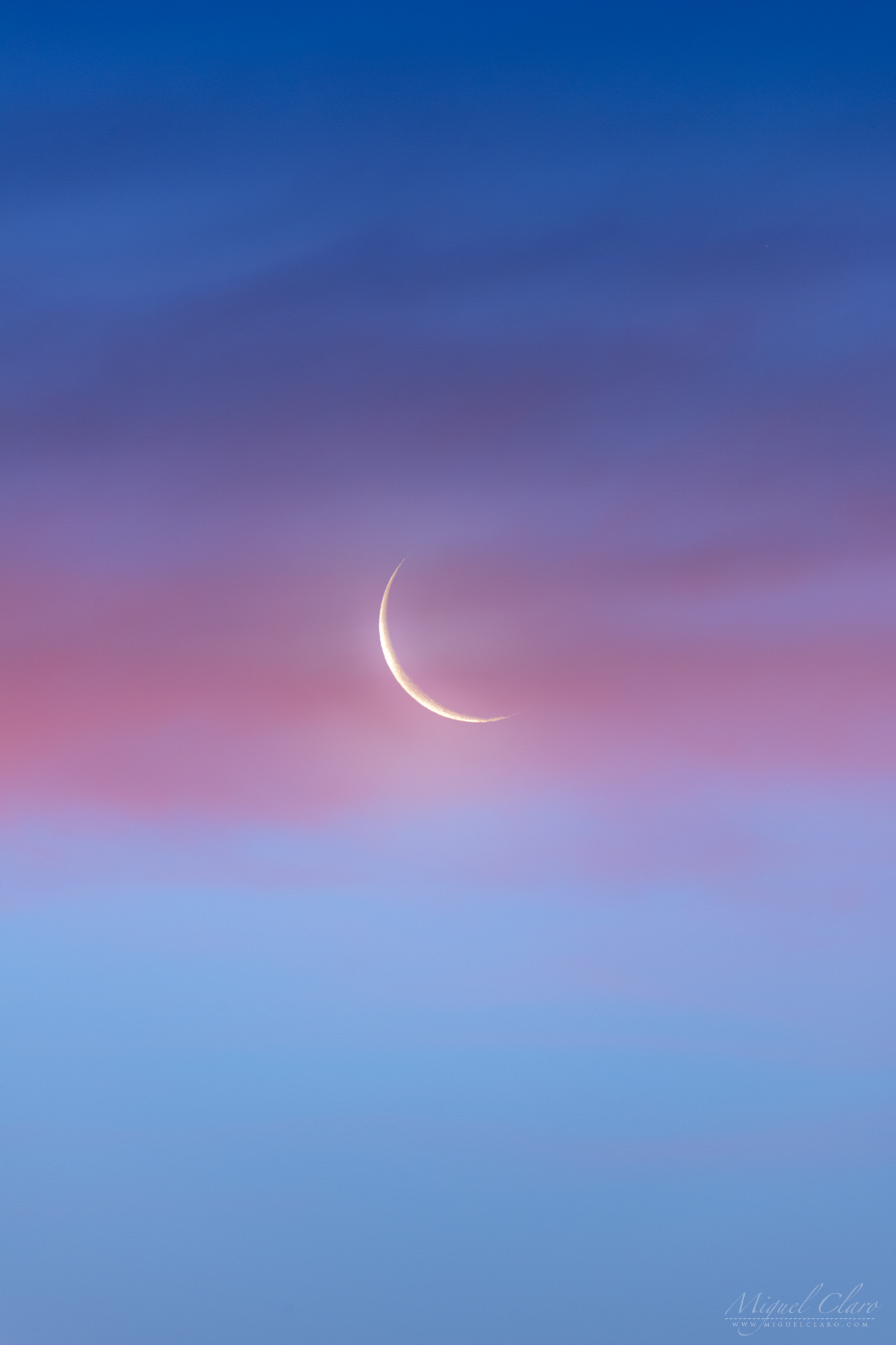
The photo shows a slightly Waning Crescent Moon rising at Dawn, against a beautiful background from the twilight and behind a pink band of clouds, just few minutes before the Sunrise. Captured above Monsaraz and lake Alqueva, in Dark Sky® Alqueva reserve, the disk was only 6% illuminated by Sun, remind us that planet Venus also can have very similar phases, that can be seen through a telescopic view from Earth, in the right time of the year. When Venus reaches its greatest approach to Earth it shows a slightly Crescent shape – an opposite result of this Waning Crescent Moon.
PT: Na foto é possível ver uma lua minguante que se levanta às primeiras horas do dia por detrás de uma nuvem rosada contra um colorido fundo crepuscular, apenas alguns minutos antes do Sol nascer. Captada acima de Monsaraz, na reserva Dark Sky® Alqueva, com o disco lunar apenas 6% iluminado pelo Sol, relembra-nos que o Planeta Vénus também pode apresentar fases muito similares às da Lua e que podem ser vistas a partir da Terra com o auxílio de um telescópio, na altura certa do ano. Quando Vénus atinge o ponto de máxima aproximação à Terra, apresenta uma magnitude de -4.5, tornando-se o planeta mais brilhante da esfera celeste, revelando uma fase Crescente similar, mas oposta à que a Lua apresenta nesta fotografia.
A Waning Crescent Moon Behind a Pinky Band of Clouds

The photo shows a Waning Crescent Moon rising at Dawn, against a beautiful background from the twilight and behind a pink band of clouds, just few minutes before the Sunrise. Captured above Monsaraz and lake Alqueva, in Dark Sky® Alqueva reserve, and due to the fact that during this time of the Month the disk was only 6% illuminated by Sun, we can clearly distinguish the Earthshine, a phenomenon related to that part of the Moon that is not directly illuminated by the Sun, but by the reflected light from Earth itself.
PT: Na foto é possível ver uma lua minguante que se levanta às primeiras horas do dia por detrás de uma nuvem rosada contra um colorido fundo crepuscular, apenas alguns minutos antes do Sol nascer. Captada acima de Monsaraz, na reserva Dark Sky® Alqueva, e devido ao facto de que durante este período do mês o disco lunar se encontra apenas 6% iluminado pelo Sol, podemos distinguir claramente um Earthshine, um fenómeno relacionado com a parte da Lua que não se encontra diretamente iluminada pelo Sol, mas pela luz refletida da própria Terra.
An Earthshine from the Waning Crescent Moon

The photo shows a Waning Crescent Moon rising at Dawn, against a beautiful background from the twilight, just few minutes before the Sunrise. Captured above Monsaraz and lake Alqueva, in Dark Sky® Alqueva reserve, and due to the fact that during this time of the Month the disk was only 6% illuminated by Sun, we can clearly distinguish the Earthshine, a phenomenon related to that part of the Moon that is not directly illuminated by the Sun, but by the reflected light from Earth itself.
PT: Na foto é possível ver uma lua minguante que se levanta às primeiras horas do dia, contra um colorido fundo crepuscular, apenas alguns minutos antes do Sol nascer. Captada acima de Monsaraz, na reserva Dark Sky® Alqueva, e devido ao facto de que durante este período do mês o disco lunar se encontra apenas 6% iluminado pelo Sol, podemos distinguir claramente um Earthshine, um fenómeno relacionado com a parte da Lua que não se encontra diretamente iluminada pelo Sol, mas pela luz refletida da própria Terra.

The Rich Colorful Field of Orion´s Belt

In the top center of the image three bright supergiant stars, Mintaka, Alnilam and Alnitak (from left to right) are shinning in blue, forming a stellar triplet also known as Orion´s Belt. This colorful and deep wide starfield, snaps part of the Orion constellation with two strong reddish H-alfa emissions from the Orion Molecular Cloud Complex, that includes Horsehead Nebula at the right side of Alnitak, and below it, the Flame Nebula featuring a skin tone. Following down the brown dense area of gas and dust and we will find M78, a bright blue reflection nebula located in the center of the picture. The second bright H-alfa emission that runs horizontally across the photo, is the end of Barnard’s Loop, Sh2-276. The imaginary diagonal line where all of those deep sky objects above described seems to be aligined, ends in the bottom center of the image, featuring an interesting dark nebula, LDN 1622.
PT: No centro superior da imagem, as três estrelas supergigantes, Mintaka, Alnilam e Alnitak, brilham intensamente numa tonalidade azul, formando um triplet estelar também conhecido como Cinturão de Orion. Este campo estelar colorido e profundo, contempla parte da constelação de Orion com duas altas emissões de H-alfa, avermelhadas, do Complexo Molecular de Orion, que inclui a Nebulosa da Cabeça do Cavalo no lado direito da estrela Alnitak e abaixo dela, a Nebulosa da Chama, visível na imagem com um tom de pele. Seguindo a área acastanhada e densa de gás e poeiras, encontraremos M78, uma nebulosa de reflexão azul brilhante localizada no centro da imagem. A segunda emissão brilhante de H-alfa que atravessa horizontalmente a parte inferior da foto, é região final do Barnard’s Loop, Sh2-276. A linha diagonal imaginária onde todos estes objetos de céu profundo acima descritos parecem estar alinhados, termina no centro inferior da imagem, apresentando uma nebulosa escura interessante, LDN 1622.
Technical details | Detalhes Técnicos
Nikon D810a | Sigma 150-600mm DG OS HSM Sports at 250mm f/5.6| ISO2000 – Exp. 240 seconds x 26 lights | Mount EQ6 Pro |Total integration of 26 Lights: 104 minutes. Processing on PixInsight 1.8 and Photoshop CC. Cumeada Observatory from Dark Sky® Alqueva Reserve, Reguengos de Monsaraz.
Cumeada Observatory, a Window to the Universe

After astronomical twilight ends, a retractable roof observatory shows an open window to the Universe, with the core of Milky Way Galaxy shinning bright against a variety of different telescopes, advanced optical equipment for visual and astrophotography purposes, available in Cumeada Observatory, the headquarter of Dark Sky® Alqueva Reserve – the First Starlight Tourism Destination in the World – located in Reguengos de Monsaraz, Portugal. The recovered building is an old primary school rehabilitated by the Municipality of Reguengos, to receive the official Observatory of Dark Sky® Alqueva
PT: Após o final do crepúsculo astronómico, um observatório de tecto retráctil mostra uma janela aberta para o Universo, com o núcleo da Via Láctea brilhando contra uma variedade de telescópios diferentes, equipamentos ópticos avançados para fins visuais e astrofotográficos, disponíveis no Observatório da Cumeada, sede oficial da Reserva Dark Sky® Alqueva – o Primeiro Destino Turístico do Mundo Starlight – localizado em Reguengos de Monsaraz, Portugal. O edifício recuperado é uma antiga escola primária reabilitada pelo município de Reguengos, para receber o Observatório oficial de Dark Sky® Alqueva.
Cumeada Observatory and the Winter Sky

After astronomical twilight ends, a retractable roof observatory shows an open window to the Universe, with the Winter Sky shinning bright against a variety of different telescopes, advanced optical equipment for visual and astrophotography purposes, available in Cumeada Observatory, the headquarter of Dark Sky® Alqueva Reserve – the First Starlight Tourism Destination in the World – located in Reguengos de Monsaraz, Portugal. The recovered building is an old primary school rehabilitated by the Municipality of Reguengos, to receive the official Observatory of Dark Sky® Alqueva
PT: Após o final do crepúsculo astronómico, um observatório de tecto retráctil mostra uma janela aberta para o Universo, com o Céu de Inverno brilhando contra uma variedade de telescópios diferentes, equipamentos ópticos avançados para fins visuais e astrofotográficos, disponíveis no Observatório da Cumeada, sede oficial da Reserva Dark Sky® Alqueva – o Primeiro Destino Turístico do Mundo Starlight – localizado em Reguengos de Monsaraz, Portugal. O edifício recuperado é uma antiga escola primária reabilitada pelo município de Reguengos, para receber o Observatório oficial de Dark Sky® Alqueva.
Oficial Observatory of Dark Sky Alqueva Working in a Winter Night from Miguel Claro on Vimeo.
Working at Cumeada Observatory, a Window to the Universe

After astronomical twilight ends, a retractable roof observatory shows an open window to the Universe, with the core of Milky Way Galaxy shinning bright against a variety of different telescopes, advanced optical equipment for visual and astrophotography purposes, available in Cumeada Observatory, the headquarter of Dark Sky® Alqueva Reserve – the First Starlight Tourism Destination in the World – located in Reguengos de Monsaraz, Portugal. The recovered building is an old primary school rehabilitated by the Municipality of Reguengos, to receive the official Observatory of Dark Sky® Alqueva
PT: Após o final do crepúsculo astronómico, um observatório de tecto retráctil mostra uma janela aberta para o Universo, com o núcleo da Via Láctea brilhando contra uma variedade de telescópios diferentes, equipamentos ópticos avançados para fins visuais e astrofotográficos, disponíveis no Observatório da Cumeada, sede oficial da Reserva Dark Sky® Alqueva – o Primeiro Destino Turístico do Mundo Starlight – localizado em Reguengos de Monsaraz, Portugal. O edifício recuperado é uma antiga escola primária reabilitada pelo município de Reguengos, para receber o Observatório oficial de Dark Sky® Alqueva.
Lunar Christmas Earthshine above Mértola Castle

Captured one day after the new moon during the Christmas week, the moon was only 2% illuminated by the sunlight. Though, we can clearly distinguish the entire disk due to a phenomenon called Lunar Earthshine. In the foreground, located in a top hill, is a beautiful well-preserved medieval castle from Mértola village, in Dark Sky® Alqueva Reserve, decorated with Christmas lights around the walls and by coincidence very well aligned with the crescent moon, forming the perfect frame for a Christmas Card.
PT: Captada no dia após a lua nova e durante a semana que antecede o Natal, a lua encontrava-se 2% iluminada pela luz solar directa. No entanto, é possível distinguir claramente todo o disco devido a um fenómeno chamado Lunar Earthshine. Em primeiro plano, localizado numa colina superior, encontra-se o bem preservado e belo castelo da vila de Mértola, na Reserva Dark Sky® Alqueva, decorado com luzes de Natal ao redor das paredes e por coincidência muito bem alinhado com a lua crescente, forma o par perfeito para um Postal de Natal.
Slightly Crescent Moon above Mértola Village

Captured one day after the new moon during the Christmas week, the moon was only 2% illuminated by the sunlight. Though, we can clearly distinguish the entire disk due to a phenomenon called Lunar Earthshine. In the foreground, located in a top hill, is a beautiful well-preserved medieval castle from Mértola village, in Dark Sky® Alqueva Reserve, decorated with Christmas lights around the walls and by coincidence very well aligned with the crescent moon, forming the perfect frame for a Christmas Card.
PT: Captada no dia após a lua nova e durante a semana que antecede o Natal, a lua encontrava-se 2% iluminada pela luz solar directa. No entanto, é possível distinguir claramente todo o disco devido a um fenómeno chamado Lunar Earthshine. Em primeiro plano, localizado numa colina superior, encontra-se o bem preservado e belo castelo da vila de Mértola, na Reserva Dark Sky® Alqueva, decorado com luzes de Natal ao redor das paredes e por coincidência muito bem alinhado com a lua crescente, forma o par perfeito para um Postal de Natal.
Bright Milky Way Mixed with Airglow and Clouds above Mina de São Domingos

A wide view of the Milky Way with planet Saturn shinning against the galaxy core above Scorpius constellation, while in the opposite direction, bright star Arcturus is setting behind a layer of orange clouds. In the background horizon, a smooth presence of green airglow is also mixed with a starry sky. In the top right corner of the image, a pink/red emission from North America Nebula (NGC7000) is well visible near Deneb star, forming a perfect triangle with the blue star Vega (top center) and Altair star (left center). This mosaic of the Milky Way was captured above a puddle of acid water from Achada do Gamo, that was – since the beginning of modern mining activities in the São Domingos Mine – the center of metallurgical activities on extracted minerals. Already during the 20th century, between the 30s and 40s, a new direction of industrial exploration took place: the sulfur, however much valued, began to be extracted from the copper pyrites through furnaces (Orkla process) in two plants installed in the Achada do Gamo during the years of 1934 and 1943.
São Domingos Mine is located in Baixo Alentejo, about 240 km from Lisbon, in the municipality of Mértola, which recently joined the Dark Sky® Alqueva Route for the great quality of the night sky. The São Domingos mining area is part of the Iberian Pyrite Range and is a decisive source of basic metals (S, Zn, Pb, Sn, Ag, Au, Fe, Co, Cd, etc.) and other elements such as sulfur (S). It has been a sought after place for the extraction of ores since antiquity, with evidence of gold, silver and copper mining in the pre-Roman and Roman times. The pyritic deposit of São Domingos (St. Dominic) was explored in various historical periods, namely: for several centuries of the first millennium BC (Eastern period), during the period between 14 BC and 395 AD (Roman period), during the Islamic period and during the modern period that was initiated in 1858 for the extraction of copper, gold and silver and was maintained until 1966, the year in which the reserves were considered exhausted. During this period, the work was done in the open air up to 120 meters deep, with work continued through wells and galleries up to 400 meters. Over 108 years of regular exploration, more than 20 million tons of materials were removed from the site, producing about 14.7 million tons of waste accumulated in heaps up to 14 meters high with a dozen different materials such as pyrite , gossan, slag, ash, iron oxides, barren rock, sludge, debris, etc. The areas of heaps, slag and channels of water, give the landscape a “lunar” aspect. The heaps are composed of different materials with high levels of metals, such as slag and ash, whose leaching through the rainwater leads to the production of acid mine drainage, usually with an ocher or reddish color.|
PT: Nesta imagem é possível aceder a uma ampla visão da Via Láctea com o planeta Saturno brilhando contra o núcleo da galáxia acima da constelação do Escorpião, enquanto na direção oposta, a estrela brilhante Arcturus se põe atrás de uma camada de nuvens alaranjada. Logo acima do horizonte e em pano de fundo, uma presença suave de airglow (luminescência foto-química) mistura-se com um céu estrelado. No canto superior direito da imagem, uma emissão rosa/vermelha proveniente da Nebulosa América do Norte (NGC7000) é bem visível perto da estrela Deneb, formando um triângulo perfeito com a estrela azul Vega (centro superior) e a estrela Altair (centro esquerdo). Este mosaico da Via Láctea foi captado acima das águas ácidas da Achada do Gamo, que foi desde o início das atividades modernas de mineração na Mina de São Domingos, o centro das atividades metalúrgicas sobre os minérios extraídos. Já durante o século XX, entre as décadas de 30 e 40, uma nova direção de exploração industrial tomou lugar: o enxofre, entretanto muito valorizado, passou a ser extraído das pirites cupríferas através de fornos (processo Orkla) em duas unidades fabris instaladas na Achada do Gamo durante os anos de 1934 e 1943.
A Mina de São Domingos, situa-se no Baixo Alentejo, a cerca de 240 km de Lisboa, no concelho de Mértola, que passou a integrar recentemente a Rota Dark Sky® Alqueva pela grande qualidade do seu céu escuro. A área mineira de São Domingos, está inserida na Faixa Piritosa Ibérica e constitui uma fonte decisiva de metais básicos (Cu, Zn, Pb, Sn, Ag, Au, Fe, Co, Cd, etc.) e de outros elementos como o enxofre (S). Foi desde a Antiguidade um local procurado para a extracção de minérios, existindo indícios de trabalhos de extracção de ouro, prata e cobre no período pré-romano e romano. O depósito pirítico de São Domingos foi explorado em diversos períodos históricos, nomeadamente: durante vários séculos do primeiro milénio a.C. (período Oriental), durante o período que mediou entre o ano 14 a.C. e o ano de 395 d.C. (período romano), durante o período islâmico e durante o período moderno que se iniciou em 1858 para a extracção de cobre, ouro e prata e manteve-se até 1966, ano em que as reservas foram consideradas esgotadas. Neste período, a lavra foi feita a céu aberto até aos 120 metros de profundidade, tendo os trabalhos continuado por meio de poços e galerias até aos 400 metros. Ao longo de 108 anos de exploração regular, foram retirados do local mais de 20 milhões de toneladas de materiais, tendo produzido cerca 14,7 milhões de toneladas de resíduos acumulados em escombreiras de até 14 metros de altura, com uma dezena de materiais diferentes como pirite, gossan, escórias, cinzas, óxidos de ferro, rocha estéril, lamas, entulhos, etc. As áreas de escombreiras, escórias e canais de água, dão à paisagem um aspecto “lunar”. As escombreiras são constituídas por diferentes materiais com teores elevados em metais, como escórias e cinzas, cuja lixiviação através das águas das chuvas leva à produção de águas ácidas (‘acid mine drainage’), geralmente com uma cor ocre ou avermelhada.
Mina de São Domingos, an Open Hole to a Chemical Universe

The magnificent chemical landscape from Achada do Gamo, seems to show an hole to the Universe where we can immerse through a puddle of acid waters, reflecting the starlight from Scorpius and planet Saturn shinning bright against the galaxy core. Since the beginning of modern mining activities in the São Domingos Mine, Achada do Gamo was the center of metallurgical activities on extracted minerals. Some heavy elements presented in these minerals have been created billions of years ago in those stars and through supernovae explosions. The gold for example was made from neutron stars during collisions. Although, silver production occurs in less massive stars than those that produce gold—and through an entirely different type of nuclear fusion, called the weak r-process. The sites of nuclear creation of some elements, such as copper, are not really well known and are continuing topics of observational and computational research. The areas of heaps, slag and channels of water, give the landscape a “lunar” aspect. The heaps are composed of different materials with high levels of metals, such as slag and ash, whose leaching through the rainwater leads to the production of acid mine drainage, usually with an ocher or reddish color.|
São Domingos Mine is located in Baixo Alentejo, about 240 km from Lisbon, in the municipality of Mértola, which recently joined the Dark Sky® Alqueva Route for the great quality of the night sky. The São Domingos mining area is part of the Iberian Pyrite Range and is a decisive source of basic metals (S, Zn, Pb, Sn, Ag, Au, Fe, Co, Cd, etc.) and other elements such as sulfur (S). It has been a sought after place for the extraction of ores since antiquity, with evidence of gold, silver and copper mining in the pre-Roman and Roman times. The pyritic deposit of São Domingos (St. Dominic) was explored in various historical periods, namely: for several centuries of the first millennium BC (Eastern period), during the period between 14 BC and 395 AD (Roman period), during the Islamic period and during the modern period that was initiated in 1858 for the extraction of copper, gold and silver and was maintained until 1966, the year in which the reserves were considered exhausted. During this period, the work was done in the open air up to 120 meters deep, with work continued through wells and galleries up to 400 meters. Over 108 years of regular exploration, more than 20 million tons of materials were removed from the site, producing about 14.7 million tons of waste accumulated in heaps up to 14 meters high with a dozen different materials such as pyrite , gossan, slag, ash, iron oxides, barren rock, sludge, debris, etc.
PT: A magnífica paisagem química de Achada do Gamo, parece mostrar um buraco para o Universo onde podemos mergulhar através de um charco de águas ácidas, refletindo a luz das estrelas do Escorpião e o planeta Saturno brilhando contra o núcleo da galáxia. Desde o início das modernas atividades de mineração na mina de São Domingos, a Achada do Gamo foi o centro das atividades metalúrgicas nos minerais extraídos. Alguns elementos pesados presentes nestes minerais foram criados há milhares de milhões de anos atrás nessas estrelas e através de explosões de supernovas. O ouro, por exemplo, foi feito a partir de estrelas de neutrões durante colisões. Apesar disso, a produção de prata ocorre em estrelas menos maciças do que aquelas que produzem ouro – e através de um tipo completamente diferente de fusão nuclear, chamado de processo-r fraco. As áreas de montes, escórias e canais de água, dão à paisagem um aspecto “lunar” que lhe confere um cenário ímpar. Os montes são compostos de diferentes materiais com altos níveis de metais, como escórias e cinzas, cuja lixiviação através da água da chuva leva à produção de drenagem de minas ácidas, geralmente com uma cor ocre ou avermelhada.
A Mina de São Domingos, situa-se no Baixo Alentejo, a cerca de 240 km de Lisboa, no concelho de Mértola, que passou a integrar recentemente a Rota Dark Sky® Alqueva pela grande qualidade do seu céu escuro. A área mineira de São Domingos, está inserida na Faixa Piritosa Ibérica e constitui uma fonte decisiva de metais básicos (Cu, Zn, Pb, Sn, Ag, Au, Fe, Co, Cd, etc.) e de outros elementos como o enxofre (S). Foi desde a Antiguidade um local procurado para a extracção de minérios, existindo indícios de trabalhos de extracção de ouro, prata e cobre no período pré-romano e romano. O depósito pirítico de São Domingos foi explorado em diversos períodos históricos, nomeadamente: durante vários séculos do primeiro milénio a.C. (período Oriental), durante o período que mediou entre o ano 14 a.C. e o ano de 395 d.C. (período romano), durante o período islâmico e durante o período moderno que se iniciou em 1858 para a extracção de cobre, ouro e prata e manteve-se até 1966, ano em que as reservas foram consideradas esgotadas. Neste período, a lavra foi feita a céu aberto até aos 120 metros de profundidade, tendo os trabalhos continuado por meio de poços e galerias até aos 400 metros. Ao longo de 108 anos de exploração regular, foram retirados do local mais de 20 milhões de toneladas de materiais, tendo produzido cerca 14,7 milhões de toneladas de resíduos acumulados em escombreiras de até 14 metros de altura, com uma dezena de materiais diferentes como pirite, gossan, escórias, cinzas, óxidos de ferro, rocha estéril, lamas, entulhos, etc.
The Arch of Milky Way Shinning Against the Acid Landscape of Achada do Gamo

The arch of Milky Way galaxy behind a tiny layer of clouds mixed with a smooth presence of green airglow, is shinning above a puddle of acid water from Achada do Gamo, that was – since the beginning of modern mining activities in the São Domingos Mine – the center of metallurgical activities on extracted minerals. Already during the 20th century, between the 30s and 40s, a new direction of industrial exploration took place: the sulfur, however much valued, began to be extracted from the copper pyrites through furnaces (Orkla process) in two plants installed in the Achada do Gamo during the years of 1934 and 1943. Near the left chimney is visible the Andromeda galaxy, seen from here as an elongated diffuse dot.
São Domingos Mine is located in Baixo Alentejo, about 240 km from Lisbon, in the municipality of Mértola, which recently joined the Dark Sky® Alqueva Route for the great quality of the night sky. The São Domingos mining area is part of the Iberian Pyrite Range and is a decisive source of basic metals (S, Zn, Pb, Sn, Ag, Au, Fe, Co, Cd, etc.) and other elements such as sulfur (S). It has been a sought after place for the extraction of ores since antiquity, with evidence of gold, silver and copper mining in the pre-Roman and Roman times. The pyritic deposit of São Domingos (St. Dominic) was explored in various historical periods, namely: for several centuries of the first millennium BC (Eastern period), during the period between 14 BC and 395 AD (Roman period), during the Islamic period and during the modern period that was initiated in 1858 for the extraction of copper, gold and silver and was maintained until 1966, the year in which the reserves were considered exhausted. During this period, the work was done in the open air up to 120 meters deep, with work continued through wells and galleries up to 400 meters. Over 108 years of regular exploration, more than 20 million tons of materials were removed from the site, producing about 14.7 million tons of waste accumulated in heaps up to 14 meters high with a dozen different materials such as pyrite , gossan, slag, ash, iron oxides, barren rock, sludge, debris, etc. The areas of heaps, slag and channels of water, give the landscape a “lunar” aspect. The heaps are composed of different materials with high levels of metals, such as slag and ash, whose leaching through the rainwater leads to the production of acid mine drainage, usually with an ocher or reddish color.|
PT: O arco da Via Láctea ergue-se por detrás de uma fina camada de nuvens que se mistura em pano de fundo com a presença suave de airglow, tornando-se visível acima das águas ácidas da Achada do Gamo, que foi desde o início das atividades modernas de mineração na Mina de São Domingos, o centro das atividades metalúrgicas sobre os minérios extraídos. Já durante o século XX, entre as décadas de 30 e 40, uma nova direção de exploração industrial tomou lugar: o enxofre, entretanto muito valorizado, passou a ser extraído das pirites cupríferas através de fornos (processo Orkla) em duas unidades fabris instaladas na Achada do Gamo durante os anos de 1934 e 1943. Logo acima do horizonte esquerdo, e perto da primeira chaminé, é visível a galáxia de Andrómeda, vista a partir daqui como um ponto difuso alongado.
A Mina de São Domingos, situa-se no Baixo Alentejo, a cerca de 240 km de Lisboa, no concelho de Mértola, que passou a integrar recentemente a Rota Dark Sky® Alqueva pela grande qualidade do seu céu escuro. A área mineira de São Domingos, está inserida na Faixa Piritosa Ibérica e constitui uma fonte decisiva de metais básicos (Cu, Zn, Pb, Sn, Ag, Au, Fe, Co, Cd, etc.) e de outros elementos como o enxofre (S). Foi desde a Antiguidade um local procurado para a extracção de minérios, existindo indícios de trabalhos de extracção de ouro, prata e cobre no período pré-romano e romano. O depósito pirítico de São Domingos foi explorado em diversos períodos históricos, nomeadamente: durante vários séculos do primeiro milénio a.C. (período Oriental), durante o período que mediou entre o ano 14 a.C. e o ano de 395 d.C. (período romano), durante o período islâmico e durante o período moderno que se iniciou em 1858 para a extracção de cobre, ouro e prata e manteve-se até 1966, ano em que as reservas foram consideradas esgotadas. Neste período, a lavra foi feita a céu aberto até aos 120 metros de profundidade, tendo os trabalhos continuado por meio de poços e galerias até aos 400 metros. Ao longo de 108 anos de exploração regular, foram retirados do local mais de 20 milhões de toneladas de materiais, tendo produzido cerca 14,7 milhões de toneladas de resíduos acumulados em escombreiras de até 14 metros de altura, com uma dezena de materiais diferentes como pirite, gossan, escórias, cinzas, óxidos de ferro, rocha estéril, lamas, entulhos, etc. As áreas de escombreiras, escórias e canais de água, dão à paisagem um aspecto “lunar”. As escombreiras são constituídas por diferentes materiais com teores elevados em metais, como escórias e cinzas, cuja lixiviação através das águas das chuvas leva à produção de águas ácidas (‘acid mine drainage’), geralmente com uma cor ocre ou avermelhada.
Star Spica and Planet Jupiter above the Acid Water of Mina de São Domingos

A moonlight scene with blue star Spica and planet Jupiter setting and shinning behind a layer of clouds, while their lights are reflecting in a puddle of acid water from Achada do Gamo, that was – since the beginning of modern mining activities in the São Domingos Mine – the center of metallurgical activities on extracted minerals. The areas of heaps, slag and channels of water, give the landscape a “lunar” aspect. The heaps are composed of different materials with high levels of metals, such as slag and ash, whose leaching through the rainwater leads to the production of acid mine drainage, usually with an ocher or reddish color.
São Domingos Mine is located in Baixo Alentejo, about 240 km from Lisbon, in the municipality of Mértola, which recently joined the Dark Sky® Alqueva Route for the great quality of the night sky. The São Domingos mining area is part of the Iberian Pyrite Range and is a decisive source of basic metals (S, Zn, Pb, Sn, Ag, Au, Fe, Co, Cd, etc.) and other elements such as sulfur (S). It has been a sought after place for the extraction of ores since antiquity, with evidence of gold, silver and copper mining in the pre-Roman and Roman times. The pyritic deposit of São Domingos (St. Dominic) was explored in various historical periods, namely: for several centuries of the first millennium BC (Eastern period), during the period between 14 BC and 395 AD (Roman period), during the Islamic period and during the modern period that was initiated in 1858 for the extraction of copper, gold and silver and was maintained until 1966, the year in which the reserves were considered exhausted. During this period, the work was done in the open air up to 120 meters deep, with work continued through wells and galleries up to 400 meters. Over 108 years of regular exploration, more than 20 million tons of materials were removed from the site, producing about 14.7 million tons of waste accumulated in heaps up to 14 meters high with a dozen different materials such as pyrite , gossan, slag, ash, iron oxides, barren rock, sludge, debris, etc.|
PT: Uma cena de luar com a estrela azul Spica e o planeta Jupiter se pondo e brilhando atrás de uma fina camada de nuvens, enquanto o seu brilho se reflecte nas águas ácidas da Achada do Gamo, que foi desde o início das atividades modernas de mineração na Mina de São Domingos, o centro das atividades metalúrgicas sobre os minérios extraídos. As áreas de escombreiras, escórias e canais de água, dão à paisagem um aspecto “lunar”. As escombreiras são constituídas por diferentes materiais com teores elevados em metais, como escórias e cinzas, cuja lixiviação através das águas das chuvas leva à produção de águas ácidas (‘acid mine drainage’), geralmente com uma cor ocre ou avermelhada.
A Mina de São Domingos, situa-se no Baixo Alentejo, a cerca de 240 km de Lisboa, no concelho de Mértola, que passou a integrar recentemente a Rota Dark Sky® Alqueva pela grande qualidade do seu céu escuro. A área mineira de São Domingos, está inserida na Faixa Piritosa Ibérica e constitui uma fonte decisiva de metais básicos (Cu, Zn, Pb, Sn, Ag, Au, Fe, Co, Cd, etc.) e de outros elementos como o enxofre (S). Foi desde a Antiguidade um local procurado para a extracção de minérios, existindo indícios de trabalhos de extracção de ouro, prata e cobre no período pré-romano e romano. O depósito pirítico de São Domingos foi explorado em diversos períodos históricos, nomeadamente: durante vários séculos do primeiro milénio a.C. (período Oriental), durante o período que mediou entre o ano 14 a.C. e o ano de 395 d.C. (período romano), durante o período islâmico e durante o período moderno que se iniciou em 1858 para a extracção de cobre, ouro e prata e manteve-se até 1966, ano em que as reservas foram consideradas esgotadas. Neste período, a lavra foi feita a céu aberto até aos 120 metros de profundidade, tendo os trabalhos continuado por meio de poços e galerias até aos 400 metros. Ao longo de 108 anos de exploração regular, foram retirados do local mais de 20 milhões de toneladas de materiais, tendo produzido cerca 14,7 milhões de toneladas de resíduos acumulados em escombreiras de até 14 metros de altura, com uma dezena de materiais diferentes como pirite, gossan, escórias, cinzas, óxidos de ferro, rocha estéril, lamas, entulhos, etc.
Milky Way Arm above an Acid Water

A view of the Milky Way arm mixed with some clouds with planet Saturn shinning against the galaxy core, near Scorpius constellation. In the top right corner of the image, a pink/red emission from North America Nebula (NGC7000) is well visible near Deneb star, forming a triangle with the blue star Vega (top center) and Altair star (left center). This mosaic of the Milky Way was captured above a puddle of acid water reflecting the starlight from Scorpius and Saturn, located in Achada do Gamo, that was – since the beginning of modern mining activities in the São Domingos Mine – the center of metallurgical activities on extracted minerals. Already during the 20th century, between the 30s and 40s, a new direction of industrial exploration took place: the sulfur, however much valued, began to be extracted from the copper pyrites through furnaces (Orkla process) in two plants installed in the Achada do Gamo during the years of 1934 and 1943.
São Domingos Mine is located in Baixo Alentejo, about 240 km from Lisbon, in the municipality of Mértola, which recently joined the Dark Sky® Alqueva Route for the great quality of the night sky. The São Domingos mining area is part of the Iberian Pyrite Range and is a decisive source of basic metals (S, Zn, Pb, Sn, Ag, Au, Fe, Co, Cd, etc.) and other elements such as sulfur (S). It has been a sought after place for the extraction of ores since antiquity, with evidence of gold, silver and copper mining in the pre-Roman and Roman times. The pyritic deposit of São Domingos (St. Dominic) was explored in various historical periods, namely: for several centuries of the first millennium BC (Eastern period), during the period between 14 BC and 395 AD (Roman period), during the Islamic period and during the modern period that was initiated in 1858 for the extraction of copper, gold and silver and was maintained until 1966, the year in which the reserves were considered exhausted. During this period, the work was done in the open air up to 120 meters deep, with work continued through wells and galleries up to 400 meters. Over 108 years of regular exploration, more than 20 million tons of materials were removed from the site, producing about 14.7 million tons of waste accumulated in heaps up to 14 meters high with a dozen different materials such as pyrite , gossan, slag, ash, iron oxides, barren rock, sludge, debris, etc. The areas of heaps, slag and channels of water, give the landscape a “lunar” aspect. The heaps are composed of different materials with high levels of metals, such as slag and ash, whose leaching through the rainwater leads to the production of acid mine drainage, usually with an ocher or reddish color.|
PT: Uma visão do braço da Via Láctea misturado com algumas nuvens com o planeta Saturno brilhando contra o centro da galáxia, perto da constelação do Escorpião. No canto superior direito da imagem, uma emissão rosa/vermelha proveniente da Nebulosa América do Norte (NGC7000) é bem visível perto da estrela Deneb, formando um triângulo com a estrela azul Vega (centro superior) e a estrela Altair (centro esquerdo). Este mosaico da Via Láctea foi captado acima das águas ácidas de um charco, reflectindo a luz estelar de Escorpião e Saturno, a partir da região da Achada do Gamo, que foi desde o início das atividades modernas de mineração na Mina de São Domingos, o centro das atividades metalúrgicas sobre os minérios extraídos. Já durante o século XX, entre as décadas de 30 e 40, uma nova direção de exploração industrial tomou lugar: o enxofre, entretanto muito valorizado, passou a ser extraído das pirites cupríferas através de fornos (processo Orkla) em duas unidades fabris instaladas na Achada do Gamo durante os anos de 1934 e 1943.
A Mina de São Domingos, situa-se no Baixo Alentejo, a cerca de 240 km de Lisboa, no concelho de Mértola, que passou a integrar recentemente a Rota Dark Sky® Alqueva pela grande qualidade do seu céu escuro. A área mineira de São Domingos, está inserida na Faixa Piritosa Ibérica e constitui uma fonte decisiva de metais básicos (Cu, Zn, Pb, Sn, Ag, Au, Fe, Co, Cd, etc.) e de outros elementos como o enxofre (S). Foi desde a Antiguidade um local procurado para a extracção de minérios, existindo indícios de trabalhos de extracção de ouro, prata e cobre no período pré-romano e romano. O depósito pirítico de São Domingos foi explorado em diversos períodos históricos, nomeadamente: durante vários séculos do primeiro milénio a.C. (período Oriental), durante o período que mediou entre o ano 14 a.C. e o ano de 395 d.C. (período romano), durante o período islâmico e durante o período moderno que se iniciou em 1858 para a extracção de cobre, ouro e prata e manteve-se até 1966, ano em que as reservas foram consideradas esgotadas. Neste período, a lavra foi feita a céu aberto até aos 120 metros de profundidade, tendo os trabalhos continuado por meio de poços e galerias até aos 400 metros. Ao longo de 108 anos de exploração regular, foram retirados do local mais de 20 milhões de toneladas de materiais, tendo produzido cerca 14,7 milhões de toneladas de resíduos acumulados em escombreiras de até 14 metros de altura, com uma dezena de materiais diferentes como pirite, gossan, escórias, cinzas, óxidos de ferro, rocha estéril, lamas, entulhos, etc. As áreas de escombreiras, escórias e canais de água, dão à paisagem um aspecto “lunar”. As escombreiras são constituídas por diferentes materiais com teores elevados em metais, como escórias e cinzas, cuja lixiviação através das águas das chuvas leva à produção de águas ácidas (‘acid mine drainage’), geralmente com uma cor ocre ou avermelhada.
Shadows from a Fragmented Chair by the Moonlight
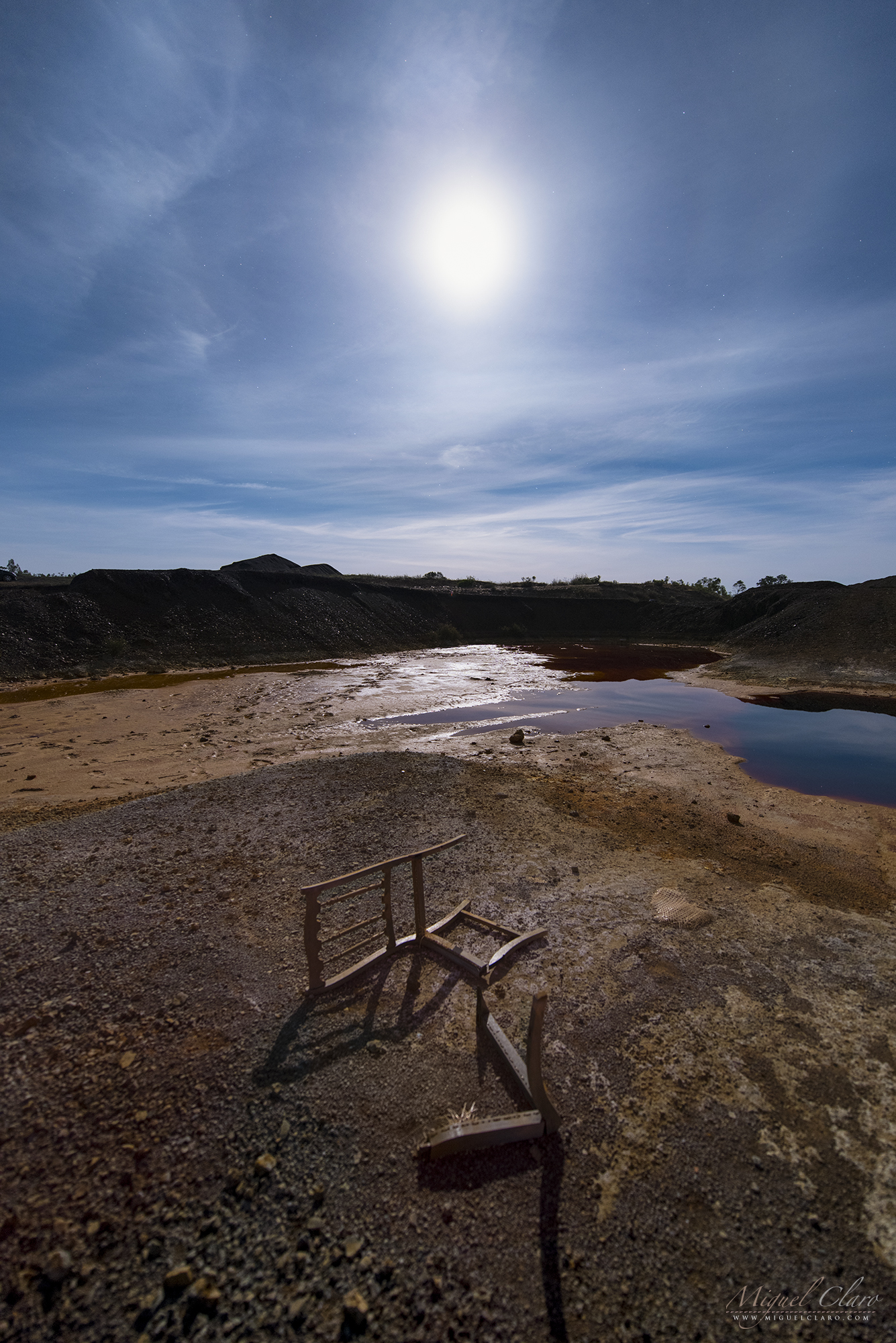
Shadows from a fragmented chair illuminated by the light of a smooth Lunar Halo above a puddle of acid water from Achada do Gamo, that was – since the beginning of modern mining activities in the São Domingos Mine – the center of metallurgical activities on extracted minerals. The areas of heaps, slag and channels of water, give the landscape a “lunar” aspect. The heaps are composed of different materials with high levels of metals, such as slag and ash, whose leaching through the rainwater leads to the production of acid mine drainage, usually with an ocher or reddish color.
São Domingos Mine is located in Baixo Alentejo, about 240 km from Lisbon, in the municipality of Mértola, which recently joined the Dark Sky® Alqueva Route for the great quality of the night sky. The São Domingos mining area is part of the Iberian Pyrite Range and is a decisive source of basic metals (S, Zn, Pb, Sn, Ag, Au, Fe, Co, Cd, etc.) and other elements such as sulfur (S). It has been a sought after place for the extraction of ores since antiquity, with evidence of gold, silver and copper mining in the pre-Roman and Roman times. The pyritic deposit of São Domingos (St. Dominic) was explored in various historical periods, namely: for several centuries of the first millennium BC (Eastern period), during the period between 14 BC and 395 AD (Roman period), during the Islamic period and during the modern period that was initiated in 1858 for the extraction of copper, gold and silver and was maintained until 1966, the year in which the reserves were considered exhausted. During this period, the work was done in the open air up to 120 meters deep, with work continued through wells and galleries up to 400 meters. Over 108 years of regular exploration, more than 20 million tons of materials were removed from the site, producing about 14.7 million tons of waste accumulated in heaps up to 14 meters high with a dozen different materials such as pyrite , gossan, slag, ash, iron oxides, barren rock, sludge, debris, etc.|
PT: Sombras de uma cadeira fragmentada iluminada pela luz de um quase imperceptível Halo lunar, que se formava acima da paisagem ácida de Achada do Gamo, que foi desde o início das atividades modernas de mineração na Mina de São Domingos, o centro das atividades metalúrgicas sobre os minérios extraídos. As áreas de escombreiras, escórias e canais de água, dão à paisagem um aspecto “lunar”. As escombreiras são constituídas por diferentes materiais com teores elevados em metais, como escórias e cinzas, cuja lixiviação através das águas das chuvas leva à produção de águas ácidas (‘acid mine drainage’), geralmente com uma cor ocre ou avermelhada.
A Mina de São Domingos, situa-se no Baixo Alentejo, a cerca de 240 km de Lisboa, no concelho de Mértola, que passou a integrar recentemente a Rota Dark Sky® Alqueva pela grande qualidade do seu céu escuro. A área mineira de São Domingos, está inserida na Faixa Piritosa Ibérica e constitui uma fonte decisiva de metais básicos (Cu, Zn, Pb, Sn, Ag, Au, Fe, Co, Cd, etc.) e de outros elementos como o enxofre (S). Foi desde a Antiguidade um local procurado para a extracção de minérios, existindo indícios de trabalhos de extracção de ouro, prata e cobre no período pré-romano e romano. O depósito pirítico de São Domingos foi explorado em diversos períodos históricos, nomeadamente: durante vários séculos do primeiro milénio a.C. (período Oriental), durante o período que mediou entre o ano 14 a.C. e o ano de 395 d.C. (período romano), durante o período islâmico e durante o período moderno que se iniciou em 1858 para a extracção de cobre, ouro e prata e manteve-se até 1966, ano em que as reservas foram consideradas esgotadas. Neste período, a lavra foi feita a céu aberto até aos 120 metros de profundidade, tendo os trabalhos continuado por meio de poços e galerias até aos 400 metros. Ao longo de 108 anos de exploração regular, foram retirados do local mais de 20 milhões de toneladas de materiais, tendo produzido cerca 14,7 milhões de toneladas de resíduos acumulados em escombreiras de até 14 metros de altura, com uma dezena de materiais diferentes como pirite, gossan, escórias, cinzas, óxidos de ferro, rocha estéril, lamas, entulhos, etc.
Summer Triangle and Planet Saturn Shinning above Achada do Gamo

A view of the Milky Way arm with planet Saturn shinning against the galaxy core, near Scorpius constellation. In the top right corner of the image, a pink/red emission from North America Nebula (NGC7000) is well visible near Deneb star, forming a perfect triangle with the blue star Vega (top center) and Altair star (left center). This mosaic of the Milky Way was captured above a puddle of acid water from Achada do Gamo, that was – since the beginning of modern mining activities in the São Domingos Mine – the center of metallurgical activities on extracted minerals. Already during the 20th century, between the 30s and 40s, a new direction of industrial exploration took place: the sulfur, however much valued, began to be extracted from the copper pyrites through furnaces (Orkla process) in two plants installed in the Achada do Gamo during the years of 1934 and 1943.
São Domingos Mine is located in Baixo Alentejo, about 240 km from Lisbon, in the municipality of Mértola, which recently joined the Dark Sky® Alqueva Route for the great quality of the night sky. The São Domingos mining area is part of the Iberian Pyrite Range and is a decisive source of basic metals (S, Zn, Pb, Sn, Ag, Au, Fe, Co, Cd, etc.) and other elements such as sulfur (S). It has been a sought after place for the extraction of ores since antiquity, with evidence of gold, silver and copper mining in the pre-Roman and Roman times. The pyritic deposit of São Domingos (St. Dominic) was explored in various historical periods, namely: for several centuries of the first millennium BC (Eastern period), during the period between 14 BC and 395 AD (Roman period), during the Islamic period and during the modern period that was initiated in 1858 for the extraction of copper, gold and silver and was maintained until 1966, the year in which the reserves were considered exhausted. During this period, the work was done in the open air up to 120 meters deep, with work continued through wells and galleries up to 400 meters. Over 108 years of regular exploration, more than 20 million tons of materials were removed from the site, producing about 14.7 million tons of waste accumulated in heaps up to 14 meters high with a dozen different materials such as pyrite , gossan, slag, ash, iron oxides, barren rock, sludge, debris, etc. The areas of heaps, slag and channels of water, give the landscape a “lunar” aspect. The heaps are composed of different materials with high levels of metals, such as slag and ash, whose leaching through the rainwater leads to the production of acid mine drainage, usually with an ocher or reddish color.|
PT: Uma visão do braço da Via Láctea com o planeta Saturno brilhando contra o centro da galáxia, perto da constelação do Escorpião. No canto superior direito da imagem, uma emissão rosa/vermelha proveniente da Nebulosa América do Norte (NGC7000) é bem visível perto da estrela Deneb, formando um triângulo perfeito com a estrela azul Vega (centro superior) e a estrela Altair (centro esquerdo). Este mosaico da Via Láctea foi captado acima das águas ácidas da Achada do Gamo, que foi desde o início das atividades modernas de mineração na Mina de São Domingos, o centro das atividades metalúrgicas sobre os minérios extraídos. Já durante o século XX, entre as décadas de 30 e 40, uma nova direção de exploração industrial tomou lugar: o enxofre, entretanto muito valorizado, passou a ser extraído das pirites cupríferas através de fornos (processo Orkla) em duas unidades fabris instaladas na Achada do Gamo durante os anos de 1934 e 1943.
A Mina de São Domingos, situa-se no Baixo Alentejo, a cerca de 240 km de Lisboa, no concelho de Mértola, que passou a integrar recentemente a Rota Dark Sky® Alqueva pela grande qualidade do seu céu escuro. A área mineira de São Domingos, está inserida na Faixa Piritosa Ibérica e constitui uma fonte decisiva de metais básicos (Cu, Zn, Pb, Sn, Ag, Au, Fe, Co, Cd, etc.) e de outros elementos como o enxofre (S). Foi desde a Antiguidade um local procurado para a extracção de minérios, existindo indícios de trabalhos de extracção de ouro, prata e cobre no período pré-romano e romano. O depósito pirítico de São Domingos foi explorado em diversos períodos históricos, nomeadamente: durante vários séculos do primeiro milénio a.C. (período Oriental), durante o período que mediou entre o ano 14 a.C. e o ano de 395 d.C. (período romano), durante o período islâmico e durante o período moderno que se iniciou em 1858 para a extracção de cobre, ouro e prata e manteve-se até 1966, ano em que as reservas foram consideradas esgotadas. Neste período, a lavra foi feita a céu aberto até aos 120 metros de profundidade, tendo os trabalhos continuado por meio de poços e galerias até aos 400 metros. Ao longo de 108 anos de exploração regular, foram retirados do local mais de 20 milhões de toneladas de materiais, tendo produzido cerca 14,7 milhões de toneladas de resíduos acumulados em escombreiras de até 14 metros de altura, com uma dezena de materiais diferentes como pirite, gossan, escórias, cinzas, óxidos de ferro, rocha estéril, lamas, entulhos, etc. As áreas de escombreiras, escórias e canais de água, dão à paisagem um aspecto “lunar”. As escombreiras são constituídas por diferentes materiais com teores elevados em metais, como escórias e cinzas, cuja lixiviação através das águas das chuvas leva à produção de águas ácidas (‘acid mine drainage’), geralmente com uma cor ocre ou avermelhada.
Moonlight and Jupiter Shinning above Corta da Mina Landscape

A Moonlight scene in a cloudy sky with bright planet Jupiter shinning above Corta da Mina landscape, that is the result of the open-pit mining operation begun in 1867 in São Domingos Mine. It has a geometrical shape of an ellipse and a depth of 120 m and a perimeter of approximately 2 km. It was the place from which the ores were extracted: the pyrites, sulfur, copper, iron, zinc, gold and silver. Around the cavity it is possible to observe several types of heaps constituted by diverse materials such as modern slag of black color, brownish Roman slag, gossan fragments of reddish color and encasing mineralization rocks like vulcanites and schists. Some of these commons have significant gold contents assuming the presence of iMt from heaps with 1g / t gold. ” After the end of the work, in 1966, the abandonment of the extraction of water from the bottom of the mine allowed the rise groundwater level within the cut to the current, apparently stationary point. The water currently contained in the cut is extremely acidic (Ph = 2) giving the water an incredible color variation with colours ranging from reddish tones to oranges and yellows, it contains a large amount of dissolved sulfates, mainly iron and arsenic sulfates, but also copper and zinc.
São Domingos Mine is located in Baixo Alentejo, about 240 km from Lisbon, in the municipality of Mértola, which recently joined the Dark Sky® Alqueva Route for the great quality of the night sky. The São Domingos mining area is part of the Iberian Pyrite Range and is a decisive source of basic metals (S, Zn, Pb, Sn, Ag, Au, Fe, Co, Cd, etc.) and other elements such as sulfur (S). It has been a sought after place for the extraction of ores since antiquity, with evidence of gold, silver and copper mining in the pre-Roman and Roman times. The pyritic deposit of São Domingos (St. Dominic) was explored in various historical periods, namely: for several centuries of the first millennium BC (Eastern period), during the period between 14 BC and 395 AD (Roman period), during the Islamic period and during the modern period that was initiated in 1858 for the extraction of copper, gold and silver and was maintained until 1966, the year in which the reserves were considered exhausted. During this period, the work was done in the open air up to 120 meters deep, with work continued through wells and galleries up to 400 meters. Over 108 years of regular exploration, more than 20 million tons of materials were removed from the site, producing about 14.7 million tons of waste accumulated in heaps up to 14 meters high with a dozen different materials such as pyrite , gossan, slag, ash, iron oxides, barren rock, sludge, debris, etc. The areas of heaps, slag and channels of water, give the landscape a “lunar” aspect. The heaps are composed of different materials with high levels of metals, such as slag and ash, whose leaching through the rainwater leads to the production of acid mine drainage, usually with an ocher or reddish color. |
PT: Um cenário ao Luar com a presença do planeta Jupiter a brilhar por detrás de um céu nublado que se precipita acima da paisagem acida da Corta da Mina, o resultado da exploração mineira a céu aberto encetada em 1867 na Mina de São Domingos, em Mértola. Possui uma forma geométrica de uma elipse e uma profundidade de 120 m e um perímetro de aproximadamente 2 km. Era o local de onde se extraíam os minérios: as pirites, enxofre, cobre, ferro, zinco, ouro e prata. Em torno da cavidade é possível observar vários tipos de escombreiras constituídas por materiais diversos como escórias modernas de cor negra, escórias romanas acastanhadas, fragmentos de gossan de cor avermelhada e rochas encaixantes da mineralização como vulcanitos e xistos. Alguns destes corpos de encombros apresentam teores significativos de ouro admitindo-se a presença de iMt de escombreiras com 1g/t de ouro.” Após o fim da laboração, em 1966, o abandono da extração de água do fundo da mina permitiu a subida do nível freático dentro da corta até ao ponto atual, aparentemente estacionário.
A água hoje contida na corta é extremamente ácida (Ph=2) conferindo à água uma variação cromática incrível com cores que vão desde tons avermelhados, a laranjas e amarelos, contém uma grande quantidade de sulfatos dissolvidos, principalmente sulfatos de ferro e arsénico mas também de cobre e zinco
A Mina de São Domingos, situa-se no Baixo Alentejo, a cerca de 240 km de Lisboa, no concelho de Mértola, que passou a integrar recentemente a Rota Dark Sky® Alqueva pela grande qualidade do seu céu escuro. A área mineira de São Domingos, está inserida na Faixa Piritosa Ibérica e constitui uma fonte decisiva de metais básicos (Cu, Zn, Pb, Sn, Ag, Au, Fe, Co, Cd, etc.) e de outros elementos como o enxofre (S). Foi desde a Antiguidade um local procurado para a extracção de minérios, existindo indícios de trabalhos de extracção de ouro, prata e cobre no período pré-romano e romano. O depósito pirítico de São Domingos foi explorado em diversos períodos históricos, nomeadamente: durante vários séculos do primeiro milénio a.C. (período Oriental), durante o período que mediou entre o ano 14 a.C. e o ano de 395 d.C. (período romano), durante o período islâmico e durante o período moderno que se iniciou em 1858 para a extracção de cobre, ouro e prata e manteve-se até 1966, ano em que as reservas foram consideradas esgotadas. Neste período, a lavra foi feita a céu aberto até aos 120 metros de profundidade, tendo os trabalhos continuado por meio de poços e galerias até aos 400 metros. Ao longo de 108 anos de exploração regular, foram retirados do local mais de 20 milhões de toneladas de materiais, tendo produzido cerca 14,7 milhões de toneladas de resíduos acumulados em escombreiras de até 14 metros de altura, com uma dezena de materiais diferentes como pirite, gossan, escórias, cinzas, óxidos de ferro, rocha estéril, lamas, entulhos, etc. As áreas de escombreiras, escórias e canais de água, dão à paisagem um aspecto “lunar”. As escombreiras são constituídas por diferentes materiais com teores elevados em metais, como escórias e cinzas, cuja lixiviação através das águas das chuvas leva à produção de águas ácidas (‘acid mine drainage’), geralmente com uma cor ocre ou avermelhada.
Full Moon Emerging from an Acid Landscape

A Full Moon is reflected in a puddle of acid water from Achada do Gamo, that was – since the beginning of modern mining activities in the São Domingos Mine – the center of metallurgical activities on extracted minerals. The areas of heaps, slag and channels of water, give the landscape a “lunar” aspect, revealed in this image naturally illuminated by the Moonlight. The heaps are composed of different materials with high levels of metals, such as slag and ash, whose leaching through the rainwater leads to the production of acid mine drainage, usually with an ocher or reddish color.
São Domingos Mine is located in Baixo Alentejo, about 240 km from Lisbon, in the municipality of Mértola, which recently joined the Dark Sky® Alqueva Route for the great quality of the night sky. The São Domingos mining area is part of the Iberian Pyrite Range and is a decisive source of basic metals (S, Zn, Pb, Sn, Ag, Au, Fe, Co, Cd, etc.) and other elements such as sulfur (S). It has been a sought after place for the extraction of ores since antiquity, with evidence of gold, silver and copper mining in the pre-Roman and Roman times. The pyritic deposit of São Domingos (St. Dominic) was explored in various historical periods, namely: for several centuries of the first millennium BC (Eastern period), during the period between 14 BC and 395 AD (Roman period), during the Islamic period and during the modern period that was initiated in 1858 for the extraction of copper, gold and silver and was maintained until 1966, the year in which the reserves were considered exhausted. During this period, the work was done in the open air up to 120 meters deep, with work continued through wells and galleries up to 400 meters. Over 108 years of regular exploration, more than 20 million tons of materials were removed from the site, producing about 14.7 million tons of waste accumulated in heaps up to 14 meters high with a dozen different materials such as pyrite , gossan, slag, ash, iron oxides, barren rock, sludge, debris, etc.|
PT: A Lua Cheia reflectida nas águas ácidas da Achada do Gamo, que foi desde o início das atividades modernas de mineração na Mina de São Domingos, o centro das atividades metalúrgicas sobre os minérios extraídos. As áreas de escombreiras, escórias e canais de água, dão à paisagem um aspecto “lunar”, revelado nesta imagem nocturna pela luz natural do luar. As escombreiras são constituídas por diferentes materiais com teores elevados em metais, como escórias e cinzas, cuja lixiviação através das águas das chuvas leva à produção de águas ácidas (‘acid mine drainage’), geralmente com uma cor ocre ou avermelhada.
A Mina de São Domingos, situa-se no Baixo Alentejo, a cerca de 240 km de Lisboa, no concelho de Mértola, que passou a integrar recentemente a Rota Dark Sky® Alqueva pela grande qualidade do seu céu escuro. A área mineira de São Domingos, está inserida na Faixa Piritosa Ibérica e constitui uma fonte decisiva de metais básicos (Cu, Zn, Pb, Sn, Ag, Au, Fe, Co, Cd, etc.) e de outros elementos como o enxofre (S). Foi desde a Antiguidade um local procurado para a extracção de minérios, existindo indícios de trabalhos de extracção de ouro, prata e cobre no período pré-romano e romano. O depósito pirítico de São Domingos foi explorado em diversos períodos históricos, nomeadamente: durante vários séculos do primeiro milénio a.C. (período Oriental), durante o período que mediou entre o ano 14 a.C. e o ano de 395 d.C. (período romano), durante o período islâmico e durante o período moderno que se iniciou em 1858 para a extracção de cobre, ouro e prata e manteve-se até 1966, ano em que as reservas foram consideradas esgotadas. Neste período, a lavra foi feita a céu aberto até aos 120 metros de profundidade, tendo os trabalhos continuado por meio de poços e galerias até aos 400 metros. Ao longo de 108 anos de exploração regular, foram retirados do local mais de 20 milhões de toneladas de materiais, tendo produzido cerca 14,7 milhões de toneladas de resíduos acumulados em escombreiras de até 14 metros de altura, com uma dezena de materiais diferentes como pirite, gossan, escórias, cinzas, óxidos de ferro, rocha estéril, lamas, entulhos, etc.
A Lunar Landscape shows a Full Moon Reflected in the Acid Water of Mina de São Domingos

A Full Moon is reflected in a puddle of acid water from Achada do Gamo, that was – since the beginning of modern mining activities in the São Domingos Mine – the center of metallurgical activities on extracted minerals. The areas of heaps, slag and channels of water, give the landscape a “lunar” aspect. The heaps are composed of different materials with high levels of metals, such as slag and ash, whose leaching through the rainwater leads to the production of acid mine drainage, usually with an ocher or reddish color.
São Domingos Mine is located in Baixo Alentejo, about 240 km from Lisbon, in the municipality of Mértola, which recently joined the Dark Sky® Alqueva Route for the great quality of the night sky. The São Domingos mining area is part of the Iberian Pyrite Range and is a decisive source of basic metals (S, Zn, Pb, Sn, Ag, Au, Fe, Co, Cd, etc.) and other elements such as sulfur (S). It has been a sought after place for the extraction of ores since antiquity, with evidence of gold, silver and copper mining in the pre-Roman and Roman times. The pyritic deposit of São Domingos (St. Dominic) was explored in various historical periods, namely: for several centuries of the first millennium BC (Eastern period), during the period between 14 BC and 395 AD (Roman period), during the Islamic period and during the modern period that was initiated in 1858 for the extraction of copper, gold and silver and was maintained until 1966, the year in which the reserves were considered exhausted. During this period, the work was done in the open air up to 120 meters deep, with work continued through wells and galleries up to 400 meters. Over 108 years of regular exploration, more than 20 million tons of materials were removed from the site, producing about 14.7 million tons of waste accumulated in heaps up to 14 meters high with a dozen different materials such as pyrite , gossan, slag, ash, iron oxides, barren rock, sludge, debris, etc.|
PT: A Lua Cheia reflectida nas águas ácidas da Achada do Gamo, que foi desde o início das atividades modernas de mineração na Mina de São Domingos, o centro das atividades metalúrgicas sobre os minérios extraídos. As áreas de escombreiras, escórias e canais de água, dão à paisagem um aspecto “lunar”. As escombreiras são constituídas por diferentes materiais com teores elevados em metais, como escórias e cinzas, cuja lixiviação através das águas das chuvas leva à produção de águas ácidas (‘acid mine drainage’), geralmente com uma cor ocre ou avermelhada.
A Mina de São Domingos, situa-se no Baixo Alentejo, a cerca de 240 km de Lisboa, no concelho de Mértola, que passou a integrar recentemente a Rota Dark Sky® Alqueva pela grande qualidade do seu céu escuro. A área mineira de São Domingos, está inserida na Faixa Piritosa Ibérica e constitui uma fonte decisiva de metais básicos (Cu, Zn, Pb, Sn, Ag, Au, Fe, Co, Cd, etc.) e de outros elementos como o enxofre (S). Foi desde a Antiguidade um local procurado para a extracção de minérios, existindo indícios de trabalhos de extracção de ouro, prata e cobre no período pré-romano e romano. O depósito pirítico de São Domingos foi explorado em diversos períodos históricos, nomeadamente: durante vários séculos do primeiro milénio a.C. (período Oriental), durante o período que mediou entre o ano 14 a.C. e o ano de 395 d.C. (período romano), durante o período islâmico e durante o período moderno que se iniciou em 1858 para a extracção de cobre, ouro e prata e manteve-se até 1966, ano em que as reservas foram consideradas esgotadas. Neste período, a lavra foi feita a céu aberto até aos 120 metros de profundidade, tendo os trabalhos continuado por meio de poços e galerias até aos 400 metros. Ao longo de 108 anos de exploração regular, foram retirados do local mais de 20 milhões de toneladas de materiais, tendo produzido cerca 14,7 milhões de toneladas de resíduos acumulados em escombreiras de até 14 metros de altura, com uma dezena de materiais diferentes como pirite, gossan, escórias, cinzas, óxidos de ferro, rocha estéril, lamas, entulhos, etc.
Moonrise Behind a Metallurgic Structure from Achada do Gamo

The Full Moon is rising against the silhouette structure from Achada do Gamo, that was – since the beginning of modern mining activities in the São Domingos Mine – the center of metallurgical activities on extracted minerals. Already during the 20th century, between the 30s and 40s, a new direction of industrial exploration took place: the sulfur, however much valued, began to be extracted from the copper pyrites through furnaces (Orkla process) in two plants installed in the Achada do Gamo during the years of 1934 and 1943.
São Domingos Mine is located in Baixo Alentejo, about 240 km from Lisbon, in the municipality of Mértola, which recently joined the Dark Sky® Alqueva Route for the great quality of the night sky. The São Domingos mining area is part of the Iberian Pyrite Range and is a decisive source of basic metals (S, Zn, Pb, Sn, Ag, Au, Fe, Co, Cd, etc.) and other elements such as sulfur (S). It has been a sought after place for the extraction of ores since antiquity, with evidence of gold, silver and copper mining in the pre-Roman and Roman times. The pyritic deposit of São Domingos (St. Dominic) was explored in various historical periods, namely: for several centuries of the first millennium BC (Eastern period), during the period between 14 BC and 395 AD (Roman period), during the Islamic period and during the modern period that was initiated in 1858 for the extraction of copper, gold and silver and was maintained until 1966, the year in which the reserves were considered exhausted. During this period, the work was done in the open air up to 120 meters deep, with work continued through wells and galleries up to 400 meters. Over 108 years of regular exploration, more than 20 million tons of materials were removed from the site, producing about 14.7 million tons of waste accumulated in heaps up to 14 meters high with a dozen different materials such as pyrite , gossan, slag, ash, iron oxides, barren rock, sludge, debris, etc. The areas of heaps, slag and channels of water, give the landscape a “lunar” aspect. The heaps are composed of different materials with high levels of metals, such as slag and ash, whose leaching through the rainwater leads to the production of acid mine drainage, usually with an ocher or reddish color. |
PT: A Lua Cheia nasce por detrás da silhueta da estrutura metalúrgica da Achada do Gamo, que foi desde o início das atividades modernas de mineração na Mina de São Domingos, o centro das atividades metalúrgicas sobre os minérios extraídos. Já durante o século XX, entre as décadas de 30 e 40, uma nova direção de exploração industrial tomou lugar: o enxofre, entretanto muito valorizado, passou a ser extraído das pirites cupríferas através de fornos (processo Orkla) em duas unidades fabris instaladas na Achada do Gamo durante os anos de 1934 e 1943.
A Mina de São Domingos, situa-se no Baixo Alentejo, a cerca de 240 km de Lisboa, no concelho de Mértola, que passou a integrar recentemente a Rota Dark Sky® Alqueva pela grande qualidade do seu céu escuro. A área mineira de São Domingos, está inserida na Faixa Piritosa Ibérica e constitui uma fonte decisiva de metais básicos (Cu, Zn, Pb, Sn, Ag, Au, Fe, Co, Cd, etc.) e de outros elementos como o enxofre (S). Foi desde a Antiguidade um local procurado para a extracção de minérios, existindo indícios de trabalhos de extracção de ouro, prata e cobre no período pré-romano e romano. O depósito pirítico de São Domingos foi explorado em diversos períodos históricos, nomeadamente: durante vários séculos do primeiro milénio a.C. (período Oriental), durante o período que mediou entre o ano 14 a.C. e o ano de 395 d.C. (período romano), durante o período islâmico e durante o período moderno que se iniciou em 1858 para a extracção de cobre, ouro e prata e manteve-se até 1966, ano em que as reservas foram consideradas esgotadas. Neste período, a lavra foi feita a céu aberto até aos 120 metros de profundidade, tendo os trabalhos continuado por meio de poços e galerias até aos 400 metros. Ao longo de 108 anos de exploração regular, foram retirados do local mais de 20 milhões de toneladas de materiais, tendo produzido cerca 14,7 milhões de toneladas de resíduos acumulados em escombreiras de até 14 metros de altura, com uma dezena de materiais diferentes como pirite, gossan, escórias, cinzas, óxidos de ferro, rocha estéril, lamas, entulhos, etc. As áreas de escombreiras, escórias e canais de água, dão à paisagem um aspecto “lunar”. As escombreiras são constituídas por diferentes materiais com teores elevados em metais, como escórias e cinzas, cuja lixiviação através das águas das chuvas leva à produção de águas ácidas (‘acid mine drainage’), geralmente com uma cor ocre ou avermelhada.
Full Moon Behind a Metallurgic Silhouette from Achada do Gamo

The Full Moon is rising against the silhouette structure from Achada do Gamo, that was – since the beginning of modern mining activities in the São Domingos Mine – the center of metallurgical activities on extracted minerals. Already during the 20th century, between the 30s and 40s, a new direction of industrial exploration took place: the sulfur, however much valued, began to be extracted from the copper pyrites through furnaces (Orkla process) in two plants installed in the Achada do Gamo during the years of 1934 and 1943.
São Domingos Mine is located in Baixo Alentejo, about 240 km from Lisbon, in the municipality of Mértola, which recently joined the Dark Sky® Alqueva Route for the great quality of the night sky. The São Domingos mining area is part of the Iberian Pyrite Range and is a decisive source of basic metals (S, Zn, Pb, Sn, Ag, Au, Fe, Co, Cd, etc.) and other elements such as sulfur (S). It has been a sought after place for the extraction of ores since antiquity, with evidence of gold, silver and copper mining in the pre-Roman and Roman times. The pyritic deposit of São Domingos (St. Dominic) was explored in various historical periods, namely: for several centuries of the first millennium BC (Eastern period), during the period between 14 BC and 395 AD (Roman period), during the Islamic period and during the modern period that was initiated in 1858 for the extraction of copper, gold and silver and was maintained until 1966, the year in which the reserves were considered exhausted. During this period, the work was done in the open air up to 120 meters deep, with work continued through wells and galleries up to 400 meters. Over 108 years of regular exploration, more than 20 million tons of materials were removed from the site, producing about 14.7 million tons of waste accumulated in heaps up to 14 meters high with a dozen different materials such as pyrite , gossan, slag, ash, iron oxides, barren rock, sludge, debris, etc. The areas of heaps, slag and channels of water, give the landscape a “lunar” aspect. The heaps are composed of different materials with high levels of metals, such as slag and ash, whose leaching through the rainwater leads to the production of acid mine drainage, usually with an ocher or reddish color. |
PT: A Lua Cheia nasce por detrás da silhueta da estrutura metalúrgica da Achada do Gamo, que foi desde o início das atividades modernas de mineração na Mina de São Domingos, o centro das atividades metalúrgicas sobre os minérios extraídos. Já durante o século XX, entre as décadas de 30 e 40, uma nova direção de exploração industrial tomou lugar: o enxofre, entretanto muito valorizado, passou a ser extraído das pirites cupríferas através de fornos (processo Orkla) em duas unidades fabris instaladas na Achada do Gamo durante os anos de 1934 e 1943.
A Mina de São Domingos, situa-se no Baixo Alentejo, a cerca de 240 km de Lisboa, no concelho de Mértola, que passou a integrar recentemente a Rota Dark Sky® Alqueva pela grande qualidade do seu céu escuro. A área mineira de São Domingos, está inserida na Faixa Piritosa Ibérica e constitui uma fonte decisiva de metais básicos (Cu, Zn, Pb, Sn, Ag, Au, Fe, Co, Cd, etc.) e de outros elementos como o enxofre (S). Foi desde a Antiguidade um local procurado para a extracção de minérios, existindo indícios de trabalhos de extracção de ouro, prata e cobre no período pré-romano e romano. O depósito pirítico de São Domingos foi explorado em diversos períodos históricos, nomeadamente: durante vários séculos do primeiro milénio a.C. (período Oriental), durante o período que mediou entre o ano 14 a.C. e o ano de 395 d.C. (período romano), durante o período islâmico e durante o período moderno que se iniciou em 1858 para a extracção de cobre, ouro e prata e manteve-se até 1966, ano em que as reservas foram consideradas esgotadas. Neste período, a lavra foi feita a céu aberto até aos 120 metros de profundidade, tendo os trabalhos continuado por meio de poços e galerias até aos 400 metros. Ao longo de 108 anos de exploração regular, foram retirados do local mais de 20 milhões de toneladas de materiais, tendo produzido cerca 14,7 milhões de toneladas de resíduos acumulados em escombreiras de até 14 metros de altura, com uma dezena de materiais diferentes como pirite, gossan, escórias, cinzas, óxidos de ferro, rocha estéril, lamas, entulhos, etc. As áreas de escombreiras, escórias e canais de água, dão à paisagem um aspecto “lunar”. As escombreiras são constituídas por diferentes materiais com teores elevados em metais, como escórias e cinzas, cuja lixiviação através das águas das chuvas leva à produção de águas ácidas (‘acid mine drainage’), geralmente com uma cor ocre ou avermelhada.
A Twilight of a Double Moonrise above Mina de São Domingos

A twilight of a “double” moonrise reflected in a puddle of acid water from Achada do Gamo, that was – since the beginning of modern mining activities in the São Domingos Mine – the center of metallurgical activities on extracted minerals. Already during the 20th century, between the 30s and 40s, a new direction of industrial exploration took place: the sulfur, however much valued, began to be extracted from the copper pyrites through furnaces (Orkla process) in two plants installed in the Achada do Gamo during the years of 1934 and 1943.
São Domingos Mine is located in Baixo Alentejo, about 240 km from Lisbon, in the municipality of Mértola, which recently joined the Dark Sky® Alqueva Route for the great quality of the night sky. The São Domingos mining area is part of the Iberian Pyrite Range and is a decisive source of basic metals (S, Zn, Pb, Sn, Ag, Au, Fe, Co, Cd, etc.) and other elements such as sulfur (S). It has been a sought after place for the extraction of ores since antiquity, with evidence of gold, silver and copper mining in the pre-Roman and Roman times. The pyritic deposit of São Domingos (St. Dominic) was explored in various historical periods, namely: for several centuries of the first millennium BC (Eastern period), during the period between 14 BC and 395 AD (Roman period), during the Islamic period and during the modern period that was initiated in 1858 for the extraction of copper, gold and silver and was maintained until 1966, the year in which the reserves were considered exhausted. During this period, the work was done in the open air up to 120 meters deep, with work continued through wells and galleries up to 400 meters. Over 108 years of regular exploration, more than 20 million tons of materials were removed from the site, producing about 14.7 million tons of waste accumulated in heaps up to 14 meters high with a dozen different materials such as pyrite , gossan, slag, ash, iron oxides, barren rock, sludge, debris, etc. The areas of heaps, slag and channels of water, give the landscape a “lunar” aspect. The heaps are composed of different materials with high levels of metals, such as slag and ash, whose leaching through the rainwater leads to the production of acid mine drainage, usually with an ocher or reddish color.|
PT: Durante o crepúsculo uma “lua dupla” nasce reflectida nas águas ácidas da Achada do Gamo, que foi desde o início das atividades modernas de mineração na Mina de São Domingos, o centro das atividades metalúrgicas sobre os minérios extraídos. Já durante o século XX, entre as décadas de 30 e 40, uma nova direção de exploração industrial tomou lugar: o enxofre, entretanto muito valorizado, passou a ser extraído das pirites cupríferas através de fornos (processo Orkla) em duas unidades fabris instaladas na Achada do Gamo durante os anos de 1934 e 1943.
A Mina de São Domingos, situa-se no Baixo Alentejo, a cerca de 240 km de Lisboa, no concelho de Mértola, que passou a integrar recentemente a Rota Dark Sky® Alqueva pela grande qualidade do seu céu escuro. A área mineira de São Domingos, está inserida na Faixa Piritosa Ibérica e constitui uma fonte decisiva de metais básicos (Cu, Zn, Pb, Sn, Ag, Au, Fe, Co, Cd, etc.) e de outros elementos como o enxofre (S). Foi desde a Antiguidade um local procurado para a extracção de minérios, existindo indícios de trabalhos de extracção de ouro, prata e cobre no período pré-romano e romano. O depósito pirítico de São Domingos foi explorado em diversos períodos históricos, nomeadamente: durante vários séculos do primeiro milénio a.C. (período Oriental), durante o período que mediou entre o ano 14 a.C. e o ano de 395 d.C. (período romano), durante o período islâmico e durante o período moderno que se iniciou em 1858 para a extracção de cobre, ouro e prata e manteve-se até 1966, ano em que as reservas foram consideradas esgotadas. Neste período, a lavra foi feita a céu aberto até aos 120 metros de profundidade, tendo os trabalhos continuado por meio de poços e galerias até aos 400 metros. Ao longo de 108 anos de exploração regular, foram retirados do local mais de 20 milhões de toneladas de materiais, tendo produzido cerca 14,7 milhões de toneladas de resíduos acumulados em escombreiras de até 14 metros de altura, com uma dezena de materiais diferentes como pirite, gossan, escórias, cinzas, óxidos de ferro, rocha estéril, lamas, entulhos, etc. As áreas de escombreiras, escórias e canais de água, dão à paisagem um aspecto “lunar”. As escombreiras são constituídas por diferentes materiais com teores elevados em metais, como escórias e cinzas, cuja lixiviação através das águas das chuvas leva à produção de águas ácidas (‘acid mine drainage’), geralmente com uma cor ocre ou avermelhada.
A Bright Meteor from Geminid above Monsaraz

As the Earth was passing through a stream of gravelly debris from “rock comet” 3200 Phaethon, I´ve captured a bright meteor above Monsaraz, Dark Sky® Alqueva reserve, in the night before the expected peak of annual Geminid meteor shower.
PT: À medida que a Terra passava pela rota de detritos deixados para trás pelo “cometa rochoso” 3200 Phaethon, foi possível captar um meteoro brilhante acima de Monsaraz, Reserva Dark Sky® Alqueva, na noite anterior ao pico esperado da chuva anual de meteoros Gemínidas.
A Colourful Startrail above São Domingos Mine

In the image above we can see a startrail sequence captured in the region of the sky where appears in the background, the diffuse path of Milky Way, rising above Achada do Gamo, that was – since the beginning of modern mining activities in the São Domingos Mine – the center of metallurgical activities on extracted minerals. Already during the 20th century, between the 30s and 40s, a new direction of industrial exploration took place: the sulfur, however much valued, began to be extracted from the copper pyrites through furnaces (Orkla process) in two plants installed in the Achada do Gamo during the years of 1934 and 1943.
São Domingos Mine is located in Baixo Alentejo, about 240 km from Lisbon, in the municipality of Mértola, which recently joined the Dark Sky® Alqueva Route for the great quality of the night sky. The São Domingos mining area is part of the Iberian Pyrite Range and is a decisive source of basic metals (S, Zn, Pb, Sn, Ag, Au, Fe, Co, Cd, etc.) and other elements such as sulfur (S). It has been a sought after place for the extraction of ores since antiquity, with evidence of gold, silver and copper mining in the pre-Roman and Roman times. The pyritic deposit of São Domingos (St. Dominic) was explored in various historical periods, namely: for several centuries of the first millennium BC (Eastern period), during the period between 14 BC and 395 AD (Roman period), during the Islamic period and during the modern period that was initiated in 1858 for the extraction of copper, gold and silver and was maintained until 1966, the year in which the reserves were considered exhausted. During this period, the work was done in the open air up to 120 meters deep, with work continued through wells and galleries up to 400 meters. Over 108 years of regular exploration, more than 20 million tons of materials were removed from the site, producing about 14.7 million tons of waste accumulated in heaps up to 14 meters high with a dozen different materials such as pyrite , gossan, slag, ash, iron oxides, barren rock, sludge, debris, etc. The areas of heaps, slag and channels of water, give the landscape a “lunar” aspect. The heaps are composed of different materials with high levels of metals, such as slag and ash, whose leaching through the rainwater leads to the production of acid mine drainage, usually with an ocher or reddish color.
PT: Na imagem acima é possível ver um rasto de estrelas na região do céu onde se encontra em pano de fundo a Via Láctea, captada acima da Achada do Gamo, que foi desde o início das atividades modernas de mineração na Mina de São Domingos, o centro das atividades metalúrgicas sobre os minérios extraídos. Já durante o século XX, entre as décadas de 30 e 40, uma nova direção de exploração industrial tomou lugar: o enxofre, entretanto muito valorizado, passou a ser extraído das pirites cupríferas através de fornos (processo Orkla) em duas unidades fabris instaladas na Achada do Gamo durante os anos de 1934 e 1943.
A Mina de São Domingos, situa-se no Baixo Alentejo, a cerca de 240 km de Lisboa, no concelho de Mértola, que passou a integrar recentemente a Rota Dark Sky® Alqueva pela grande qualidade do seu céu escuro. A área mineira de São Domingos, está inserida na Faixa Piritosa Ibérica e constitui uma fonte decisiva de metais básicos (Cu, Zn, Pb, Sn, Ag, Au, Fe, Co, Cd, etc.) e de outros elementos como o enxofre (S). Foi desde a Antiguidade um local procurado para a extracção de minérios, existindo indícios de trabalhos de extracção de ouro, prata e cobre no período pré-romano e romano. O depósito pirítico de São Domingos foi explorado em diversos períodos históricos, nomeadamente: durante vários séculos do primeiro milénio a.C. (período Oriental), durante o período que mediou entre o ano 14 a.C. e o ano de 395 d.C. (período romano), durante o período islâmico e durante o período moderno que se iniciou em 1858 para a extracção de cobre, ouro e prata e manteve-se até 1966, ano em que as reservas foram consideradas esgotadas. Neste período, a lavra foi feita a céu aberto até aos 120 metros de profundidade, tendo os trabalhos continuado por meio de poços e galerias até aos 400 metros. Ao longo de 108 anos de exploração regular, foram retirados do local mais de 20 milhões de toneladas de materiais, tendo produzido cerca 14,7 milhões de toneladas de resíduos acumulados em escombreiras de até 14 metros de altura, com uma dezena de materiais diferentes como pirite, gossan, escórias, cinzas, óxidos de ferro, rocha estéril, lamas, entulhos, etc. As áreas de escombreiras, escórias e canais de água, dão à paisagem um aspecto “lunar”. As escombreiras são constituídas por diferentes materiais com teores elevados em metais, como escórias e cinzas, cuja lixiviação através das águas das chuvas leva à produção de águas ácidas (‘acid mine drainage’), geralmente com uma cor ocre ou avermelhada.
Super Full Cold Moon Rising above Lake Alqueva in Monsaraz

With the disk illuminated 98%, the photo shows the moon rising against the pink background from “Belt of Venus”, anti-twilight arch phenomenon, above Monsaraz and lake Alqueva, in Dark Sky® Alqueva reserve, one day before the “Full Cold Moon” of December – as it is known – reaches a 100% of light. It will also be the first (and last) “supermoon” of 2017. Supermoons happen when a full moon approximately coincides with the moon’s perigee, or a point in its orbit at which it is closest to Earth. This makes the moon appear up to 8 percent larger and 16 percent brighter than usual.
Super Full Cold Moon Rising Against “Belt of Venus” above Monsaraz

With the disk illuminated 98%, the photo shows the moon rising against the pink background from “Belt of Venus”, anti-twilight arch phenomenon, above Monsaraz and lake Alqueva, in Dark Sky® Alqueva reserve, one day before the “Full Cold Moon” of December – as it is known – reaches a 100% of light. It will also be the first (and last) “supermoon” of 2017. Supermoons happen when a full moon approximately coincides with the moon’s perigee, or a point in its orbit at which it is closest to Earth. This makes the moon appear up to 8 percent larger and 16 percent brighter than usual.
A Baby Moon is Shinning and Heating

A baby moon is growing and heating while is reflecting more and more sunlight over the days. The shinning side of the moon can reach temperatures of 253 degrees F (123º C) contrasting with the “shadow side” that can have temperatures dipping to minus 243 F (minus 153º C). Less then half of the hottest temperature on the Moon would be enough to start a series of fires in our forests around the Planet. While this “baby” Moon is growing and showing a beautiful Earthshine, here on Earth, Firefighters are fighting like heroes each year, showing the strength and courage to facing the real power of heating, trying to save more human and animal lives as well as avoiding the devastation provoked by fires that leading to an end of the nature in his wild state.
The sculpture in the foreground visible in the image were made by Charneca Brothers, and was erected in Reguengos de Monsaraz, Dark Sky® Alqueva Reserve to honor the Firefighters on their 75th anniversary.
PT: Uma lua “ainda jovem” cresce e aquece enquanto reflete mais e mais luz solar ao longo dos dias. O lado brilhante da lua pode atingir temperaturas de 123ºC (253º F) contrastando com o “lado à sombra” que pode mergulhar em temperaturas de 153ºC negativos (-243º F). Menos de metade da temperatura mais quente da Lua seria suficiente para iniciar uma série de incêndios nas nossas florestas ao redor do Planeta. Enquanto esta lua “bebé” cresce e nos revela um lindo Earthshine lunar, aqui na Terra, bombeiros lutam como heróis a cada ano, mostrando uma força e coragem incansável para enfrentar o poder real do calor proveniente dos fogos florestais, tentando assim salvar mais vidas humanas e animais, evitando a devastação provocada por incêndios, que levam à extinção da natureza no seu estado mais puro e selvagem.
A escultura em primeiro plano visível na imagem, é da autoria dos Irmãos Charneca e foi erguida em Reguengos de Monsaraz, Reserva Dark Sky® Alqueva, para homenagear os Bombeiros, no seu 75º aniversário.
Skywatcher Observing the Largest and Strongest Sunspot in a Decade

On this carefully planned single shot taken on September 7 with a telephoto lens at 600mm, 2,1km away from the Castle of Noudar Park, in Portugal, a skywatcher can be seen observing with its filtered binoculars the majestic group of sunspots (AR 2679; AR2674 and AR2673) well visible in the Sun´s disk just a few minutes before the sun going down behind the castle. On Sept. 6th at 1202 UT, the sunspot AR2673 – so large and wide as our entire planet Earth – (seen at the right side of the man´s silhouette) unleashed a major X9.3-class solar flare, the strongest solar flare in more than a decade. X-rays and UV radiation from the blast ionized the top of Earth’s atmosphere, causing a strong shortwave radio blackout over Europe, Africa and the Atlantic Ocean. The debris from Wednesday’s monster X9-class solar flare reached Earth last night, and its impact produced a severe G4-class geomagnetic storm.
Included in the great Alqueva Dark Sky Reserve – first site in the world to receive the “Starlight Tourism Destination” certification – Noudar Natural Park is located in a farm estate called Herdade da Coitadinha spreads across 1000 hectare, near the village of Barrancos (Alentejo, Portugal) and in the border with Spain. The road from the Park’s entrance to the Noudar Castle goes through an extensive holm oak grove (‘montado’) area, ending with a majestic view over the water lines. In Noudar, life presents itself in a state of wilderness and absolute purity.
The Castle of Noudar and the church of Nossa Senhora do Desterro is located between the Múrtega and the Ardila rivers which flow towards the West. Its construction was finished in 1307, during the reign of Don Dinis. The place was chosen because of its natural defenses, easy access and the closeness of a water spring of excellent quality. This medieval fortress was very important for border defense against the kingdom of Castile during the early 14th Century.
PT: Este disparo único cuidadosamente planeado, captado no Parque de Natureza de Noudar a 2,1 km de distância do Castelo e onde podemos ver a silhueta humano de um amigo (Fernando Formiga), enquanto observava com seus binóculos filtrados o majestoso grupo de manchas solares (AR 2679; AR2674 e AR2673) bem visíveis no disco do Sol enquanto este se punha atrás do castelo. No passado dia 6 de setembro, a mancha solar AR2673 – tão grande e ampla quanto o planeta Terra – (vista à direita da silhueta) desencadeou um grande Flare Solar de classe X9.3, a explosão solar mais forte em mais de uma década. Os raios-X e a radiação UV da explosão ionizaram o topo da atmosfera terrestre, causando um forte apagão de rádio de ondas curtas sobre a Europa, África e o Oceano Atlântico. As partículas carregadas decorrentes da explosão solar da passada quarta-feira chegaram à Terra na noite passada, e seu impacto produziu uma tempestade geo magnética de classe G4, classificada como grave. Isto é, auroraras boreais muito intensas que poderão ser visíveis até de Nova Iorque.
Um pequeno “behind the scenes” feito com o iphone foi partilhado na minha página pública e pode ser visto aqui.
International Space Station Crossing a Solar Prominence

Our Sun is now entering in a relatively quiet cycle of 11 years, featuring only a small sunspot, but an interesting group of prominences in the upper limb of suns disk, this image shows some extra activity, with the dark silhouette of ISS crossing the sun´s disc at a distance of 426km from us and a speed of about 28,000km/h, the International Space Station (ISS) completes an entire orbit around Earth each 90 minutes. This large artificial satellite with a width of 108.5 meters seems although very small when compared with the Solar disc with an angular size of 31.5′ is actually 29.2 times larger than the ISS in the moment of the passage. Hard to see it even with a special telescope equipped with Ha filters, only the camera shutter of a fast sequence of shots could capture this rare moment that happens in a blink of an eye, as it was seen from Mourão, Dark Sky® Alqueva Reserve, Portugal, on June 14, 2017, at 13h53m10s with a total duration of only 0,54 seconds. Its very interesting to recognise on the picture the ISS structure with the solar panels and main body well distinct, remembering that this celestial object have astronauts on board permanently, with a privileged view from our beautiful “Pale Blue Dot”.
PT: O nosso Sol encontra-se agora mum ciclo relativamente calmo de 11 anos, com apenas uma pequena mancha solar visível mas um interessante grupo de protuberâncias no limbo superior do disco, esta fotografia revela-nos alguma atividade incomum, com a silhueta escura da ISS atravessando o sol a uma distância de 426km de nós e uma velocidade média de cerca de 28,000 km/h, a Estação Espacial Internacional (ISS) completa uma órbita em torno da Terra a cada 90 minutos. Este grande satélite artificial com uma envergadura de 108,5 metros parece muito pequeno quando comparado com o disco solar com um tamanho angular de 31,5 ‘ é na verdade 29,2 vezes maior do que a ISS no momento da passagem. Difícil de observá-la mesmo com um telescópio especial equipado com filtros de protecção Ha, só o obturador da câmara fotográfica numa sequência de disparos rápidos tem a capacidade de captar e eternizar este momento raro que acontece num um piscar de olhos, com a curta duração de apenas 0.54 segundos, como foi visto a partir de Mourão, Reserva Dark Sky® Alqueva, Portugal, em 14 de junho de 2017, às 13h53m10s. Na fotografia é possível reconhecer a estrutura da ISS com os seus painéis solares e o corpo principal bem distinto, lembrando que este objeto celestial tem astronautas a bordo em permanência com acesso a uma visão privilegiada do nosso “Pequeno Ponto Azul”.
Technical details | Detalhes Técnicos
LUNT LS100T Ha | AZ-HEQ5GT | Nikon D810a (DX) | F/7 | ISO1600 – Exp. 1/6400 | Median Sum of 80 images Disk + 80 images Solar Flares. Mourão, Dark Sky® Alqueva, Portugal. 14/06/2017 13h53m10s.
ISS Details | Detalhes da ISS:
ISS angular size: 64.80″; distance: 426 km
Angular separation: 1° 09′; azimuth: 196.2°; altitude: 73.5°
Center line distance: In the center; visibility path width: 3.93 km
R.A.: 05h 35m; Dec: +22° 25′; parallactic angle: -16.5°
ISS velocity: 58.1 ′/s (angular); 7.20 km/s (transverse)
ISS velocity: -1.63 km/s (radial); 7.39 km/s (total);
Direction of motion relative to zenith: -31.6°
Sun angular size: 31.5′; 29.2 times larger than the ISS
Rho Ophiuchi – A Colourful Cloud in Space

Featuring the bright orange star Antares from Scorpius constellation, Rho Ophiuchi Cloud Complex is one of the most colourful nebulas in space and the closest star-forming regions to the Solar System, at an estimated distance of 460 light years.These interstellar clouds of gas and dust contain both red emission nebulas and blue reflection nebulas. The dark brown regions are caused by dust grains, born in young stellar atmospheres, which effectively block light emitted behind them. From the lower left corner, many dark absorption nebulas extends from the central band of our Milky Way Galaxy. Connecting the Pipe Nebula to the colourful region near bright star Antares, is a dark cloud known as “Dark River”, it can be identified as the brown dust lane connected to Antares, and spans about 100 light years. Since the Dark River dust lane lies only about 500 light years away, it only appears as a bridge to the much more distant Galactic Center, that actually lies about 25,000 light years farther away. The distant globular cluster M4 is just seen at the right of the red supergiant star Antares, one of the brighter stars in the night sky, though it lies far behind the colourful cloud complex, at a distance of some 7,000 light-years.
PT: Nesta imagem é possível ver a brilhante estrela alaranjada Antares da constelação do Escorpião, no meio do complexo de Rho Ophiuchi, um dos complexos nebulosos mais coloridos do espaço e uma das regiões de formações de estrelas mais próximas ao sistema solar, localizado a uma distância estimada de 460 anos-luz, estas nuvens inter-estelares de gás e poeiras contêm nebulosas de emissão (vermelhas) e nebulosas de reflexão (azul). As regiões a castanho escuro são causadas por grãos de poeira, nascidos em atmosferas estelares jovens, que efetivamente bloqueiam a luz emitida por trás delas. No canto inferior esquerdo, muitas nebulosas de absorção escura se estendem da banda central de nossa Galáxia, a Via Láctea, conectando a “Pipe Nebula” à região colorida perto da estrela brilhante Antares. Esta nebulosa escura é conhecida como “Dark River”, pode ser identificada como a banda de poeira castanha escura que está conectada à região de Antares e que se estende por 100 anos-luz de distância. O aglomerado globular M4 pode ser visto à direita da estrela super gigante vermelha Antares, uma das estrelas mais brilhantes do céu noturno, este aglomerado está no entanto bem atrás do complexo colorido, a uma distância de cerca de 7.000 anos-luz.
Technical details | Detalhes Técnicos
Nikon D810a | 105mm f/3.5| ISO800 – Exp. 105 seconds x 42 lights | Montagem HEQ5 Pro |Total integration of 42 Lights: 73,5 minutes. Processing on PixInsight 1.8 and Photoshop CC. Cumeada Observatory from Dark Sky® Alqueva Reserve, Reguengos de Monsaraz.
Half of the Moon and Lunar X in a Craters Show

When the Moon in it´s orbital movement around Earth is 50% illuminated the by sunlight, can show us a beautiful game of light and shadows providing a remarkable view from its large and small craters, in a one night show for an observer equipped with a telescope. In this high resolution sharp mosaic of two panels, composed by an average stack of 16 pictures each one, the crescent moon lies at a distance of more than 373,000km from Earth, showing besides the grey landscape spread by lunar impacts of ancient times, an interesting shape known as the Lunar X (try to find it for yourself). This strange effect in which light and shadow creates the appearance of a letter ‘X’ on the rim of the Blanchinus, La Caille and Purbach craters, is only visible for a few hours before the first quarter, slightly below the lunar terminator. But this fine sharp picture, can also provide a detailed view from craters like, Aristoteles with a diameter of 87km and a depth of 3.3 km, lies near the southern edge of the Mare Frigoris and to the east of the Montes Alpes mountain range. Posidonius (with a diameter of 95 km and a 2.3 km of depth) is a lunar impact crater that is located on the north-eastern edge of Mare Serenitatis, to the south of Lacus Somniorum. The floor is also slightly bulged due to the past lava uplift, which also likely produced the complex of rilles. The crater Chacornac is attached to the southeast rim, and to the north is Daniell. Not far away, in the northeast part of the Moon we find a similar but smaller shape of Hercules (with diameter of 69 km and a 3.2 km of depth).The crater floor has been flooded by lava in the past, and contains several areas of low albedo. Captured on April 4 of 2017 in Cumeada Observatory from Dark Sky® Alqueva Reserve, Reguengos de Monsaraz.
PT: Quando a Lua no seu movimento orbital ao redor da Terra se encontra 50% iluminada pela luz do Sol, revela-se um fantástico jogo entre luz e sombra, proporcionando uma visão notável desde as crateras mais pequenas às mais profundas, incluíndo vales, montes e mares. Uma visão ímpar ao alcance de um observador equipado com telescópio ou binóculos. Neste mosaico de alta resolução de dois painéis, composto cada um por 16 imagens empilhadas, a lua crescente encontra-se a uma distância de mais de 373.000 quilómetros da terra, mostrando além da paisagem cinzenta salpicada pelos impactos lunares ocorridos em tempos ancestrais, uma “intrigante e interessante” forma conhecida como o Lunar X. Este estranho efeito em que luz e sombra criam a aparência de uma letra “X” na borda das crateras de Blanchinus, La Caille e Purbach, só pode ser visível por algumas horas antes da Lua atingir o Primeiro Quarto (Crescente), Ligeiramente abaixo do terminador lunar. Esta imagem, permite ainda aceder a uma visão detalhada de algumas crateras como, Aristoteles com um diâmetro de 87 km e uma profundidade de 3,3 km, que fica perto da borda sul da Mare Frigoris e ao leste da cordilheira Montes Alpes. Posidonius (com um diâmetro de 95 km e 2.3 km de profundidade) é uma cratera de impacto lunar que está localizada na borda nordeste de Mare Serenitatis, ao sul de Lacus Somniorum. O “chão” desta cratera também é ligeiramente abaulado devido ao seu passado associada à passagem de lava, que também produziu provavelmente o complexo de fissuras. A cratera Chacornac é anexada ao bordo sudeste, e ao norte encontra-se Daniell. Não muito longe, na parte nordeste da Lua, encontramos ainda uma forma similar mas de menor dimensão, a cratera Hércules (com diâmetro de 69 km e uma profundidade de 3,2 km). O chão desta cratera foi inundado por lava no passado e contém várias áreas de baixo albedo.
Technical details | Detalhes Técnicos
Celestron C14 EDGE HD (XLT) | Canon 6D | ISO1250 – Exp. 1/250 | Mosaic of two panels with 16 images each. Cumeada Observatory from Dark Sky® Alqueva Reserve, Reguengos de Monsaraz.
Respecting the Night Sky – Milky Way above Cumeada Observatory, Dark Sky Alqueva

Cumeada, in Reguengos de Monsaraz, Portugal, is a small village where is located the headquarter of Dark Sky® Alqueva Reserve, the First Starlight Tourism Destination in the World. The recovered building is an old primary school rehabilitated by the Municipality of Reguengos to receive the official Observatory of Dark Sky® Alqueva. All the public lights from the entire village were changed to LED and the position of incident light, directed to the ground, as we can see in the image. An effort between the main power supplier company operating in Portugal (EDP), the Municipality and the Dark Sky® Alqueva, to respect the night sky and all the surrounding needs. Whenever the Observatory is operating, the light flux from the entire village can be reduced from 100% to 10% only, using a smartphone app, so even with the street lights On and set to 10%, we can clearly distinguish the Milky Way arch, the street itself, the roads and surrounding area, so people can feel secure at the same time. This procedure had a huge impact in the night sky quality that is constantly monitored with a Sky Quality Meter registering an average measurement of SQM: 21.45 mag/arcsec^2.
PT: A Cumeada, em Reguengos de Monsaraz, Portugal, é uma pequena vila onde está localizada a sede da Dark Sky® Alqueva, o Primeiro Destino Turístico do Mundo certificado pela Fundação Starlight. O edifício recuperado é uma antiga escola primária do Estado Novo reabilitada pelo Município de Reguengos para receber o Observatório oficial do Dark Sky® Alqueva. As luzes públicas de toda a vila foram alteradas para LED e a posição da luz incidente, direcionada para o chão, como é possível ver na imagem captada numa noite húmida e fria, permitindo registar esse ângulo de incidência da luz. Um esforço conjunto entre a EDP, o Município e a Reserva Dark Sky® Alqueva, para respeitar o céu noturno e todas as necessidades circundantes. Sempre que o Observatório está operando, o fluxo de luz de toda a vila pode ser reduzido de 100% para 10% apenas, usando um aplicativo para smartphone. Deste modo, mesmo com as luzes da rua acesas e reduzidas para 10%, é possível distinguir claramente o braço arqueado da Via Láctea no céu, assim como a rua, as estradas e área circundante, para que as pessoas também se possam sentir simultaneamente seguras. Este procedimento teve um enorme impacto na qualidade do céu noturno da região da sede, que é constantemente monitorizado com um Medidor da Qualidade do Céu (SQM) registando uma medida média de SQM: 21,45 mag/arcsec^2.
The Shadow of Earth and Belt of Venus above Alqueva

In the background sky of this beautiful spring field scene from Alqueva region, is strongly visible above the horizon of Campinho village, the Earth’s shadow, which is the shadow that the Earth itself casts on its atmosphere. This shadow is visible in the opposite half of the sky to the sunset or sunrise, and is seen right above the horizon as a dark blue band. Immediately above, where the evening air is still lit, glows a pink band called the anti-twilight arch, also known as “Belt of Venus”, and is caused by backscattering of refracted sunlight due to fine dust particles high in the atmosphere. Captured during the twilight in Dark Sky® Alqueva Reserve.
PT: No céu de fundo desta paisagem primaveril alentejana, é possível ver logo acima do horizonte da aldeia do Campinho, um fenómeno conhecido como “Earth Shadow”, que é a sombra da própria Terra projectada na atmosfera. Apesar deste fenómeno atmosférico ser relativamente comum e visível durante o amanhecer e crepúsculo nem sempre é visível com tanta intensidade, passando despercebido a muitas das pessoas. Logo acima do tom azul escuro associada à sombra da Terra, encontramos numa tonalidade rosa o “Cinturão de Vénus” (Belt of Venus). Esta esplendorosa tonalidade rosácea ou arco anti-crepuscular, torna-se visível estendendo-se por cerca de 10°a 20 ° acima do horizonte. A cor rosa do arco deve-se à retro-difusão da luz avermelhada do nascer ou pôr do Sol. Imagem captada durante o crepúsculo no Campinho, Dark Sky® Alqueva.
Heart Nebula, When the Universe Falls in Love

The beautiful Heart Nebula also known as IC 1805, is an emission nebula that have the shape of a human heart showing glowing ionized hydrogen gas and darker dust lanes. Lying at about 7500 light years away from Earth, is located in the Perseus Arm of the Galaxy in the constellation Cassiopeia. The very brightest part of this nebula (the knot at the right edge) is separately classified as NGC 896, because it was the first part of this nebula to be discovered. The nebula’s intense red output and its configuration are driven by the radiation emanating from a small group of stars near the nebula’s center. This open cluster of stars known as Melotte 15, contains a few bright stars nearly 50 times the mass of our Sun, and many more dim stars that are only a fraction of our Sun’s mass.
PT: A bela Nebulosa do Coração também conhecida como IC 1805, é uma nebulosa de emissão que tem a forma de um coração humano, revelando o brilho do hidrogénio ionizado e faixas de poeira mais escuras. Situada a cerca de 7500 anos-luz da Terra, está localizada no Braço de Perseus da nossa Galáxia, mais precisamente na constelação Cassiopeia. A parte mais brilhante desta nebulosa (o nó na borda direita) é classificado separadamente como NGC 896, porque foi a primeira parte desta nebulosa a ser descoberta. A intensa emissão vermelha da nebulosa e a sua configuração são impulsionadas pela radiação que emana de um pequeno grupo de estrelas perto do centro da nebulosa. Este conjunto aberto de estrelas conhecido como Melotte 15, contém algumas estrelas brilhantes com quase 50 vezes a massa do nosso Sol, e muitas mais estrelas fracas que são apenas uma fração da massa do nosso Sol.
Technical details | Detalhes Técnicos
Taka FSQ-106ED – EM200 auto-guided | Canon 60Da | ISO1600 – Exp. 210 seconds x 12 lights | Total integration of 12 Lights: 42 minutes. Processing on PixInsight 1.8 and CS6. Cumeada Observatory from Dark Sky® Alqueva Reserve, Reguengos de Monsaraz.
Bright Meteor and Planet Jupiter above Alqueva

In this winter scene of a cloudy night, a bright and fast meteor have crossed the sky near Arcturus while at the right side planet Jupiter were shinning near the blue star Spica. Below, in the small lagoon from the rural hotel Naveterra, in Alandroal, northern part of Dark Sky® Alqueva Reserve, two horses were spotted near the water that is reflecting the greenish color of the sky.
The Trifid Nebula Between a Colorful Ocean of Stars

The Trifid Nebula (M20 and NGC 6514) lies 5200 light-years away and is an H II region located in the constellation of Sagittarius. It was discovered by Charles Messier on June 5, 1764. Its name means ‘divided into three lobes’. The object is an unusual combination of an open cluster of stars; an emission nebula (the lower, red portion), a reflection nebula (the upper, blue portion) and a dark nebula which forms the three prominent dust lanes, also knwon as Barnard 85. The Trifid is only 300,000 years old and is a star forming region in the Scutum spiral arm of the Milky Way. A hot young star in the center illuminates the nebula. The most massive star that has formed in this region is HD 164492A, an O7.5III star with a mass more than 20 times the mass of the Sun. This star is surrounded by a cluster of approximately 3100 young stars.
PT: A Nebulosa Trífida (M20 e NGC 6514) fica a 5200 anos-luz de distância e é uma região H II, ou seja, composta de gás e poeira estelar onde recentemente se começaram a formar novas estrelas, e está localizada na constelação de Sagitário. Foi descoberta por Charles Messier em 5 de junho de 1764. Seu nome significa “dividido em três lóbulos”. O objeto é uma combinação incomum de um aglomerado aberto de estrelas; Uma nebulosa de emissão (parte inferior vermelha), uma nebulosa de reflexão (parte superior azul) e uma nebulosa escura que forma as três faixas proeminentes de poeiras escuras, catalogada como Barnard 85 (B85) por Edward Barnard. A Trífida tem apenas 300.000 anos de idade e está localizada na região Scutum no braço espiral da Via Láctea. Uma estrela jovem e quente no centro ilumina a nebulosa. A estrela mais maciça que se formou nesta região é HD 164492A, uma estrela O7.5III com uma massa de mais de 20 vezes superior à do sol. Esta estrela está cercada por um conjunto de aproximadamente 3100 jovens estrelas.
Technical details | Detalhes Técnicos
Taka FSQ-106ED + Extender-Q 1.6x – EM200 auto-guided | Nikon D810a at DX format (1,5x)| ISO2500 – Exp. 240 seconds x 13 lights | Total integration: 52 minutes. Processing on PixInsight 1.8 and CS6. Noudar Park, Barrancos, Dark Sky® Alqueva Reserve, Portugal.
Alqueva Paradise and the Winter Sky

This paradise night scene of the winter sky above the lake of Campinho village, Alqueva Dark Sky® Reserve, shows, above, star clusters and diffuse red/violet colors shinning from deep space objects like Orion and other emission nebulae spread in the celestial sphere. In the center left of the image, we can see a rare and faint white light known as Gegenschein, a faint brightening of the night sky in the region of the antisolar point. like the zodiacal light, the gegenschein is sunlight scattered by interplanetary dust. Most of this dust is orbiting the Sun in about the ecliptic plane. It is distinguished from zodiacal light by its high angle of reflection of the incident sunlight on the dust particles.
PT: Esta linda cena noturna do céu de inverno que se ergue acima do lago da vila do Campinho, Reserva Dark Sky® Alqueva, mostra-nos aglomerados de estrelas e cores difusas vermelho/violeta brilhando intensamente espalhadas pelo céu de inverno, provenientes de nebulosas de emissão e objectos de céu profundo como Orion. No centro esquerdo da imagem, podemos ver uma luz branca rara e fraca conhecida como Gegenschein, que é um ligeiro brilho do céu noturno na região do ponto antisolar. Como a luz zodiacal, o gegenschein é a luz solar dispersa pela poeira interplanetária. A maior parte dessa poeira está orbitando o Sol em torno do plano eclíptico. Distingue-se da luz zodiacal pelo seu alto ângulo de reflexão da luz solar incidente sobre as partículas de poeira.
Gegenschein Against the Winter Deep Sky

This lovely night scene of the winter sky above the lake of Campinho village, Alqueva Dark Sky® Reserve, shows high above, star clusters and diffuse red/violet colors shinning from deep sky objects like California, Rosette, Barnard´s Loop, Horse Head, Orion and other emission nebulae spread in the winter sky. At left in center of the image, we can see a rare and faint white light known as Gegenschein, that is a faint brightening of the night sky in the region of the antisolar point. like the zodiacal light, the gegenschein is sunlight scattered by interplanetary dust. Most of this dust is orbiting the Sun in about the ecliptic plane. It is distinguished from zodiacal light by its high angle of reflection of the incident sunlight on the dust particles. Below some bands of red airglow are also visible.
PT: Esta linda cena noturna do céu de inverno que se ergue acima do lago da vila do Campinho, Reserva Dark Sky® Alqueva, mostra-nos aglomerados de estrelas e cores difusas vermelho/violeta brilhando intensamente espalhadas pelo céu de inverno. California, Rosette, Barnard´s Loop, Horse Head e Orion, são algumas das imensas nebulosas de emissão visíveis nesta época do ano. À esquerda no centro da imagem, podemos ver uma luz branca rara e fraca conhecida como Gegenschein, que é um ligeiro brilho do céu noturno na região do ponto antisolar. Como a luz zodiacal, o gegenschein é a luz solar dispersa pela poeira interplanetária. A maior parte dessa poeira está orbitando o Sol em torno do plano eclíptico. Distingue-se da luz zodiacal pelo seu alto ângulo de reflexão da luz solar incidente sobre as partículas de poeira. Abaixo, são ainda visíveis algumas faixas de airglow vermelho.
A Bridge to Andromeda Galaxy

In this lovely night scene of the winter sky we can see a small bridge from Campinho region, Alqueva Dark Sky® Reserve that seems to indicate the path to Andromeda Galaxy which is visible just above the horizon in the center of the picture. High above, star clusters and diffuse red/violet colors are shinning and spread in the winter sky, coming from deep sky objects like Orion, California, Rosette, Barnard´s Loop, Heart & Soul and other emission nebulae. At left in the direction of Pleiades, a faint white light is visible and known as the Zodiacal Light.
PT: Nesta cena de céu noturno do inverno, podemos ver uma pequena ponte da região do Campinho, na Reserva Dark Sky® Alqueva, que parece indicar o caminho para a Galáxia de Andrómeda, que é visível logo acima do horizonte no centro da fotografia. No alto, aglomerados de estrelas e cores difusas vermelho/violeta brilham intensamente espalhadas pelo céu de inverno. Orion, California, Rosette, Barnard´s Loop, Heart & Soul nebula, são algumas das imensas nebulosas de emissão visíveis nesta época do ano. À esquerda, na direção das Pleiades, uma fraca luz branca é visível e conhecida como a Luz Zodiacal.
The Dusty Shiny Heart of Orion

The Orion Nebula (M42) is a diffuse and large nebula complex situated in the Milky Way, being south of Orion’s Belt in the constellation of Orion, is one of the brightest and beautiful nebulae also visible to naked eye in the night sky. M42 is located at a distance of about 1350 light years and is the closest region of massive star formation to Earth. The M42 nebula is estimated to be 24 light years across. It has a mass of about 2000 times the mass of the Sun. This nebula has revealed much about the process of how stars and planetary systems are formed from collapsing clouds of gas and dust. Astronomers have directly observed protoplanetary disks, brown dwarfs, intense and turbulent motions of the gas, and the photo-ionizing effects of massive nearby stars in the nebula.
The brightest central part of the nebula is called Huygenian region, and the Fish’s Mouth is the dark nebulosity that separates M43 from the bright part. Outside the edges of M42 we can find the “Wings” of Orion. The core of the nebula contains a very young open cluster, known as the Trapezium due to the asterism of its primary four stars. Two of these can be resolved into their component binary systems on nights with good seeing, giving a total of six stars. The stars of the Trapezium, along with many other stars, are still in their early years.
Observers have long noted a distinctive greenish tint to the nebula, in addition to regions of red and of blue-violet. The red hue is a result of the Hα recombination line radiation at a wavelength of 656.3 nm. This red emission glows from the light of hydrogen gas excited by energetic newly-formed hot and young stars in the core of the nebula. The blue-violet coloration is the reflected radiation from the massive O-class stars in the heart of the nebula. This complex contains dark nebulae, emission nebulae, reflection nebulae, and H II regions.
NGC 1977 is a reflection nebula 1/2 degree northeast of the Orion Nebula. This NGC nebula also includes NGC1973 and NGC1975, divided as a complex of blue reflection nebulae mixed with dark lanes and a red emission nebulosity. It is also called The Running Man Nebula and Sharpless Catalog 279. More about
PT: A Nebulosa de Orion (M42) é um grande complexo nebuloso difuso situado na Via Láctea, a sul do Cinturão de Orion na constelação de Orion, sendo também uma das mais brilhantes e fascinantes nebulosas visíveis a olho nu no céu noturno. M42 está localizado a uma distância de cerca de 1350 anos-luz e é a região mais próxima da Terra na formação de estrelas maciças. A nebulosa M42 está estimada em 24 anos-luz de diâmetro. Tem uma massa de cerca de 2000 vezes a massa do Sol. O estudo desta nebulosa já permitiu revelar muito sobre o processo de como as estrelas e os sistemas planetários são formados por nuvens de gás e poeira em colapso. Os astrónomos observaram directamente discos protoplanetários, anãs castanhas, movimentos intensos e turbulentos de gás e os efeitos foto-ionizantes de estrelas maciças próximas, na nebulosa.
A parte central mais brilhante da nebulosa é chamada região de Huygenian, e a “Fish’s Mouth” é a nebulosidade escura que separa M43 da parte mais brilhante da M42. Fora dos limites da M42 encontramos as “Asas” de Orion. O núcleo da nebulosa contém um aglomerado aberto muito jovem, conhecido como o Trapézio devido ao asterismo de suas quatro estrelas primárias. Duas destas podem ser resolvidas nos seus sistemas binários, em noites com boa visibilidade e estabilidade atmosférica, totalizando a soma de seis estrelas. As estrelas do Trapézio, conjuntamente com muitas outras estrelas, estão ainda nos seus primeiros anos de vida.
Além de regiões de tonalidade vermelha e azul-violeta, tem-se observado desde há muito tempo um matiz esverdeado distinto nalgumas regiões da nebulosa. A tonalidade vermelha é explicada pela emissão de uma combinação de linhas de radiação do hidrogênio, Hα, com um comprimento de onda de 656,3 nanómetros. A cor azul-violeta é o reflexo da radiação das estrelas de tipo espectral O (muito luminosas e de cores azuladas) sobre o centro da nebulosa. Este complexo contém nebulosas escuras, nebulosas de emissão, nebulosas de reflexão e regiões H II.
NGC 1977 é uma nebulosa de reflexão 1/2 grau a nordeste (à esquerda na imagem) da Nebulosa de Orion. Esta nebulosa NGC inclui também a NGC1973 e NGC1975, dividindo-se assim como um complexo de nebulosas de reflexão azuis, misturadas com nebulosas escuras e uma nebulosidade de emissão vermelha. É também chamado de “The Running Man Nebula”.
Technical details | Detalhes Técnicos
Taka FSQ-106ED + Extender-Q 1.6x – EM200 auto-guided | Nikon D810A | ISO1600 – Exp. 10 seconds x 5 lights + ISO1600 – Exp. 30 seconds x 5 lights + ISO1600 – Exp. 240 seconds x 17 lights | Total integration of 27 Lights: 71 minutes. Processing on PixInsight 1.8 and CS6. Cumeada Observatory from Dark Sky® Alqueva Reserve, Reguengos de Monsaraz.
The Dust of Pleiades Star Cluster and a Faint Spiral Galaxy

The Pleiades, or Seven Sisters (Messier 45 or M45), is an open star cluster containing middle-aged, hot B-type stars located in the constellation of Taurus. It is among the nearest star clusters to Earth and is the cluster most obvious to the naked eye in the night sky. The cluster contains 1,000 stars, of which more than a dozen can be seen with the unaided eye. The celestial entity has several meanings in different cultures and traditions.
The blue nebulosity that surrounds the cluster is a reflection nebula. The cluster is dominated by hot blue and extremely luminous stars that have formed within the last 100 million years, and are located 391 light-years away according to measurements made by the Hipparcos satellite. Dust that forms a faint reflection nebulosity around the brightest stars was thought at first to be left over from the formation of the cluster (hence the alternative name Maia Nebula after the star Maia), but is now known to be an unrelated dust cloud in the interstellar medium, through which the stars are currently passing. Computer simulations have shown that the Pleiades was probably formed from a compact configuration that resembled the Orion Nebula. Astronomers estimate that the cluster will survive for about another 250 million years, after which it will disperse due to gravitational interactions with its galactic neighborhood.
In the same field of view and less obvious than the brightest hot stars from Pleiades, near the star Electra, can be seen a very faint spiral galaxy UGC 2838 (PGC13696) with a magnitude of 17.8, is beyond the limit of our human capacity to distinguish faint objects and is in the limit detection of many small optical instruments. The named members of the Pleiades and their magnitudes are: Pleione – 5.2 | Atlas – 3.8 | Alcyone – 3.0 | Merope – 4.3 | Electra – 3.8 | Celaeno – 5.4 | Taygeta – 4.4 | Maia – 4.0 | Sterope – 5.9

PT: As Plêiades, ou Sete Irmãs (Messier 45 ou M45), é um aglomerado de estrelas aberto contendo estrelas de meia-idade, tipo B quentes, localizadas na constelação do Touro. Está entre os aglomerados de estrelas mais próximos da Terra e é o aglomerado mais óbvio a olho nu no céu noturno. Este cluster, contém cerca de 1000 estrelas das quais mais de uma dúzia podem ser vistas a o olho nu para um observador experiente e com boa acuidade visual. Este objecto celeste tem vários significados em diferentes culturas e tradições.
A nebulosidade azul que circunda o cluster é uma nebulosa de reflexão. O cluster é dominado por estrelas azuis quentes e extremamente luminosas que se formaram nos últimos 100 milhões de anos e estão localizadas a 391 anos-luz de distância da Terra de acordo com as medições feitas pelo satélite Hipparcos. Pensava-se inicialmente que a poeira que forma uma tênue nebulosidade de reflexão em torno das estrelas mais brilhantes teria sido consequência da formação do aglomerado, mas agora é conhecida por ser uma nuvem de poeira Interstelar não relacionada, pela qual as estrelas estão a atravessar atualmente. As simulações de computador mostraram que as Plêiades provavelmente foram formadas a partir de uma configuração compacta que se assemelhava à Nebulosa de Orion. Os astrónomos estimam que o cluster irá sobreviver por cerca de mais 250 milhões de anos, após o que se dispersará devido às interações gravitacionais com sua vizinhança galáctica.
No mesmo campo de visão e menos óbvio que as estrelas quentes mais brilhantes de Pleiades, perto da estrela Electra, pode ser vista uma galáxia espiral muito fraca UGC 2838 (PGC13696) com uma magnitude de 17,8 está além do limite de detecção da nossa capacidade humana para distinguir objetos fracos e no limite de detecção de muitos instrumentos ópticos mais pequenos.
As principais estrelas das Plêiades e suas magnitudes aparentes são: Pleione – 5.2 | Atlas – 3,8 | Alcyone – 3.0 | Merope – 4.3 | Electra – 3.8 | Celaeno – 5.4 | Taygeta – 4.4 | Maia – 4.0 | Sterope – 5,9
Technical details | Detalhes Técnicos
Taka FSQ-106ED + Extender-Q 1.6x – EM200 auto-guided | Nikon D810A | ISO2500 – Exp. 300 seconds x 15 lights + ISO3200 – Exp. 210 seconds x 10 lights + ISO2500 – Exp. 270 seconds x 13 lights | Total integration of 38 Lights: 2h48 minutes. Processing on PixInsight 1.8 and CS6. Cumeada Observatory from Dark Sky® Alqueva Reserve, Reguengos de Monsaraz.
A Christmas tree adorned with stars

This could be a Christmas tree from Alentejo adorned with stars…the luminous and colorful balls that sprinkle with magic the sky of the Dark Sky® Alqueva. In the center of this composition captured in Campinho, Reguengos de Monsaraz, the silhouetted branches embrace the most beautiful and well-known winter constellation, Orion. Just below them, the bright and shimmering star Sirius reminds us of the star of Bethlehem.

Above we can see a comparison between the wide field image at left, where we can spot the entire constellation of Orion in the winter sky, with the small angle of about (2.25ºx 1.37º) where it fits the beautiful Dusty Heart of Orion Nebula (at right). The full resolution of Orion Nebula can be seen here.
PT: Esta poderia ser uma árvore de Natal alentejana, adornada de estrelas… as bolas luminosas e coloridas que salpicam de magia o céu do Dark Sky® Alqueva. No centro desta composição captada no Campinho, em Reguengos de Monsaraz, os ramos em silhueta abraçam a mais bela e conhecida constelação de Inverno, Orion. Logo abaixo destes, a estrela Sírius luminosa e cintilante faz-nos lembrar a estrela de Belém!
Rosette Nebula, When a Flower Gives Birth in Space

The Rosette Nebula is a large complex of bright emission and dark nebulae, located near one end of a giant molecular cloud in the Monoceros region of the Milky Way Galaxy. The open cluster in the center, NGC 2244, is closely associated with the nebulosity, the stars of the cluster having been formed from the nebula’s matter. Scientists conclude that the central cluster formed first, followed by expansion of the nebula, which triggered the formation of the neighboring clusters, including NGC 2237. The cluster and nebula lie at a distance of some 5,000 light-years from Earth and the center hole measure roughly 50 light years in diameter. Stellar winds from these hot young stars has cleared out the cavity in the center of the nebula. The radiation from the young stars excites the atoms in the nebula, causing them to emit radiation themselves producing the redish color of an hydrogen-alpha emission. The mass of the nebula is estimated to be around 10,000 solar masses.
A survey of the nebula with the Chandra X-ray Observatory has revealed the presence of numerous new-born stars inside optical Rosette Nebula and studded within a dense molecular cloud. Altogether, approximately 2500 young stars lie in this star-forming complex,The X-rays reveal hundreds of young stars clustered in the center of the image and additional fainter clusters on either side. The study of the cluster provides the first probe of the low-mass stars in this satellite cluster. The presence of several X-ray emitting stars around the pillars and the detection of an outflow — commonly associated with very young stars — originating from a dark area of the optical image indicates that star formation is continuing in NGC 2237.
The dark nebulae are part of a complex of Bok globules inside the Rosette Nebula. Bok Globules are dense opaque clouds of gas and dust, some of which are condensing under gravitational attraction to form stars and planets. Bok globules were first seen and observed by astronomer Bart Bok in the 1940s.
PT: A Nebulosa da Roseta é um grande complexo de emissão brilhante e de nebulosas escuras, localizado perto de uma extremidade de uma nuvem molecular gigante na região de Monoceros, na Via Láctea. O aglomerado aberto ao centro, NGC 2244, está intimamente associado à nebulosidade tendo as estrelas do aglomerado sido formadas a partir da matéria da nebulosa. Os cientistas concluem que o aglomerado central se formou primeiro, seguido pela expansão da nebulosa, o que desencadeou a formação dos aglomerados vizinhos, incluindo o NGC 2237. O aglomerado e a nebulosa ficam a uma distância de cerca de 5.000 anos-luz da Terra e a medida da cavidade central é de cerca de 50 anos-luz de diâmetro. Os ventos estelares destas estrelas jovens e quentes apagaram a cavidade no centro da nebulosa. A radiação das estrelas jovens excita os átomos na nebulosa, fazendo com que eles emitam radiação produzindo a cor avermelhada, uma emissão de hidrogénio-alfa. A massa da nebulosa está estimada em cerca de 10.000 massas solares.
Um estudo recente da nebulosa com o Observatório Chandra de raios-X, revelou a presença de numerosas estrelas recém-nascidas dentro da nebulosa óptica Rosette e studded dentro de uma nuvem molecular densa. Ao todo, aproximadamente 2500 estrelas novas encontram-se neste complexo de formação de estrelas, os raios X revelam centenas de estrelas novas agrupadas no centro da imagem e em uns conjuntos mais pequenos de cada lado. As nebulosas escuras são parte de um complexo de “Bok Globules” dentro da Nebulosa Roseta. Bok Globules são densas nuvens opacas de gás e poeira, algumas das quais estão a condensar-se sob atração gravitacional para formar estrelas e planetas. Os “glóbulos de Bok” foram vistos pela primeira vez e observados pelo astrónomo Bart Bok na década de 1940.
Technical details | Detalhes Técnicos
Taka FSQ-106ED + Extender-Q 1.6x – EM200 auto-guider | Nikon D810A – ISO2500 – Exp. 300 seconds x 26 lights – Total integration: 130 minutes . Processing on PixInsight 1.8 and CS6. Cumeada Observatory from Dark Sky® Alqueva Reserve, Reguengos de Monsaraz.
Working Under the Stars After a Deep Sky Session
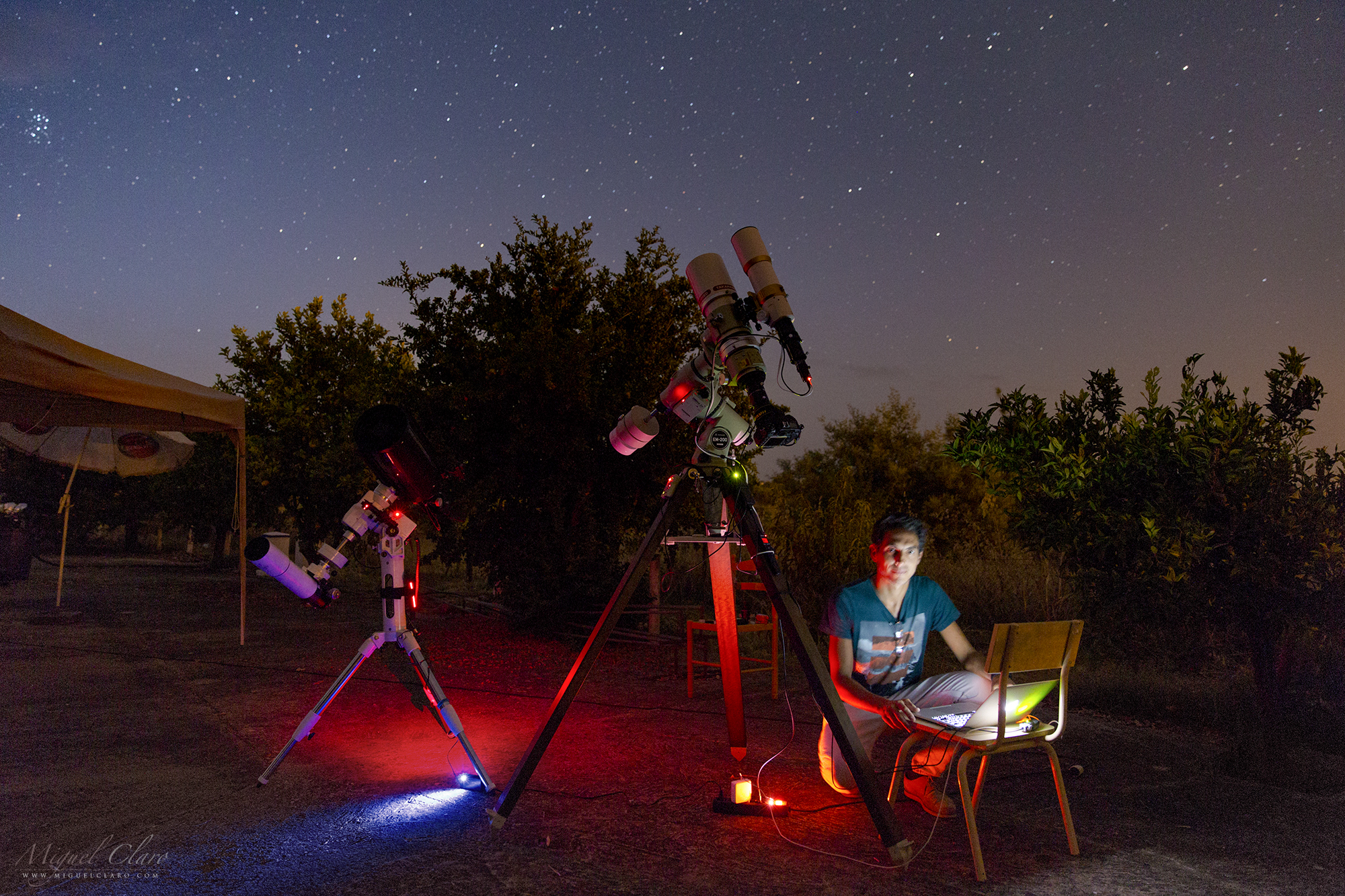
After a night of work under the starry sky of Mourão, in Alqueva Dark Sky® Reserve, a self portrait shows all the equipment necessary for a deep sky session with two different telescopes controlled by a laptop.
PT: Depois de uma noite de trabalho sob o céu estrelado de Mourão, na Reserva Dark Sky® Alqueva, um auto-retrato mostra todo o equipamento necessário para uma sessão de céu profundo com dois telescópios diferentes controlados por um computador portátil.
Dreaming Sphere

A path of light illuminates our land on Earth, but in the same way, a light cloud of gas and dust is shining bright and high in the sky of this full dome view. In the foreground, a dead tree is standing below the gigantic arc of our galaxy, the Milky Way. This “dreaming sphere” was captured in Noudar Park, Alqueva Dark Sky® Reserve, Barrancos.
PT: Um caminho de luz ilumina a Terra, enquanto simultaneamente uma nuvem luminosa de gás e poeira cósmica brilha alto no céu desta visão “full dome”. Em primeiro plano, uma árvore morta mantém-se erguida abaixo do gigantesco arco galáctico da Via Láctea. Esta “esfera de sonhos” foi captada no Parque de Natureza de Noudar, em Barrancos, na Reserva Dark Sky® Alqueva.
Colorful Night Sky – A Stellar Spectrum

When we first look at the night sky, we can not distinguish the color of each star with our own eyes, although, if we record in a long exposure sequence the path of each star, due to the motion of rotating Earth and consequently the rotation of celestial sphere, a starry trailed sky can reveal much of our colorful Universe. In the image above, captured in Noudar Park, Alqueva Dark Sky® Reserve, Portugal, we can see a lot of different color paths, like: blue, yellow, white or orange. Each color is directly related to the type and temperature of each star. Some of them are hottest, like Alfirk, in Cepheus constellation, and some are coolest like Eltanin, in Draco.
In astronomy, stellar classification is the classification of stars based on their spectral characteristics. Electromagnetic radiation from the star is analyzed by splitting it with a prism or diffraction grating into a spectrum exhibiting the rainbow of colors interspersed with absorption lines. Each line indicates an ion of a certain chemical element, with the line strength indicating the abundance of that ion. The relative abundance of the different ions varies with the temperature of the photosphere. The spectral class of a star is a short code summarizing the ionization state, giving an objective measure of the photosphere’s temperature and density.
Most stars are currently classified under the Morgan–Keenan (MK) system using the letters O, B, A, F, G, K, and M, a sequence from the hottest (O type – blue stars) to the coolest (M type – red stars). Each letter class is then subdivided using a numeric digit with 0 being hottest and 9 being coolest (e.g. A8, A9, F0, F1 form a sequence from hotter to cooler). The sequence has been expanded with classes for other stars and star-like objects that do not fit in the classical system, such as class D for white dwarfs and class C for carbon stars.
In the MK system, a luminosity class is added to the spectral class using Roman numerals. This is based on the width of certain absorption lines in the star’s spectrum, which vary with the density of the atmosphere and so distinguish giant stars from dwarfs. Luminosity class 0 or Ia+ stars for hypergiants, class I stars for supergiants, class II for bright giants, class III for regular giants, class IV for sub-giants, class V for main-sequence stars, class sd for sub-dwarfs, and class D for white dwarfs. The full spectral class for the Sun is then G2V, indicating a main-sequence star with a temperature around 5,800 K. Source and more info: click here.
PT: Quando de noite olhamos para o céu não conseguimos percepcionar com os nossos próprios olhos a cor de cada estrela, no entanto, se registarmos numa sequência de longa exposição o rasto de cada estrela, devido ao movimento de rotação da Terra e à consequente rotação da esfera celeste, uma imagem startrail poderá revelar um Universo colorido e rico em informação. Na imagem acima captada no Parque de Natureza de Noudar, Reserva Dark Sky® Alqueva, em Barrancos, podemos ver uma grande diversidade de cores desde o azul, ao amarelo, branco ou laranja. Cada cor está directamente relacionada com o tipo e temperatura de cada estrela. Algumas delas são mais quentes, como Alfirk, na constelação do Cefeu, e outras são mais frias como Eltanin, no Dragão.

Perseids Meteor Shower in the Sky of Mourão

Some meteors crossing the sky of Mourão in Dark Sky® Alqueva reserve, against the background of Milky Way galaxy as seen just 1 day after the predicted peak, on 13th August. Perseids are a prolific meteor shower associated with the comet Swift–Tuttle. The Perseids are so called because the point from which they appear to come, called the radiant, lies in the constellation of Perseus. The background image is a single exposure with one meteor captured, the other seven meteors were combined as a result of a sequence of consecutive exposures to show the radiant of Perseids.
PT: Alguns meteoros cruzando o céu de Mourão na Reserva Dark Sky® Alqueva, contra o fundo da Via Láctea, um dia após o pico previsto a 13 de Agosto. As Perseidas são uma chuva de meteoros muito intensa, associada à passagem do cometa Swift-Tuttle. As Perseidas são assim chamadas porque o ponto a partir do qual elas parecem radiar, o radiante, encontra-se na constelação do Perseus. A imagem de fundo é uma única exposição com um meteoro capturado, os outros sete meteoros foram combinadas como resultado de uma sequência de exposições consecutivas para mostrar o radiante da chuva de estrelas mais activa do ano.
Perseids in Noudar Park

Some meteors from Perseids shower captured one week before the peak predicted to 12 August, above the landscape of Noudar Park, in Alqueva Dark Sky® Reserve, Barrancos. In the foreground an Olive Tree is at the left side of Milky Way.
PT: Alguns meteoros captados uma semana antes do pico máximo da chuva de estrelas anual das Perseidas, previsto para 12 de Agosto. Acima deles, é possível ver o céu do Parque de Natureza de Noudar, em Barrancos, Reserva Dark Sky® Alqueva. No primeiro plano, uma oliveira destaca-se do horizonte à esquerda da imponente presença da Via Láctea.
Bridge of Light – Connecting worlds, realities and dimensions

EN: A bridge could be a connection of two worlds, realities or dimensions, or simply two sides of lake as we can see on the image, but in a figurative sense, could also be a word that simbolizes a “perfect connection” between pristine and modern, the night sky and the landscape of our beautiful planet in suspension among the arm of gas and dust from our galaxy, the Milky Way. Reflected in the calm water of the largest manmade lake in Europe (250Km²) are the light of a slowly lonely car that took several seconds to cross the entire bridge. But also the light of the stars, which took hundred or millions of years at a speed of light to reach this particular point, ready to be recorded in this singular picture taken from one of the rare Dark Sky places on Earth, in Mourão, Alqueva Dark Sky Reserve.
PT: Uma ponte pode ser a conexão de dois mundos, realidades ou dimensões, ou simplesmente a ligação a duas margens de um lago. Em sentido figurado, também pode ser uma palavra que simboliza uma “conexão perfeita” entre o Prístino e o Moderno, o céu noturno e a paisagem do nosso belo planeta em suspensão entre o braço de gás e poeira cósmica da nossa galáxia, a Via Láctea. Refletida na água calma do maior lago artificial da Europa (250Km²), está não só a luz de um carro lento e solitário que levou vários segundos para completar a travessia desta ponte e gravar o seu trajecto no espelho de água do Alqueva, como também o brilho das estrelas que levou dezenas, centenas e milhares de anos a percorrer numa viajem à velocidade da luz, a distância que nos separa no longínquo vácuo Interestelar. Aqui ficaram registadas as impressões de luz de uma viagem no tempo e no espaço, na história da própria Terra, do próprio Homem, um ser inteligente mas ainda recente na cronologia da vida deste Universo, que nesta imagem singular nos é revelado em perfeita harmonia e sintonia com a natureza que nos rodeia, num dos raros lugares da Terra onde o céu da antiguidade, ainda pode ser apreciado, partilhado e lembrado. Mourão, Dark Sky® Alqueva.
A Cork Tree Surrounded by a Strong Presence of Airglow

EN: An all sky – fulldome view – of a huge Cork trees with a background full of green yellowed Air Glow (Atmospheric Chemiluminescence) that surrounds the entire Earth and can be seen from space. Sky of Alandroal | Alqueva Dark Sky
PT: Uma visão all sky de um grande sobreiro, onde por detrás deste e em pano de fundo, é possível observar a forte presença de Air glow, um fenómeno conhecido por luminescência fotoquímica da atmosfera com a presença de um tom verde amarelado junto ao horizonte, é uma emissão que rodeia todo o planeta Terra e pode ser vista do espaço. Céu do Alandroal | Dark Sky Alqueva


